
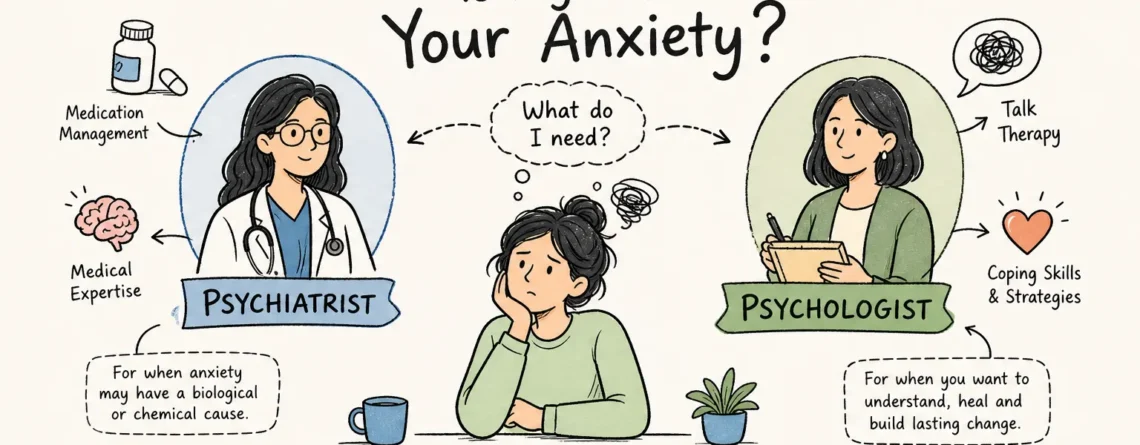
You know the moment. It is past 2 am, you cannot stop your thoughts from racing, and you are deep in a Google rabbit hole trying to figure out whether you need a psychiatrist or a therapist. You close twenty tabs more confused than when you started. The question feels like a trap, especially when you are already overwhelmed.
If you are asking yourself, “Should I see a psychiatrist or psychologist for anxiety in India?”, you are not alone, and the answer is more straightforward than the internet makes it seem. It is a clinical decision with a clear logic behind it. Once you understand what each professional actually does, the right path becomes obvious. This guide walks you through exactly that, without the medical jargon.
One thing worth noting upfront: integrated mental health clinics, like Headspace Neuro-Psychiatry Clinic in Paschim Vihar, Delhi, have simplified this decision considerably by housing both psychiatric care and psychotherapy under one roof. The fundamentals, though, come first.
What actually separates a psychiatrist from a psychologist in India
Many people use these two terms interchangeably, and that confusion is where most of the difficulty begins. They are distinct professions with different training, different legal powers, and different tools at their disposal.
The training path and who regulates each profession
A psychiatrist is a medical doctor. They complete an MBBS (roughly 5.5 years including internship), followed by an MD or DNB in Psychiatry (another 3 years), totalling approximately 8 to 9 years. They register with the National Medical Commission (NMC) or their respective State Medical Council. A clinical psychologist, by contrast, completes a BA or BSc in Psychology, then an MA or MSc, then a mandatory M.Phil in Clinical Psychology, and registers with the Rehabilitation Council of India (RCI). The RCI registration is the non-negotiable licence for clinical practice.
This matters because the term “counsellor” is used loosely in India. Someone with only a bachelor’s degree calling themselves a counsellor is not a licensed clinical psychologist and has no legal standing to provide clinical mental health care. Always check credentials before booking.
Prescription rights: the single most important legal difference
A psychiatrist can diagnose mental disorders, prescribe psychotropic medications (antidepressants, antipsychotics, anxiolytics), and authorise hospitalisation under the Mental Healthcare Act, 2017. A clinical psychologist cannot prescribe medication anywhere in India. Their tools are psychotherapy, psychological assessments, and structured counselling. This is the one distinction that determines which professional you actually need, more than any other factor.
Should I see a psychiatrist or psychologist for anxiety in India? How to gauge your severity
Not all anxiety is the same. A self-assessment framework can help you identify which direction to start in, and it is simpler than it sounds. For an approachable comparison on deciding who to see for anxiety, many readers find a clear Q&A-style overview helpful when weighing psychiatrist versus psychologist options (should I see a psychologist or psychiatrist for anxiety?).
Symptoms that typically respond well to therapy alone
Mild-to-moderate anxiety often responds well to structured talk therapy without medication. If your anxiety shows up as persistent worry about work or relationships, social nervousness, or low-level panic that does not stop you from functioning, a clinical psychologist offering Cognitive Behavioural Therapy (CBT) is usually the right first step. The key indicator is functionality: can you still go to work, maintain your relationships, and sleep with reasonable consistency? If yes, starting with therapy makes sense.
Red flags that need a psychiatric evaluation first
Certain symptoms signal that therapy alone will not be sufficient, at least not initially. These include frequent panic attacks with physical symptoms such as chest tightness, breathlessness, or digestive distress; anxiety so severe it prevents you from leaving the house or holding a job; suicidal thoughts or self-harm urges; co-occurring depression or significant mood instability; or anxiety that persisted through a prior course of therapy without meaningful improvement. When any of these are present, a psychiatrist should be your first call, not your second.
When to choose a clinical psychologist for anxiety in India
Choosing a psychologist is not a lesser option. For a large proportion of people with anxiety, it is the most effective and efficient path to recovery.
How CBT and exposure therapy address anxiety at its root
CBT is the most evidence-backed intervention for anxiety disorders, used across generalised anxiety disorder (GAD), panic disorder, social anxiety, and OCD. Indian clinical trials and international meta-analyses support its effectiveness, with strong outcomes measured at three to twelve months post-intervention. CBT works by identifying the thought patterns that sustain anxious cycles and building practical skills to interrupt them. Exposure therapy, often integrated within CBT, gradually reduces avoidance by helping patients face feared situations in a controlled, supported setting. Unlike medication, the skills learnt in CBT are retained long after sessions end.
What a realistic therapy course looks like in India
Most patients see meaningful improvement within 12 to 16 weekly sessions spanning three to five months. Initial changes are often noticeable within the first few weeks. Face-to-face, therapist-guided CBT consistently outperforms computer-based or self-directed formats in clinical studies. For social anxiety disorder specifically, a study conducted in an Indian clinical context found that a brief protocol of six structured group sessions, each two hours in duration, over six weeks, produced significant and lasting improvement at a two-month follow-up, though the sample consisted of medical students, and results may not generalise to all clinical populations.
If you are based in Delhi and looking for therapist-led care, consider local options such as Struggling with Anxiety? Find a Psychotherapist in Delhi that outline what to expect from structured psychotherapy in the city.
When to see a psychiatrist in India: medication as part of the plan
Medication for anxiety is not a sign of weakness or failure. It is a medical tool with specific, well-established indications, and for many people it is what makes recovery possible.
First-line medications used for anxiety in India
SSRIs (selective serotonin reuptake inhibitors) like sertraline and escitalopram are the most commonly prescribed first-line medications for generalised anxiety, panic disorder, and social anxiety in India. SNRIs like venlafaxine are close alternatives, particularly for GAD. Benzodiazepines such as alprazolam and clonazepam are sometimes used short-term, typically for two to four weeks, to bridge the gap before SSRIs reach full effect, but they carry significant dependence risks if used beyond that window. For clear, patient-facing information on how SSRIs are used and monitored, reputable health resources provide useful summaries (SSRIs: what to know).
Beta-blockers like propranolol are prescribed specifically for performance anxiety, addressing the physical symptoms rather than the underlying disorder. A psychiatrist selects and monitors these based on your individual symptom profile, history, and medical background.
Situations where starting medication makes immediate clinical sense
If anxiety is so severe that it prevents you from functioning enough to engage meaningfully in therapy, medication can stabilise you sufficiently for psychological work to take hold. Similarly, if you have already tried therapy and reached a plateau, if there is a suspected biological component to your symptoms, or if anxiety is escalating rapidly, a psychiatric evaluation should happen before or alongside any therapy referral. The goal is not medication for its own sake, it is creating the conditions under which recovery becomes possible. If you want to understand how a psychiatrist typically supports patients through diagnosis and medication in Delhi, see How a Psychiatrist Doctor Helps You in Delhi | HeadSpace Clinic.
Why the strongest outcomes often combine both approaches
The psychiatrist-versus-psychologist question is, for many people, a false choice. The most effective care for moderate-to-severe anxiety is not one or the other, it is both, working in coordination.
How psychiatrists and psychologists work together in practice
In a collaborative care model, the psychiatrist handles diagnosis and pharmacological management while the clinical psychologist runs CBT sessions. Both professionals share case notes and adjust the treatment plan together. Medication reduces symptom intensity enough for therapy skills to take hold; therapy builds the long-term resilience that medication alone cannot provide. Clinical guidelines broadly recommend combined treatment for moderate-to-severe anxiety, as outcomes typically exceed either approach used alone, though it is worth noting that direct evidence for combined SSRI and CBT superiority in adult GAD specifically within Asian populations remains limited, and individual responses vary. For a plain-language comparison of roles and when to see which professional, an accessible overview contrasts the two professions and typical responsibilities (psychiatrist vs psychologist: do you need a psychiatrist or a psychologist?).
What to look for in an integrated clinic, and why it matters for Delhi patients
Finding a psychiatrist and a psychologist who communicate well with each other is genuinely difficult in many Indian cities. Research on mental health workforce gaps and service-delivery challenges in India points to coordination shortfalls as a key barrier, and that burden typically falls on the patient, which is the last thing someone struggling with anxiety needs. Integrated mental health clinics that house both services under one roof remove that friction entirely.
Headspace Neuro-Psychiatry Clinic in Paschim Vihar, Delhi, offers both psychiatric consultation and structured psychotherapy as part of a single care pathway, so you are not left managing two separate professionals with no shared understanding of your case.
How to find and verify qualified mental health care in India
Knowing what kind of help you need is only half the equation. Finding a qualified, trustworthy professional is the other half, and it is more straightforward than most people assume.
Verifying credentials: the two registries every patient should check
Before booking any appointment, ask for registration details. For a psychologist, request their RCI registration number and search it on the Rehabilitation Council of India’s official CRR portal. For a psychiatrist, verify their NMC registration and confirm they hold an MD or DNB in Psychiatry, not merely an MBBS. A practitioner who cannot provide these numbers promptly should not be trusted with your mental health care. Professional directories via the Indian Psychiatric Society (IPS) and the Indian Association of Clinical Psychologists (IACP) are also reliable starting points for finding verified specialists. For guidance on why choosing quality psychiatric care in Delhi matters, see Why Choosing the Best Psychiatrist in Delhi Matters.
Realistic fees, wait times, and the telehealth option
In Delhi/NCR, psychiatrist consultations typically range from ₹1,000 to ₹3,500 in-person; clinical psychologists range from ₹800 to ₹2,500. Government institutions like AIIMS offer subsidised care, though new patient wait times can stretch to two to six weeks. Mid-tier private clinics usually see new patients within one to three days.
Telehealth platforms such as Practo and iCliniq list verified credentials upfront and often connect patients within hours, a practical option for those in smaller cities or with limited mobility. On insurance: while the IRDAI mandate legally requires parity between mental and physical illness coverage, outpatient consultations are only covered if your specific policy includes an OPD benefit. Check your policy schedule directly before assuming the cost will be covered.
The decision, simplified
The choice between a psychiatrist and a psychologist for anxiety is not about one being superior to the other. It is about matching the professional’s tools to what your symptoms actually require.
- Mild-to-moderate anxiety with functional daily life: start with a clinical psychologist and CBT.
- Severe, rapidly worsening, or complex anxiety with co-occurring conditions: see a psychiatrist first.
- Unsure of your severity, or wanting to avoid back-and-forth coordination: look for a clinic that offers both under one roof.
India has a significant shortage of qualified mental health professionals, roughly 0.75 psychiatrists per 100,000 people against the WHO’s recommended minimum of three. That makes finding qualified care feel harder than it should; local reporting highlights that India needs 3 psychiatrists per lakh population, yet current numbers fall well short. But qualified help does exist, particularly in Delhi-NCR, and many anxiety disorders respond well to evidence-based psychotherapy and medication when the right support is in place.
So if you are still asking yourself, “Should I see a psychiatrist or psychologist for anxiety in India?”, use the framework above as your starting point. The most important step is not getting the first choice perfect. It is making the appointment. If you are in Delhi and ready to take that step, Headspace Neuro-Psychiatry Clinic offers both psychiatric consultation and psychotherapy as part of an integrated care pathway. You do not have to manage the coordination yourself. You just have to show up.


Leave a Reply