
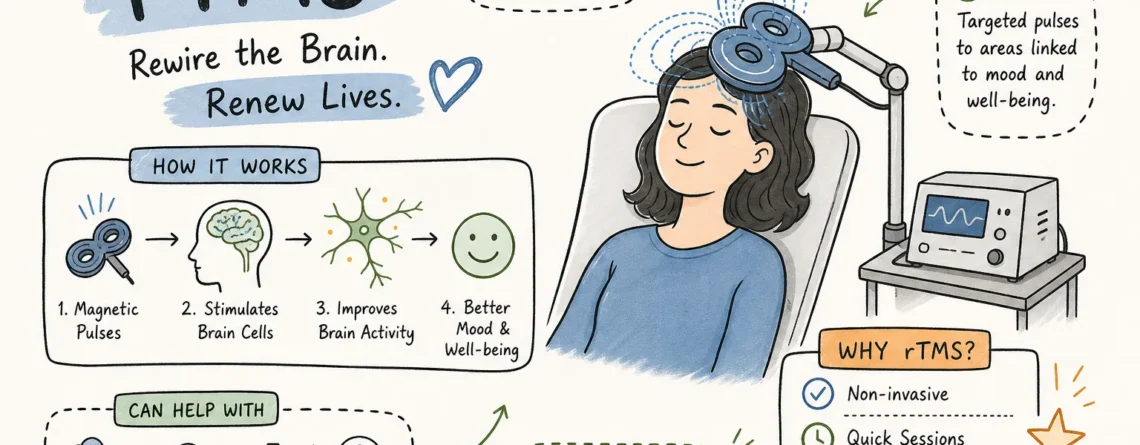
Repetitive transcranial magnetic stimulation, or rTMS, is a non-invasive brain stimulation therapy that uses precisely targeted magnetic pulses to alter the way certain neural circuits fire. No anaesthesia, no surgery, no hospitalisation. The treatment was FDA-cleared for major depression in 2008 and now has more than 40 sham-controlled trials behind it. In India, specialist psychiatric centres such as Headspace Clinic (HeadSpace Neuro-Psychiatry Clinic) in Paschim Vihar, Delhi are integrating rTMS into full-spectrum care, making this technology more accessible across the Delhi-NCR region.
By the end of this guide, you will understand how repetitive transcranial magnetic stimulation works at a neuronal level, which conditions it addresses, what a full treatment course involves, its safety profile, and the practical steps to explore it with your psychiatrist.
What is repetitive transcranial magnetic stimulation?
Many people with depression spend years cycling through antidepressants, adjusting doses, switching molecules, hoping the next prescription will finally be the one that works. For roughly one in three patients, it never quite does. That gap between the promise of medication and the reality of daily life is exactly where repetitive transcranial magnetic stimulation becomes relevant, and understanding what repetitive transcranial magnetic stimulation is, how it works, and who it helps is increasingly important for anyone navigating treatment-resistant mental illness in India.
The magnetic pulse and what it does to neurons
A coil placed against the scalp generates a rapidly changing magnetic field, which passes through the skull and induces a small electric current in the targeted brain tissue. This causes neurons to depolarise, that is, they fire. A single diagnostic pulse produces a transient effect that fades within milliseconds, but repetitive stimulation is a fundamentally different process.
When pulses are delivered in sequence, enough AMPA receptors are recruited to trigger NMDA receptor activation. This opens the gate for calcium ions to enter the postsynaptic neuron, setting off a cascade of molecular changes: phosphorylation of existing receptors, synthesis of new ones, and shifts in gene expression. The net result is a long-lasting change in synaptic strength, either strengthening connections or weakening them, depending on frequency. High-frequency rTMS at 10 Hz increases cortical excitability; low-frequency rTMS at 1 Hz reduces it. For readers who want a deeper dive into these cellular and synaptic mechanisms, see this Frontiers in Physiology review of rTMS mechanisms.
Theta-burst stimulation: the faster cousin
Theta-burst stimulation (TBS) achieves the same neuroplastic effect through a much shorter session. It mimics the brain’s natural theta rhythm by grouping pulses into short bursts at 50 Hz, repeated at 5 Hz. The intermittent variant, iTBS, produces excitatory effects comparable to standard 10 Hz rTMS but delivers 600 pulses in roughly three minutes rather than 37 minutes. The FDA cleared iTBS for depression, and it is increasingly used where session length is a practical barrier to completing a full repetitive TMS course. Recent systematic reviews and meta-analyses summarising iTBS efficacy can help clinicians choose between protocols; see one such review evaluating iTBS outcomes.
How does repetitive transcranial magnetic stimulation work for specific conditions?
Depression: where the evidence is strongest
Major depressive disorder, particularly treatment-resistant depression, is the primary indication for rTMS. The clinical literature includes over 40 sham-controlled trials, and meta-analyses report a pooled standardised mean difference of approximately 0.76 for high-frequency rTMS versus sham, a meaningful effect size. In real-world settings, roughly 58% of patients respond to treatment and 37% achieve full remission. Of those who respond, about 63% maintain their improvement at the 12-month mark, which is a genuine durability result for a population that has typically exhausted several prior options.
OCD, PTSD, and other evidence-backed uses
OCD gained FDA clearance for deep TMS in 2018, with clinical data showing around a 45% response rate one month after completing a standard course targeting the medial prefrontal cortex. PTSD has a growing body of meta-analytic evidence; meta-analyses published through 2024 report effect sizes in the large range, and repetitive TMS is increasingly offered alongside trauma-focused therapy rather than as a stand-alone treatment. Generalised anxiety disorder, bipolar depression, and schizophrenia negative symptoms are conditions with promising but earlier-stage evidence, typically considered when standard treatments have produced limited results. rTMS is also FDA-cleared for smoking cessation.
What to expect from repetitive transcranial magnetic stimulation treatment
The session experience
The patient sits in a chair while a trained technician positions the magnetic coil against the scalp, usually over the left dorsolateral prefrontal cortex for depression. There is a rapid clicking sound during each pulse train and a tapping sensation on the scalp. Neither is painful and no sedation is needed. Standard 10 Hz sessions run 20 to 40 minutes; iTBS sessions are completed in 3 to 10 minutes. Because no anaesthesia is involved and there is no post-procedure recovery period, most patients drive home and continue with their normal workday.
Protocol details and what a full course means
The standard TMS therapy protocol delivers 3,000 pulses per session at 110 to 120 percent of the patient’s resting motor threshold. A full course typically comprises 30 to 36 sessions, five days a week over six weeks, totalling approximately 18,000 to 20,000 pulses. Accelerated formats such as the SAINT protocol, which delivers 10 iTBS sessions per day over five consecutive days, are used in specialist centres for severe cases and have shown remission rates of 79 to 90 percent in research settings. The SAINT approach and its schedule are described in clinic summaries of the SAINT protocol. The most practical commitment to plan for is attendance. Five sessions per week for several weeks demands reliable, consistent access to a facility offering the treatment.
rTMS safety: what’s common, what’s rare, and who should avoid it
Side effects most patients experience
The most common effects are headache and scalp discomfort at the stimulation site, reported by 20 to 36 percent of patients. Both typically resolve within an hour and rarely require anything more than standard pain relief. Facial muscle twitching during stimulation occurs in around 21 percent of patients; this is a normal response to superficial nerve stimulation, not a sign of seizure activity. Earplugs are provided as standard during every session. Rare psychiatric effects include transient hypomania, which clinicians actively monitor for in patients with a bipolar history. For clinicians and patients wanting a systematic overview of adverse events and tolerability, this open-access review is a useful resource: rTMS safety and side-effects review.
Contraindications and who shouldn’t consider rTMS
Absolute contraindications include metallic or electronic implants near the head, such as cochlear implants, deep brain stimulators, aneurysm clips, and cardiac pacemakers. A history of seizures or epilepsy is also a contraindication. The seizure risk from rTMS itself is extremely low, at fewer than three cases per 100,000 sessions, but it rises in patients with pre-existing neurological vulnerability. Medications that lower the seizure threshold, notably bupropion at high doses, require careful review before starting. Pregnancy, active psychosis, and patients under 18 years of age all require specialist assessment before proceeding, as the safety evidence in these groups remains limited.
rTMS vs ECT vs antidepressants: the key differences
Why rTMS is not ECT
ECT deliberately induces a generalised seizure under general anaesthesia. Repetitive transcranial magnetic stimulation does not cause a seizure, requires no anaesthesia, and produces no memory impairment. Many patients assume the two are similar because both involve the brain; the clinical reality is quite different. Meta-analyses show ECT achieves higher numerical remission rates in severe melancholic or psychotic depression, approximately 52 percent versus 35 percent for rTMS, though the difference does not always reach statistical significance. rTMS is preferred when anaesthetic risk is a concern or when a patient declines ECT.
How rTMS fits alongside or instead of medication
rTMS is not a replacement for medication in most cases. The strongest clinical outcomes appear when rTMS is combined with pharmacotherapy or psychotherapy. Where it becomes particularly valuable is for patients who cannot tolerate antidepressant side effects, weight gain, sexual dysfunction, and sedation among them, or for those who have failed two or more adequate medication trials. Unlike antidepressants, rTMS carries no systemic drug interactions and does not require daily compliance. For patients managing complex medical histories or struggling with adherence, that practical difference can be genuinely significant.
Getting rTMS in India: costs, availability, and what to ask your psychiatrist
Cost and availability across India
A standard rTMS course in India typically costs between ₹60,000 and ₹2,10,000, depending on the city, facility, and protocol. Individual sessions are priced at roughly ₹2,000 to ₹7,000, with a full course spanning 20 to 30 sessions. Treatment is concentrated in private hospitals and specialist neuro-psychiatry centres in major metros: Delhi, Mumbai, Bengaluru, Hyderabad, and Kolkata. Most patients pay out of pocket, though the Ayushman Bharat scheme includes rTMS for eligible families. Headspace Clinic (HeadSpace Neuro-Psychiatry Clinic) in Delhi is among the evidence-based practices integrating neuromodulation alongside conventional psychiatry, offering patients across the region access to a full range of modern mental health care. For practical local guidance on pathways and what to expect when seeking treatment in Delhi, see Depression Treatment in Delhi: A Complete Patient Guide.
Questions to ask your psychiatrist before starting rTMS
The referral pathway begins with a psychiatrist confirming your diagnosis and documenting inadequate response to at least two prior antidepressant trials. From there, four questions are worth raising directly with your psychiatrist. First, are you a candidate given your complete medical and medication history? Second, which protocol, standard 10 Hz or iTBS, is recommended for your specific condition? Third, how will response be measured across the course, and what does a partial response mean for the plan going forward? Finally, ask about maintenance sessions: many patients who respond to an initial course benefit from periodic top-up treatments to preserve their gains over time. If you want ongoing practical guidance, the Mental Health Tips, Treatments & Expert Advice | HeadSpace Clinic blog offers articles on navigating treatment decisions and recovery.
Is rTMS right for you?
Repetitive transcranial magnetic stimulation is a non-invasive, evidence-based treatment that modulates neural circuits through repeated magnetic pulses, with its strongest clinical foundation in treatment-resistant depression and OCD. It is not a last resort or an experimental curiosity, it is a well-studied clinical tool with a defined safety profile and clear eligibility criteria. For many patients, the relief of knowing there is a treatment that works differently from medication, without the systemic side effects or the daily pill burden, can itself mark a turning point.
If standard treatments have not delivered the results you or someone you care for needed, the most useful next step is a direct conversation with a qualified psychiatrist who can review your full history and determine whether rTMS belongs in your care plan. Specialist neuro-psychiatry centres in Delhi, including Headspace Clinic (HeadSpace Neuro-Psychiatry Clinic), are making these conversations easier to start and these treatments more straightforward to access. To understand the clinic’s values and approach to patient care, you can also review the Mission, HeadSpace Clinic.





Leave a Reply