
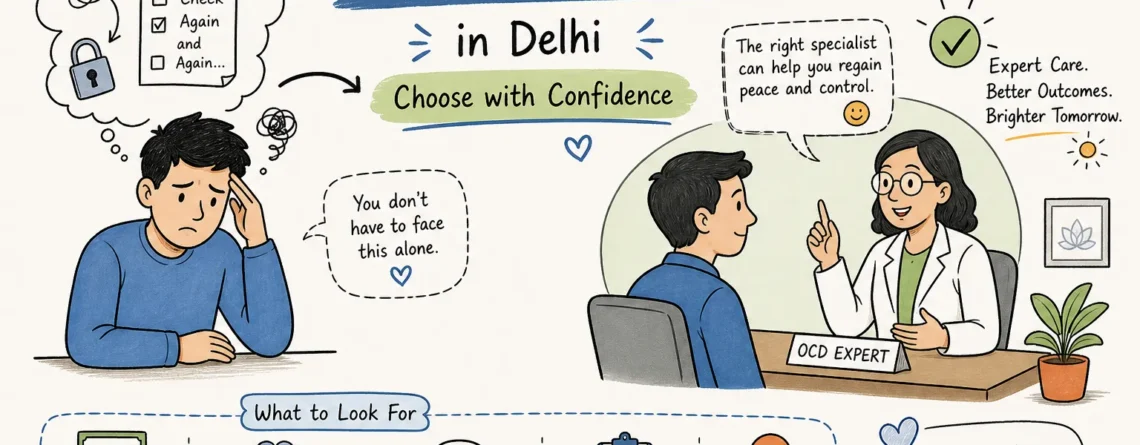
If you are looking for the best doctor for OCD treatment in Delhi, you already know how disorienting the search can feel. You have spent the better part of an evening searching “OCD psychiatrist Delhi,” and now you have fifteen names on your screen, a browser full of tabs, and a sinking feeling that you are no closer to an answer than when you started. That sense of overwhelm is more common than you might expect. Finding a specialist for obsessive compulsive disorder treatment in Delhi is genuinely harder than it looks, because OCD is not a quirky personality trait or a preference for a tidy desk. It is a clinically recognised anxiety disorder that disrupts careers, strains relationships, and quietly hollows out whole years of a person’s life.
Many patients seeking obsessive compulsive disorder treatment in Delhi have already spent months with the wrong clinician or the wrong treatment approach, handed a generic prescription, told to manage their stress, and sent home without a structured plan. That wastes time, money, and hope. This guide gives you a practical framework to shortlist, evaluate, and confidently book a qualified OCD specialist in Delhi.
Why OCD treatment needs a specialist, not just any psychiatrist
Most people assume that any psychiatrist can treat OCD effectively. That assumption is understandable but not quite accurate. OCD responds best to very specific, structured therapies, particularly Exposure and Response Prevention, and not every psychiatrist is trained to deliver or coordinate them. Without ERP-informed care, a generalist approach may be less effective and delay recovery, allowing obsessive-compulsive cycles to persist rather than weaken.
Psychiatrist or psychologist: who should you see first for OCD?
In India, a psychiatrist holds an MBBS plus MD Psychiatry and can diagnose OCD, prescribe medication, and in some cases offer therapy. A clinical psychologist holds an M.Phil or PhD in Clinical Psychology, is registered with the Rehabilitation Council of India (RCI), and delivers structured psychotherapy without prescribing. For mild-to-moderate OCD, starting with an ERP-trained psychologist is a reasonable first step. For moderate-to-severe OCD, where medication is likely needed alongside therapy, the strongest outcome comes from a coordinated team where both roles exist under one roof.
The cost of seeing a generalist first
When someone visits a general physician or a non-specialised psychiatrist for OCD, they may receive an antidepressant at doses typically used for depression and advice to reduce stress, rather than a structured OCD-specific plan. Without ERP-trained guidance, obsessions return, compulsions intensify, and the patient concludes that treatment does not work for them. This is a common and understandable misstep, not a personal failure. But it is precisely why choosing the right type of specialist from the start matters so much.
Qualifications that signal genuine OCD expertise in Delhi
Not all psychiatry degrees translate into OCD expertise. A doctor’s years of experience matter, but they matter less than where those years were focused. Reading a specialist’s profile critically, rather than simply counting years in practice, is a skill worth developing before you book your first appointment.
Degrees and training credentials to look for
An MBBS followed by MD Psychiatry or DPM is the baseline qualification for any psychiatrist. Beyond the degree, look specifically for mention of OCD, anxiety disorders, or CBT in the doctor’s listed areas of practice. Membership in the Indian Psychiatric Society adds credibility, as does any additional training in cognitive behavioural therapy. For psychologists, RCI registration is non-negotiable; it confirms the practitioner meets India’s statutory clinical standards and has completed a recognised M.Phil programme.
Why ERP training is the single most important credential
Exposure and Response Prevention is the gold-standard, evidence-based therapy for OCD, and it is a technical skill set that requires specific training beyond general therapy experience. When reviewing a specialist’s profile, look for explicit mention of ERP, CBT for OCD, or obsessive compulsive disorder among their listed areas of expertise. A high patient review count is a positive signal, but ERP-specific training is the qualification that actually predicts treatment success. If a clinic or doctor does not mention ERP at all, that is a significant concern, one worth acting on before you book.
Experience markers that go beyond years in practice
A doctor with 20 years of general psychiatry and a doctor with 8 years of OCD-focused practice are not interchangeable. Ask about the proportion of OCD cases they treat, whether they use standardised assessment tools such as the Y-BOCS scale, and whether they work as part of a multidisciplinary team. These details reveal the depth of specialisation, not just seniority.
How to choose the best doctor for OCD treatment in Delhi: understanding what works
Knowing what effective OCD treatment looks like means you can recognise it when a specialist describes it, and notice when something important is missing. Evidence-based care for OCD rests on three pillars: ERP therapy, CBT, and medication, often used in combination.
ERP therapy: what every OCD specialist must know and use
Exposure and Response Prevention works by gradually exposing a patient to the thoughts or situations that trigger obsessions, while deliberately resisting the compulsive response. Over time, the brain learns that the feared outcome does not materialise, and the compulsive urge weakens. Clinical studies on Indian OCD populations suggest that combined ERP and SSRI medication achieves a 70 to 85 per cent response rate. In Delhi, clinics that explicitly offer ERP as a structured programme are the right starting point for your shortlist, confirm this before booking rather than assuming it is offered.
CBT, SSRIs, and when to use them together
CBT for OCD helps patients identify and challenge the distorted thinking patterns that fuel obsessions; ERP is the core active component within that approach. SSRIs, fluoxetine, sertraline, fluvoxamine, and escitalopram, are the first-line medications, and they are typically prescribed at higher doses for OCD than for depression. These medications generally take 10 to 12 weeks to show meaningful effect at OCD-specific doses. For moderate-to-severe OCD, a combination of ERP and SSRI medication is the most effective protocol. A good specialist will explain this at the first consultation as a best-practice approach, rather than offering a prescription as the only option.
When standard treatment is not working: advanced options
For treatment-resistant OCD, where two or more adequate medication trials and adequate ERP have not achieved sufficient relief, advanced interventions such as repetitive Transcranial Magnetic Stimulation or Deep TMS are available at select centres in Delhi. Preliminary findings from a multicentre Indian study suggest that more than one in three patients with treatment-resistant OCD showed a meaningful response to Deep TMS. This is not a first-line treatment; it is for a specific subset of patients. Knowing the option exists means you can ask about it if standard approaches have stalled.
Questions to ask before and during your first OCD consultation
A first consultation is a two-way assessment. The doctor is evaluating the patient, and the patient is evaluating the doctor. Going in with a few targeted questions changes the entire dynamic in your favour.
Before you book: three screening questions to ask the clinic
Before committing to an appointment, call the clinic and ask these questions:
- Does the doctor or the clinic team offer structured ERP therapy for OCD specifically?
- Is a standardised OCD assessment tool such as the Y-BOCS used during evaluation?
- Is there a clinical psychologist on the team for therapy sessions if medication is also prescribed?
The answers will filter out generalists from genuine OCD specialists quickly. A clinic that cannot answer clearly is likely not OCD-specialised, and that tells you what you need to know.
During the first appointment: what to pay attention to
A thorough first OCD consultation should include a detailed history of obsessions and compulsions, a formal severity assessment, a discussion of all treatment options, and a collaborative outline of what the treatment plan will involve. Note that session length expectations differ by role: a psychiatrist managing medication may have a shorter appointment than a psychologist delivering structured therapy. What matters is whether the doctor is thorough, covers your history in depth, and discusses treatment options beyond medication alone. Ask directly: “Do you use ERP as part of treatment, and do you or a colleague deliver it?” The answer tells you a great deal about the clinic’s depth of expertise and commitment to evidence-based care.
Fees, wait times, and how to book an OCD specialist in Delhi
Practical barriers, cost, wait times, confusing booking processes, stop many people from getting help. Here are the real numbers so you can plan without surprises.
What OCD treatment actually costs in Delhi
Initial psychiatric consultation fees in Delhi range from approximately ₹800 to ₹5,750, depending on the specialist’s experience and clinic location. Psychologist-led ERP sessions of 50 to 60 minutes typically cost between ₹1,500 and ₹4,025 per session. Based on listed private provider rates, a full outpatient OCD treatment course, 12 to 20 ERP sessions over three to six months, combined with psychiatric follow-ups, may cost between ₹50,000 and ₹2,00,000 for private care.
Government facilities such as AIIMS Delhi offer OPD consultations at ₹10 to ₹100, though wait times are considerably longer. For many families, the right balance is a private specialist for diagnosis and treatment planning, with certain follow-ups managed more affordably over time.
Getting a faster appointment: teleconsults and online booking
Most leading OCD specialists in Delhi now offer video consultations, with fees ranging from ₹300 to ₹1,200 for online slots. Booking platforms such as Practo and Lybrate list real-time availability and allow direct booking, often with first appointments available within two to five days for online sessions compared to one to four weeks for in-person visits at busier practices. If you want a specific specialist whose in-person diary is full, ask for a teleconsult first, most will accommodate it, and it gives you the assessment you need without the wait.
Shortlisting the best doctor for OCD treatment in Delhi: a practical checklist
Use this when comparing clinics and specialists side by side.
The shortlisting checklist for an OCD specialist in Delhi
Before finalising a centre or doctor, run through these criteria:
- MD Psychiatry qualification with stated OCD or anxiety disorder specialisation
- Explicit ERP and CBT capability, delivered by a trained clinical psychologist on staff
- Use of standardised assessment tools such as the Y-BOCS
- Transparent treatment plan with realistic timelines, not just a prescription on day one
- Inpatient or residential options where available and required for severe cases (verify with the clinic directly)
- Clear, reasonable fee structure with accessible follow-up
A centre that meets most of these criteria is worth booking. One that meets none should prompt you to look elsewhere without hesitation.
Why a full-spectrum psychiatric centre matters for OCD in Delhi
OCD rarely travels alone. Many patients also live with depression, anxiety disorders, or past trauma, conditions that require coordinated care between a psychiatrist and a psychologist. A full-spectrum centre handles this without requiring the patient to manage multiple clinics, separate referrals, and fragmented handoffs between providers.
Headspace Neuro-Psychiatry Clinic, led by Dr. Deepak Verma (MBBS, MD Psychiatry), is one example of an integrated psychiatric centre in Delhi offering personalised OCD treatment plans that combine psychiatric assessment, medication management, and structured psychotherapy within a single team. For patients across Delhi-NCR who need a coordinated point of care rather than a patchwork of specialists, a centre with this kind of integrated model is worth including in your shortlist.
Take one concrete step today
Choosing the best doctor for OCD treatment in Delhi does not have to feel like a second job. With the right criteria in mind, the right treatment approach to look for, and the right questions ready, the decision becomes significantly clearer.
OCD is treatable. Decades of research and clinical outcomes confirm this. The goal is simply to find an OCD specialist near you who knows how to apply that evidence to your specific situation, your specific obsessions, and your specific life. Whether you are exploring OCD counselling in Delhi for the first time or reconsidering a treatment approach that has not worked, the framework in this guide applies equally.
Start with one concrete step: call a clinic, ask the three screening questions from this guide, and book a first consultation. That appointment is not a commitment to anything, it is information. It tells you whether this specialist is right for you, and it gets you moving in the right direction rather than staying stuck in a browser tab at midnight.
If you are in Delhi-NCR and want a starting point with an experienced MD Psychiatrist, reach out to Headspace Neuro-Psychiatry Clinic for an initial assessment and a personalised OCD treatment plan. The right support exists, and it is worth taking one step today to find it.



Leave a Reply