
When worry stops being useful
Excessive worry is worry that is out of proportion to the situation, hard to control and present on most days. People often worry about health, family, work or money, and sometimes about things that have not happened and may never happen. It usually comes with physical tension: tiredness, poor sleep, muscle aches and trouble concentrating.
Some worry is normal and even helpful. When it has gone on for weeks and is getting in the way of daily life, it may be a sign of generalised anxiety disorder or another condition that responds well to therapy and, if needed, medicine.
Signs of excessive worry
People with excessive worry often say they cannot remember the last time their mind felt quiet. One worry is settled and another takes its place. Typical signs:
- Worrying on most days about several different things
- Finding it very hard to stop once a worry starts
- Expecting the worst, even when things are going well
- Restlessness or feeling keyed up
- Tiredness, muscle tension, headaches
- Trouble falling asleep because of a busy mind
- Irritability and difficulty concentrating
- Needing frequent reassurance from family or doctors
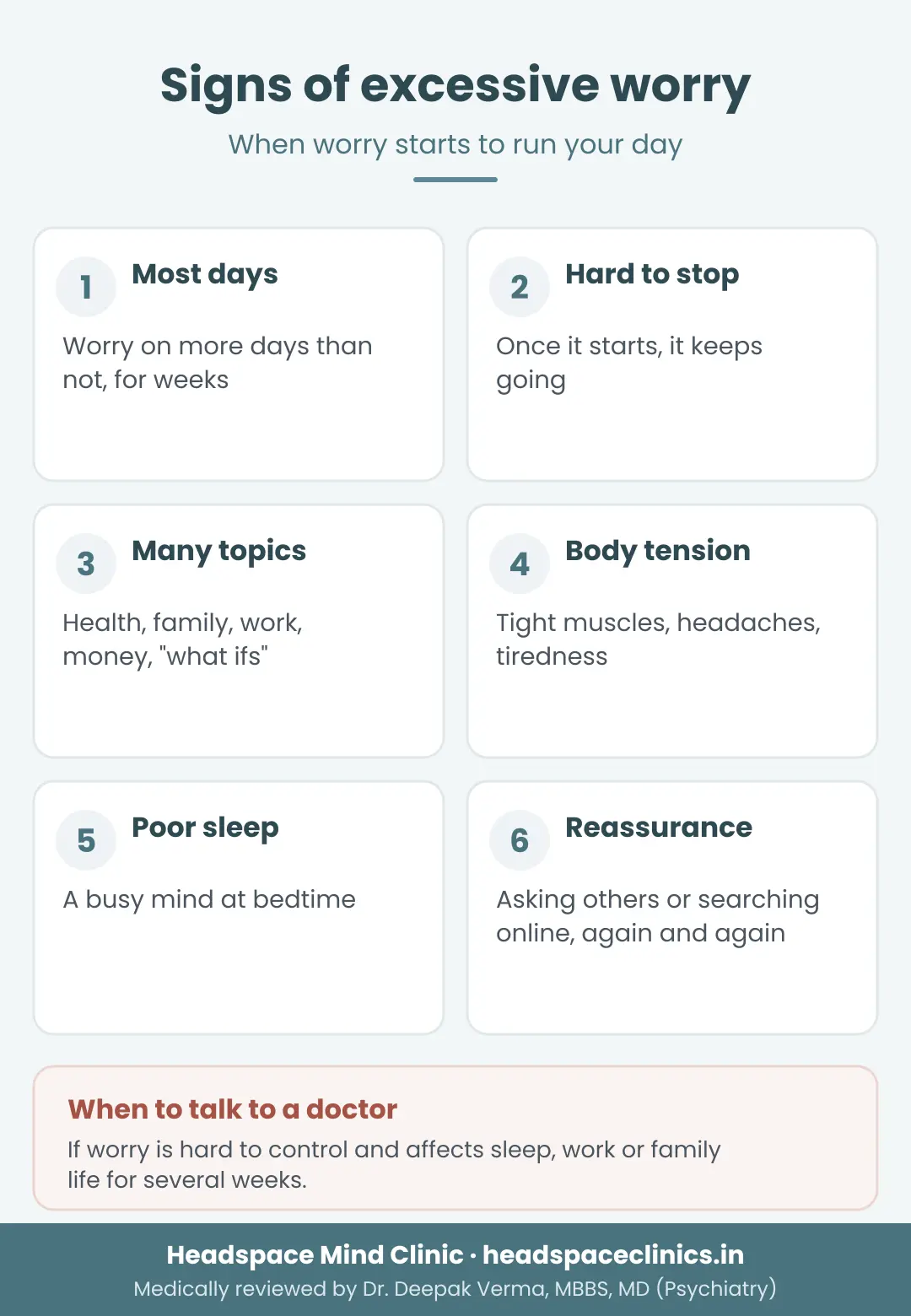
Signs of excessive worry. Tap the image to enlarge.

In clinical consultations, excessive worry often presents as a constant feeling that something might go wrong. People may worry about health, family, work or situations that have not even happened. When worry becomes difficult to control and starts interfering with daily life, it may indicate an underlying anxiety problem.
Dr. Deepak Verma, MBBS, MD (Psychiatry), Consultant Psychiatrist, Headspace Mind Clinic
Helpful worry or excessive worry?
A little worry before an exam makes you revise. Worry about a family member’s health makes you book the check-up. That kind of worry is short, tied to a real problem and ends when you act.
Excessive worry behaves differently. It jumps from topic to topic, keeps going after you have done what you can, and focuses on events that are unlikely or far away. It often feels impossible to put down, and people describe being tired from it rather than helped by it.
If you notice that the worry itself has become the problem, it is worth talking to someone.
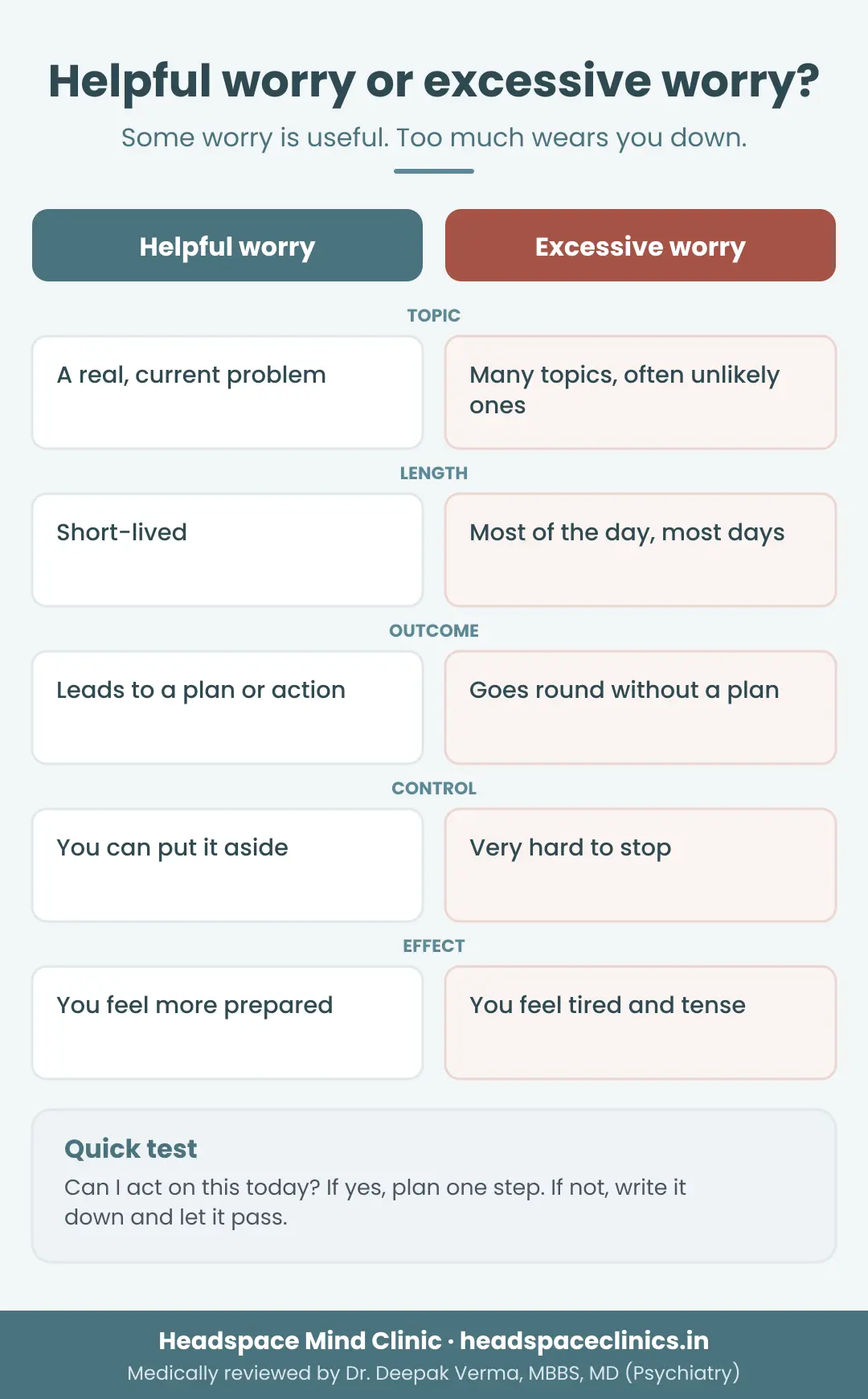
Helpful vs excessive worry. Tap the image to enlarge.
What causes excessive worry?
There is rarely a single cause. Anxiety tends to run in families, and some people are naturally more sensitive to uncertainty. Long periods of stress, difficult experiences in childhood, a recent loss or illness, caffeine, alcohol and poor sleep all make worry more likely. Some medical problems, such as an overactive thyroid, can produce anxiety symptoms, which is why a doctor may suggest blood tests.
Persistent, hard-to-control worry is the core feature of generalised anxiety disorder (GAD). It also appears in other conditions:
Worry about many things, most days, for months
Worry mixed with low mood and loss of interest
Worries that drive checking or repeated rituals
Thoughts that go round in circles
Sudden surges of intense fear
Lying awake with worries
What helps with excessive worry
Practical steps you can start this week.
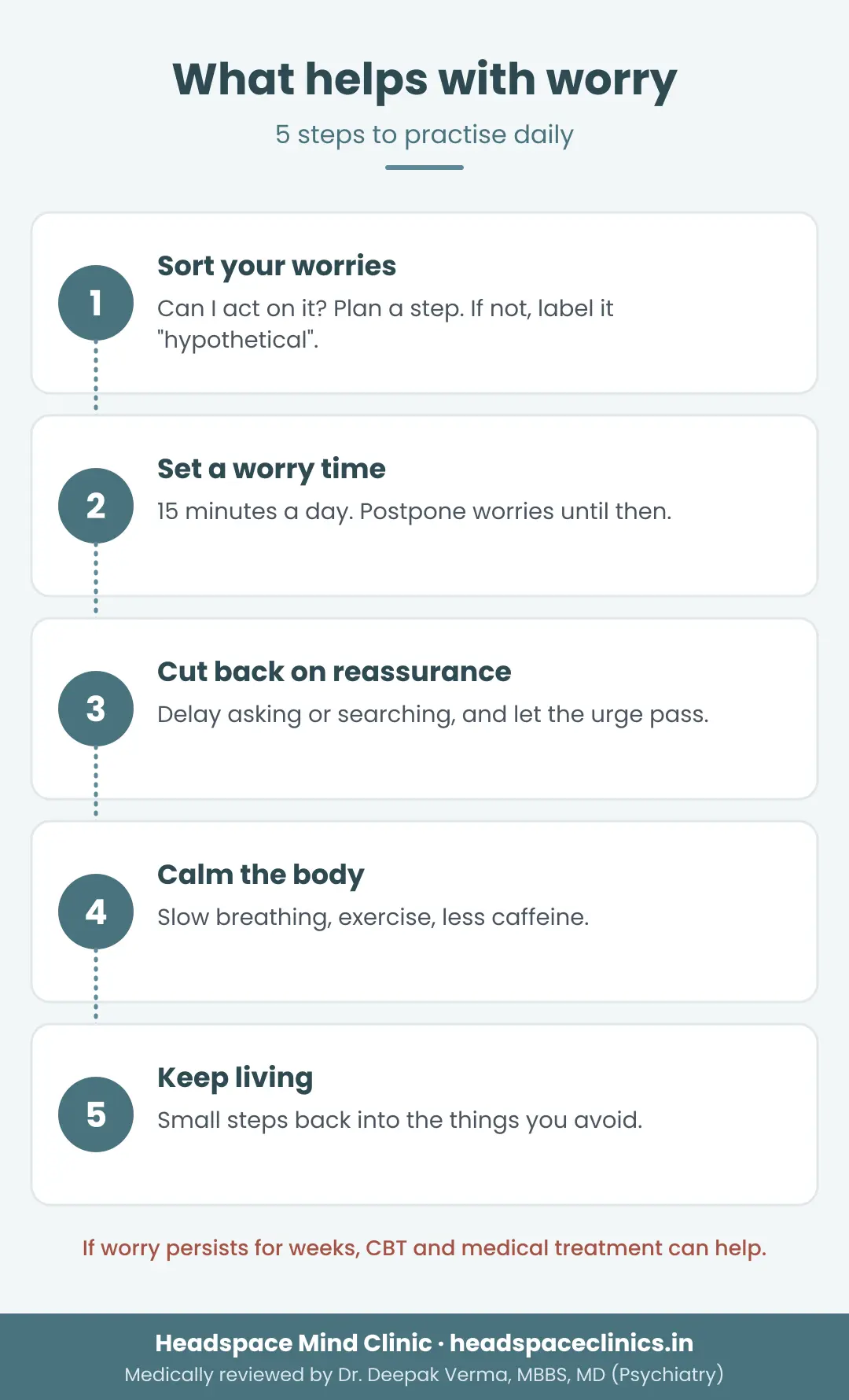
5 steps that help with worry. Tap the image to enlarge.
Sort worries into two piles. Write each worry down and ask whether you can do something about it. If yes, plan a small step and put it in your diary. If not, label it “hypothetical” and practise letting it pass.
Give worry a time slot. Fifteen minutes a day, at the same time, away from bedtime. When worries arrive at other times, note them and postpone them to that slot.
Cut back on reassurance. Asking family repeatedly, or searching online, brings brief relief and then more doubt. Try to delay the urge and see if it passes.
Calm the body. Slow breathing (in for 4, out for 6), regular exercise and less caffeine lower the background tension that feeds worry.
Keep doing things. Avoiding situations because of worry makes the worry stronger. Small, regular steps back into normal life help more than waiting until you feel ready.
Is my worry a sign to get help?
A quick way to decide whether to talk to a professional. It is not a diagnosis.
Tick the statements that apply to you. Nothing you tick is stored or sent anywhere.
This self-check is an educational aid, not a diagnostic test. Only a qualified professional can assess you properly.
When to see a doctor about worry
Consider a consultation if worry has been present most days for several weeks, if you cannot control it, or if it is affecting sleep, work or relationships. Seek help sooner if you also have low mood, panic attacks, heavy alcohol use or any thoughts of self-harm.
At the first visit your psychiatrist will ask about your worries, health, sleep, caffeine and alcohol, medicines and family history. A physical check or blood tests may be suggested to rule out medical causes.
How excessive worry is treated
Cognitive behavioural therapy (CBT) is the most studied psychological treatment for generalised anxiety. It helps you notice worry patterns, tolerate uncertainty and drop habits such as reassurance-seeking that keep worry going. When symptoms are moderate to severe, or therapy alone is not enough, medicines such as SSRIs may be suggested; they are taken daily and work over a few weeks. Sedative tablets are not a long-term answer because of the risk of dependence.
- Assessment by our consultant psychiatrist
- Talking therapy, including CBT, with our clinical psychologists
- Medicines only when they are needed, with regular reviews
- Video follow-ups for existing patients
ज़्यादा चिंता करना (Excessive worry in Hindi)
हर समय यह डर लगे कि कुछ बुरा होने वाला है, सेहत, परिवार, काम या पैसों की चिंता बार-बार हो और उसे रोकना मुश्किल लगे, तो यह ज़्यादा चिंता (excessive worry) है। इसके साथ बेचैनी, थकान, नींद की कमी और ध्यान लगाने में दिक़्क़त हो सकती है। अगर यह कई हफ़्तों से चल रहा है और रोज़मर्रा की ज़िंदगी पर असर डाल रहा है, तो यह एंग्ज़ायटी डिसऑर्डर का संकेत हो सकता है, जिसका इलाज संभव है। यह जानकारी केवल शिक्षा के लिए है। अपॉइंटमेंट के लिए कॉल करें: +91 99711 66040
Founder of Headspace Mind Clinic. Dr. Verma sees patients at our Paschim Vihar, Rohini and Narela clinics. About our psychiatry service →
Three clinics in West and North Delhi
Psychiatrist consultation fee: ₹1,800 at Paschim Vihar and Rohini, ₹500 at Narela. All appointments are scheduled; please call or book online.
Frequently asked questions
Worry is normal when it is linked to a real problem, lasts a short time and ends when you act. It becomes a concern when it is present most days, jumps from one topic to another, feels uncontrollable and affects sleep, work or relationships.
Not always. Excessive worry is a symptom. Generalised anxiety disorder is a diagnosis made by a professional when worry is persistent, hard to control and comes with physical symptoms such as tension, tiredness and poor sleep over several months.
Some people are more sensitive to uncertainty and fill the gap with the worst possible outcome. Stress, past difficult experiences and poor sleep make this stronger. CBT teaches practical ways to notice and question this habit.
Yes. Ongoing worry keeps the body’s stress response switched on, which can cause muscle tension, headaches, stomach upset, a racing heart and tiredness. A doctor can check whether there is also a physical cause.
Not necessarily. Therapy helps many people on its own. Medicines are considered when symptoms are moderate to severe or therapy alone has not been enough. Your psychiatrist will discuss the options with you.
Yes. In young people it may show up as stomach aches, refusing to go to school, constant questions or trouble sleeping. Our team sees children and adolescents with parents involved. Exam anxiety in teenagers.
Book a consultation
Choose your preferred clinic and our team will call you to confirm a time. This form is for appointments only; please do not use it in an emergency.
References
- Gautam S, Jain A, Gautam M, Vahia VN, Gautam A. Clinical Practice Guidelines for the Management of Generalised Anxiety Disorder (GAD) and Panic Disorder (PD). Indian Journal of Psychiatry. 2017;59(Suppl 1):S67–S73. Indian Psychiatric Society
- National Institute for Health and Care Excellence (NICE). Generalised anxiety disorder and panic disorder in adults: management (CG113). nice.org.uk
- Dugas MJ, Robichaud M. Cognitive-Behavioral Treatment for Generalized Anxiety Disorder: From Science to Practice. New York: Routledge; 2007.
- World Health Organization. International Classification of Diseases, 11th Revision (ICD-11). icd.who.int
- Tele-MANAS, National Tele Mental Health Programme, Ministry of Health and Family Welfare, Government of India. Helpline 14416.
Medically reviewed by Dr. Deepak Verma (MBBS, MD Psychiatry; DMC Reg. No. 37616). Last reviewed: 15 November 2026.
Medical disclaimer. The information on this page is provided for general educational purposes only. It is not medical advice and is not intended to diagnose, treat, cure or prevent any condition. Reading this page or using the self-check does not create a doctor–patient relationship with Dr. Deepak Verma or Headspace Mind Clinic. Please consult a qualified doctor about any symptom, diagnosis or treatment, and do not start, stop or change any medicine without talking to the doctor who prescribed it. Do not ignore professional advice, or delay seeking it, because of something you have read here. Symptoms, causes and responses to treatment differ from person to person, and no particular result is promised. Links to other websites are given for reference only, and we are not responsible for their content. If you think you or someone else may be facing a medical or mental health emergency, call 112, call Tele-MANAS on 14416 (free, 24×7) or go to the nearest hospital emergency department.