
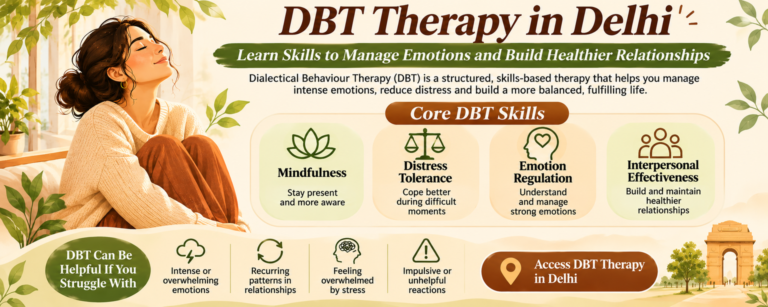
DBT Therapy in Delhi: Learn Skills to Manage Emotions and Build Healthier Relationships
Dialectical Behaviour Therapy (DBT)
Managing strong emotions can be difficult,especially during stressful situations or conflicts in relationships. Some people end up reacting impulsively, struggling to cope with distress, or taking longer to recover from emotionally difficult experiences.
Dialectical Behaviour Therapy (DBT) is a structured form of psychotherapy that helps individuals understand their emotions and develop healthier ways of responding to them. It focuses on building practical skills to regulate emotions, manage stress, learn a better way to communicate, and make more thoughtful decisions during difficult situations.
DBT can be helpful for individuals experiencing emotional dysregulation, impulsive behaviours, recurring interpersonal difficulties, or difficulties handling stress. The therapy is tailored to the individual’s concerns, with an emphasis on accepting present experiences while working towards meaningful behavioural change.
At Headspace Mind Clinic, we aim to help individuals understand how DBT works, what skills it involves, and whether this approach may be suitable for their needs. The treatment plan is determined through an individual assessment and may be adapted according to the person’s concerns and therapeutic goals.
Considering DBT Therapy?
Learn about the treatment approach,the skills it teaches, and whether it may be appropriate for your concerns.
Quick answer:What is DBT?
DBT is a structured psychotherapy developed to help people manage intense emotions and patterns of behaviour that can cause significant distress. It commonly teaches four groups of skills: mindfulness, distress tolerance, emotion regulation, and interpersonal effectiveness.
Comprehensive DBT programmes may include individual therapy, skills training, betweensession support, and a consultation team for therapists. The exact components depend on the programme. A service offering selected DBT-informed techniques should not automatically be described as comprehensive DBT.
What Is Dialectical Behaviour Therapy (DBT) ?
Dialectical Behaviour Therapy (DBT) is a form of psychotherapy developed by psychologist Marsha M.Linehan. Earlier it was designed to support people experiencing persistent suicidal thoughts and behaviours. Over time,its use has expanded to addressa wider range of emotional and behavioural chalanges.
DBT combines behavioural techniques, mindfulness,acceptance, and practical skills training. The aim is to help individuals understand their emotional responses, manage difficult situations, and develop healthier ways of coping with everyday stress.
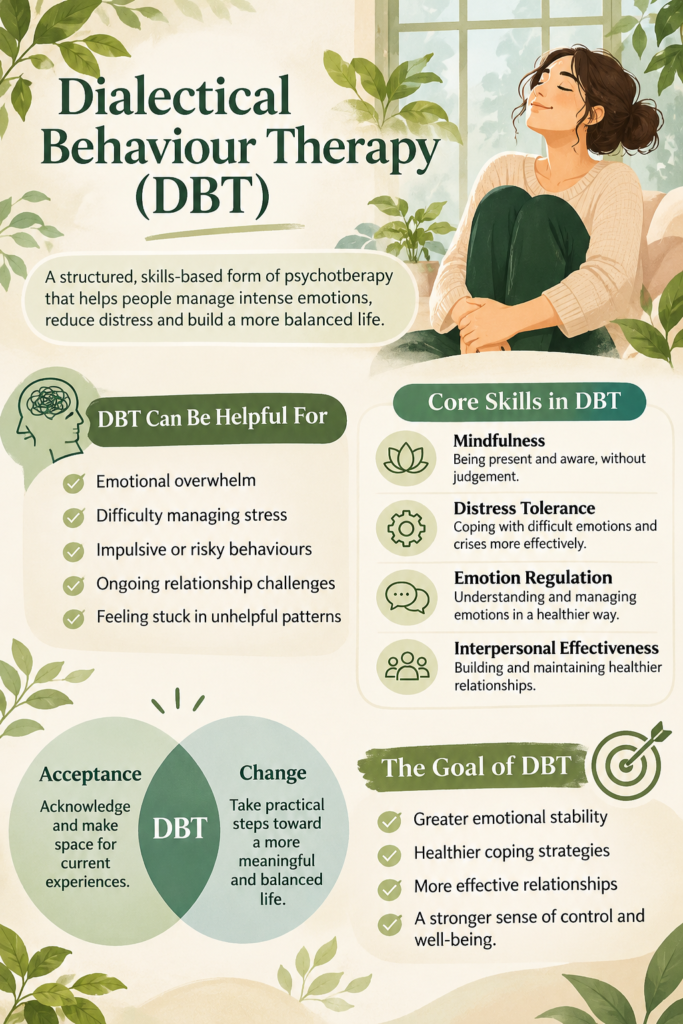
Acentral principle of DBT is the balance between acceptance and change. Both are important parts of the therapeutic process.
Acceptance involves acknowledging one’ s emotions, thoughts, and experiences without immediately judging or trying to suppress them.Changefocuses on identifying unhelpful patterns and gradually developing more effective ways of thinking, behaving, and responding.
These two approaches work together.A person can accept that they are struggling emotionally while also recognising that they can learn new skills to handle similar situations differently in the future.
What Does “Dialectical” Mean?
The term dialectical refers to bringing together two perspectives that may initially seem contradictory and finding a way for both to coexist.
In DBT, this is reflected in two important ideas:
- Acceptance: “What I am feeling is real, and I can acknowledge it without judging myself.”
- Change: “Eventhough I feel this way, I can learn new ways to respond.
For example, someone who becomes angryduringa disagreement may recognise that their frustration is understandable given the situation. At the same time, they can learn to express that frustration without shouting,acting impulsively, or damaging the relationship.
The goal is not to ignore or invalidate the emotion. Instead, the person learns to acknowledge what they feel while choosing a response that is more helpful for themselves and others.
What does DBT focuson?
DBT helps individuals develop practical skills to managee motions,cope with stress, and respond more effectively to challenging situations. These skills include:
- Identifying emotions and understanding the situations that trigger them.
- Managing stress without reacting impulsively or making thesituation more difficult.
- Taking a pause before reacting and making more considered decisions.
- Expressing feelings and needs clearly while maintaining healthy boundaries.
- Staying mindful of the present moment rather than becoming caught up in distressing thoughts.
- Building habits and behaviours that works with personal values andlong-term goals.
- Recovering from emotional setbacks and handling future challenges more effectively.
The general focus of therapy varies according to each person’ sconcerns and treatment goals. DBT is not about eliminating negative emotions or remaining calm in every situation. Instead, it helps individuals understand their emotions, accept that difficult feelings are part of life, and choose healthier ways to respond to them
Is DBT Only for Borderline Personality Disorder?
No. Dialectical Behaviour Therapy was originally developed for people experiencing chronic suicidal thoughts and behaviours and was later extensively studied in the treatment of borderline personality disorder (BPD). Its principles and techniques have since been adapted for other difficulties involving emotional regulation, impulsivity, self-harm, and interpersonal relationships.nal relationships.
DBT may be considered when an individual struggles to manage intense emotions, cope with distress, or navigate recurring behavioural and relationship difficulties. However, its suitability depends on the person’ sneeds,the nature of their concerns, and the available treatment programme. DBT is not the only treatment option for these difficulties, and the most appropriate approach should be determined through an individual assessment.
Related services at Headspace MindClinic
How Does DBT Work?
DBT uses a combined methods to help individuals understand patterns of their behaviour, develop skills, and work towards specific treatment goals.
Instead of only relying on the discussion, DBT often includes structured exercises and opportunities to practise skills in real-life situations.
Therapy may involve identifying situations that lead to distress, understanding the pattern of their thoughts andemotions involved, examining what happens next, and developing alternative responses.
Understanding the behaviour pattern
Understanding an Emotional Reaction
Imagine a person receives a message that they interpret as rejection. They feel anxious and angry, send several messages, and later regret the exchange. A DBT-informed approach may explore the sequence of events to understand what happened and where change is possible.
Breaking Down the Experience
- Prompting Event What happened immediately before the emotional reaction?
- Interpretations What meaning did the person attach to the message or situation?
- Emotions & Physical Responses What did the person feel in their mind and body?
- Urges & Actions What did the person feel compelled to do, and what did they actually do?
- Consequences What happened immediately afterward and later?
- Skills to Practise What might help the person pause, tolerate uncertainty, or communicate more effectively next time?
The purpose is not to label someone as difficult or irrational. It is to understand the sequence of events, recognise patterns, and identify opportunities for change.
Learning and practising skills
DBT skills are meant to be practised not understood in theory. A therapist can help a person learn a skill during a session talk about situations where the skill could be useful and look back at what happened when the person tried to use the skill.
For example a person who tends to react away during conflict might practise pausing noticing the person’s emotional state and choosing a response that matches the person’s goals.
Practice is not always easy. A skill may feel unfamiliar. May not work as expected in every situation. Therapy can help a person understand what happened and adjust the person’s approach.
Reviewing progress
Progress can be measured through agreed treatment goals, changes in the person’s behaviour better coping, the person’s functioning in life and relevant symptom measures.
In DBT monitoring and prioritising treatment targets are key parts of the model. The exact process depends on the treatment setting. The person’s needs.
The Four Core Skill Areas in DBT
DBT skills training is usually organised into four core modules. Each module addresses an aspect of emotional and behavioural functioning.
1. Mindfulness
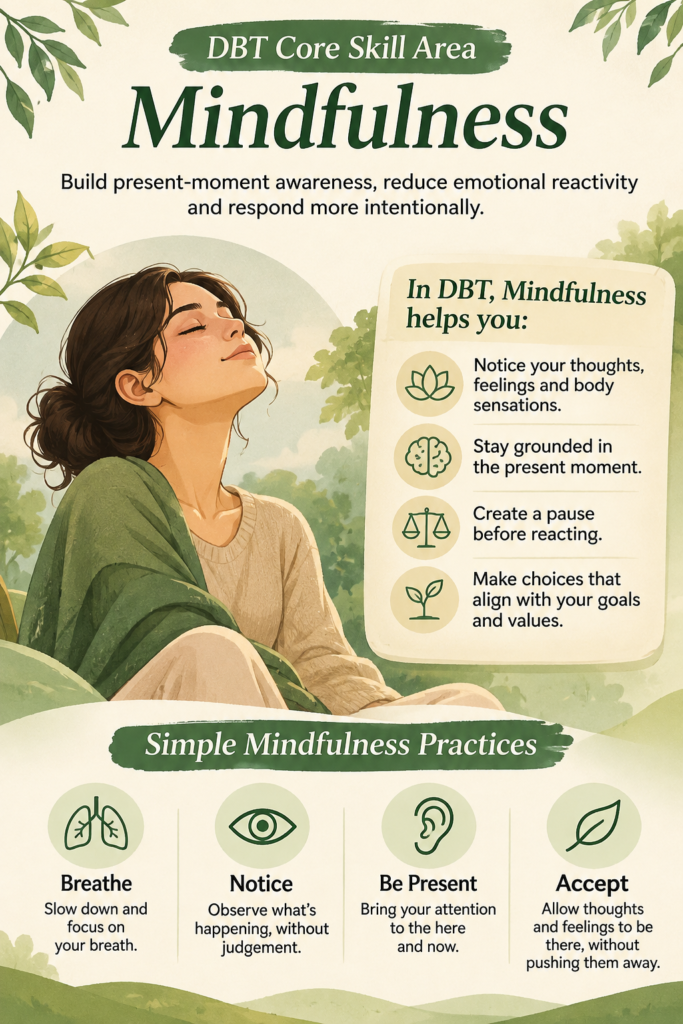
Mindfulness helps people pay attention to the present moment and notice thoughts, feelings, sensations, and urges without immediately reacting to them.
Example: Recognising “I am feeling angry” before deciding what to say or do.
2. Distress Tolerance
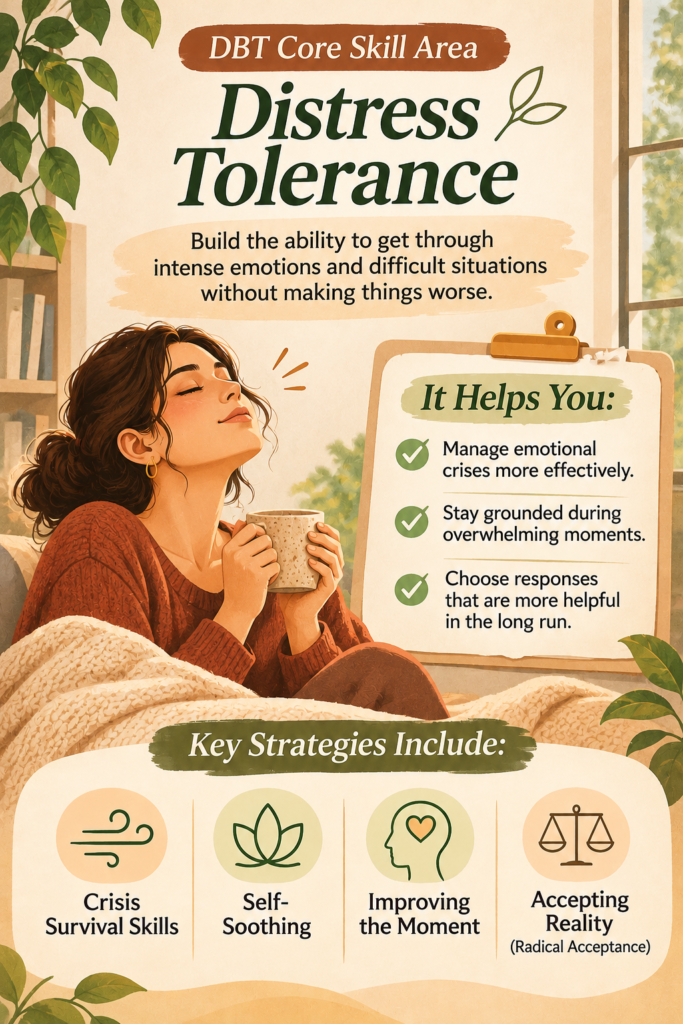
Distress tolerance skills help people get through difficult moments without making the situation worse. They focus on managing immediate distress when a problem cannot be resolved straight away.
Example: Using a planned coping strategy before responding to a stressful message.
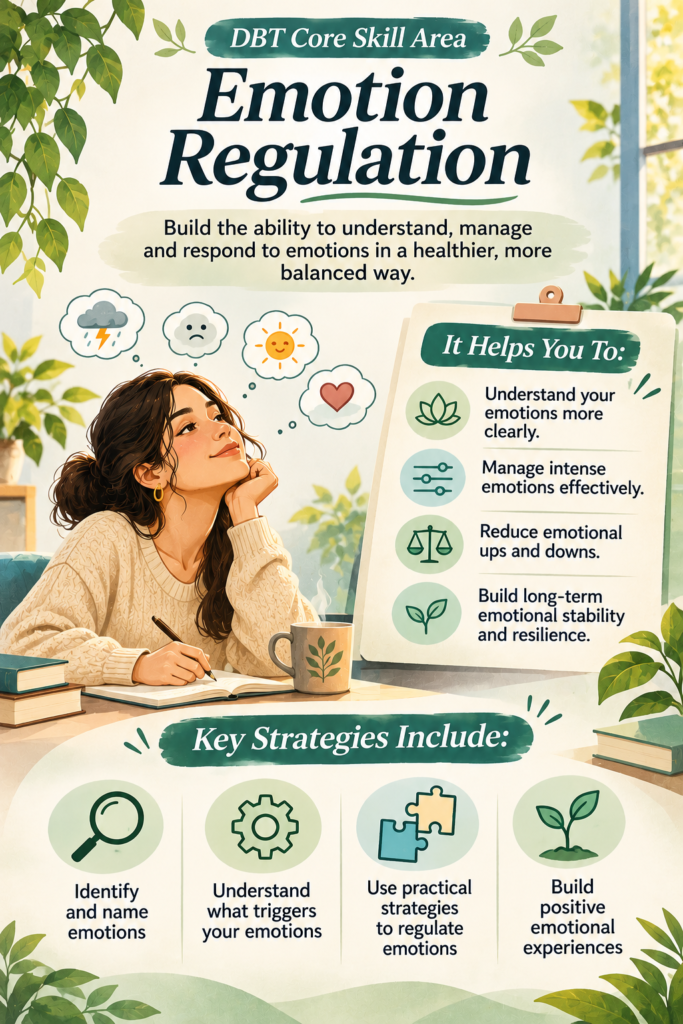
3. Emotion Regulation
Emotion regulation skills help people identify emotions, understand factors that influence them, and respond in ways that support their wellbeing and goals.
Example: Recognising that poor sleep and ongoing stress may make emotional reactions harder to manage, then working on healthier routines and coping strategies.
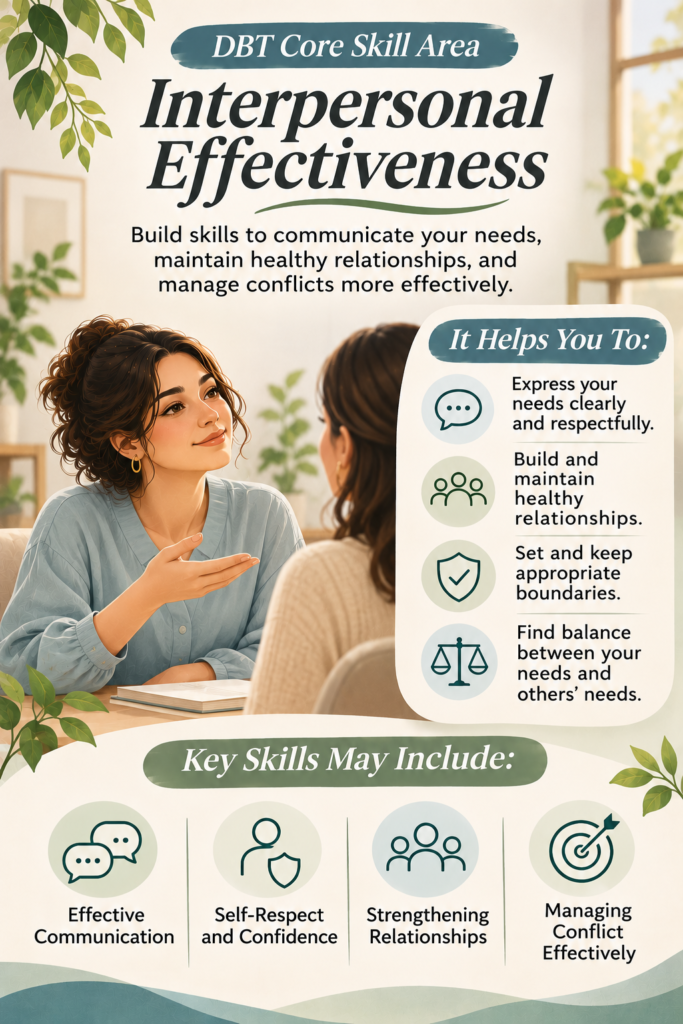
4. Interpersonal Effectiveness
Interpersonal effectiveness skills focus on communicating needs keeping self-respect setting boundaries and navigating disagreements while keeping relationship goals in mind.
Example: Expressing a concern without using insults, threats or abandoning the person’s own needs.
These skills are interconnected. A person may need to notice a reaction through mindfulness endure the immediate distress regulate the emotion over time and use interpersonal skills to solve the underlying conflict.
What Are the Main Goals of DBT?
DBT goals are individualised,. They often focus on cutting harmful or disruptive behaviour improving emotional coping and building a life that feels more manageable and meaningful.
Improving emotional awareness
Some people experience emotions that rise quickly and feel hard to understand. DBT can help a person identify patterns, recognise triggers and separate feelings from the actions the person feels urged to take.
The goal is not to eliminate emotion. The goal is to increase the person’s ability to respond thoughtfully
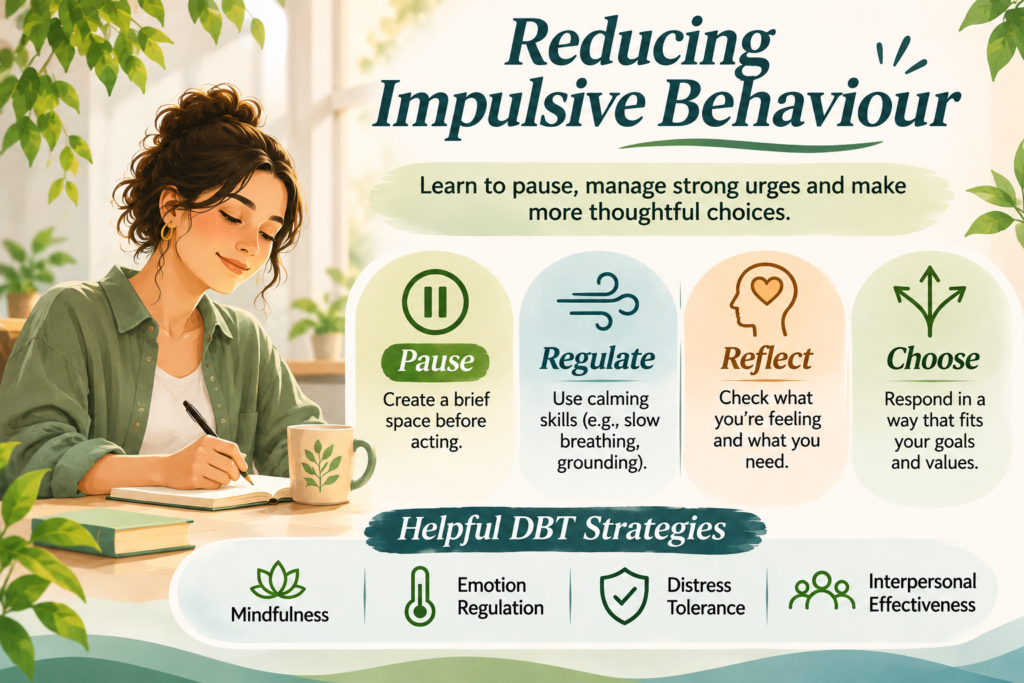
Reducing impulsive behaviour
Impulsivity may involve reacting before considering the consequences. Depending on the person this can affect communication, relationships, spending, substance use or other areas of life.
DBT may help a person pause evaluate the situation endure feelings and choose an action that is more consistent with the person’s long-term goals
Developing healthier relationships
Relationship difficulties can arise when people struggle to express needs respond to criticism tolerate uncertainty or keep boundaries during conflict.
DBT interpersonal skills may help a person communicate clearly listen more effectively negotiate and balance the conflict with others.
Increasing distress tolerance
Not every problem can be solved immediately. Distress tolerance skills can help a person manage moments while deciding what action is appropriate.
Building a meaningful life
DBT is not focused on reducing symptoms or avoiding unwanted behaviours. It also emphasises building behaviours and routines that support a life the person considers meaningful.
Goals may include relationships, more stable routines, participation in work or education healthier coping strategies and greater confidence in managing challenges.
Supporting safety and reducing high-risk behaviours
In DBT behaviours that threaten life are given high priority. Treatment may include assessment and management of safety-related concerns.
DBT should not be described as a substitute for emergency care. Anyone at risk of harming themselves or someone else needs urgent assessment and suitable crisis support.
Who May Benefit from DBT?
DBT may be suitable, for people who experience difficulties with emotional regulation, distress tolerance, impulsive reactions or interpersonal functioning. It may also be recommended for clinical presentations based on an individual assessment.
People who find emotions to manage
A person may experience emotions that feel unusually intense last longer than expected or lead to reactions the person later regrets.
People experiencing recurring conflict
DBT can become useful when repeated disagreements, difficulties in setting boundaries or impulsive communication begin to hurt relationships. Skills training helps people practise expressing needs and managing conflict effectively.
People who struggle to tolerate distress
Some people respond to distress by avoiding situations acting impulsively or using coping strategies that create problems. DBT can help them develop more effective ways to manage difficult moments.
People receiving treatment for borderline personality disorder
DBT is a well-established treatment approach for borderline personality disorder. Is especially linked to treating emotional dysregulation and self-harm difficulties. The right treatment plan depends on the person’s presentation, needs, preferences and services that are available.
People with complex emotional or behavioural difficulties
DBT-informed approaches may be considered in selected circumstances for other concerns that involve emotional or behavioural regulation. However the evidence base and suitability are not the same across all conditions. The therapist should explain why a particular approach is being recommended.
People seeking skills rather than discussion alone
Some people prefer a structured approach that includes skills practice, exercises and review of real-life situations. DBT may appeal to people who want to develop strategies while also exploring the context of their difficulties.
Important: This section should not be used as a self-diagnosis checklist. A professional assessment is needed to establish whether DBT is appropriate.
DBT vs CBT: What Is the Difference?
Dialectical Behaviour Therapy and Cognitive Behavioural Therapy are structured psychological treatments but they have different emphases
CBT often focuses on the relationship between thoughts, emotions, and behaviours, helping people identify and modify unhelpful patterns. DBT incorporates behavioural strategies while placing particular emphasis on balancing acceptance and change, developing specific coping skills, and managing intense emotions.
DBT is related to the broader behavioural therapy tradition and includes elements that overlap with CBT.
DBT and CBT, side by side
Two evidence-based talking therapies. They overlap, but they start from different places.
| Feature | 🌿DBTDialectical Behaviour Therapy | 🧠CBTCognitive Behavioural Therapy |
|---|---|---|
| 🎯Main emphasis | Acceptance and change, emotion regulation, distress tolerance, and interpersonal skills. | Understanding and modifying patterns of thinking and behaviour that contribute to distress. |
| 🧰Skills training | Four commonly recognised skill areas:
MindfulnessDistress toleranceEmotion regulationInterpersonal effectiveness
|
Techniques vary by treatment protocol and may include:
Cognitive restructuringBehavioural experimentsExposure
|
| 🏗️Treatment structure | Comprehensive DBT has defined components and a treatment hierarchy. | Structure depends on the specific CBT protocol and presenting concern. |
| 🩺Common clinical use | Strongly associated with BPD and suicidal or self-harm-related behaviours; adapted for other concerns. | Used for many conditions, including several anxiety and depressive disorders. |
| 📒Between-session practice | Common in DBT skills-based treatment. | Common in many CBT approaches. |
| 🤝Suitability | Depends on the person’s needs, goals, clinical presentation, and available programme. | Depends on the person’s needs, goals, clinical presentation, and relevant evidence. |
🌱 This comparison is for general information only. A qualified mental health professional can help decide which approach fits a person best.
Neither approach is universally better. The most appropriate option depends on the concern being treated, the evidence for that condition, the professional’s expertise, and the person’s preferences.
Cognitive Behavioural Therapy (CBT) in Delhi.
Unsure Which Therapy to Explore?
Understanding your concerns and goals can help identify which treatment approaches may be worth considering.
What Does a DBT Treatment Programme Involve?
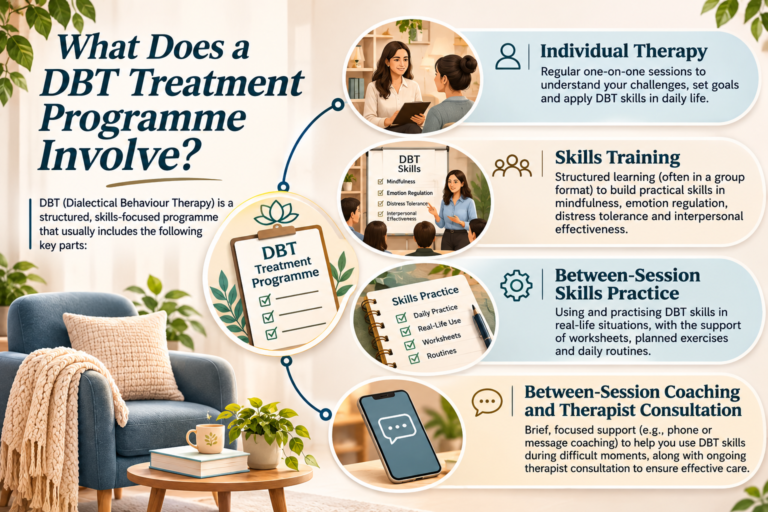
The term “DBT” is sometimes used to describe a treatment programme and sometimes to describe the use of individual DBT-informed skills within another therapeutic approach. These are not necessarily equivalent.
Individual therapy
In DBT individual therapy is used to work on personalised treatment targets review patterns of behaviour and apply skills to the person’s circumstances.
The therapist may help the patient identify situations that lead to distress examine what happened before and after a behaviour and develop strategies to respond effectively.
Skills training
Skills training helps people learn and practise mindfulness, distress tolerance, emotion regulation and interpersonal effectiveness.
Depending on the programme training may occur in a group or another structured format. A skills group is not necessarily the same as group psychotherapy and the programme structure should be explained clearly.
Between-session skills practice
Practice between sessions can help people apply skills in life. This may involve recording reactions rehearsing a communication strategy or reviewing how a coping skill worked in a difficult situation.
The type and amount of practice should be appropriate to the treatment plan.
Between-session coaching and therapist consultation
Comprehensive DBT may include between-session skills coaching under defined programme rules along with a consultation team, for therapists. These components support the delivery of the treatment model.
Not every clinic or therapist offers all of these elements. The exact service must be checked, not assumed.
Is every DBT service DBT?
No. Some professionals give DBT-informed therapy or only a few skills, not the full comprehensive model.
When enquiring about DBT patients can ask:
- Is this DBT or DBT-informed therapy?
- Is skills training included?
- Are sessions provided?
- What support is available between sessions?
- How are progress and safety concerns reviewed?
- What qualifications and training does the professional have in DBT?
These questions help patients understand the service before making a decision.
Is DBT the Same as Mindfulness or Emotional Control?
No. Mindfulness is one of DBT’s core skill areas. Dbt is broader than mindfulness alone.
Similarly DBT does not ask people to suppress emotions or pretend that difficult experiences do not matter. DBT teaches skills for noticing emotions tolerating distress and choosing responses that’re more effective in context.
For example a person may still feel angry after learning DBT skills. The difference is that the person recognises the anger earlier understands what triggered it and chooses to communicate without engaging in behaviour that worsens the situation.
Emotional regulation is not the same as being calm all the time. Emotional regulation means developing a flexible and effective relationship with emotions.
Can DBT Help Without Medication?
DBT is a form of psychotherapy. Does not itself require medication. Some people may receive psychotherapy without medication when that is appropriate for their needs and clinical circumstances.
Others may benefit from a combination of psychotherapy and medication. This decision depends on the individual’s assessment, symptoms, treatment history, preferences and clinical recommendations.
DBT should not be presented as a replacement for medication in every case. Should medication be presented as necessary for everyone receiving DBT.
If a patient is already taking medication the patient should discuss any questions or concerns with the prescribing clinician rather than stopping or changing treatment independently.
When Should Someone Consider Professional Assessment Before DBT?
A professional assessment can help clarify the nature of a person’s difficulties. Whether DBT is likely to be an appropriate option.
Assessment may be especially important when symptoms are severe several concerns are occurring together the person has experienced improvement from previous treatment or there are safety-related concerns.
A clinician may consider the person’s symptoms, medical and psychiatric history functioning, previous treatment, goals and preferences.
The outcome of assessment may be a recommendation for DBT, another form of psychotherapy, psychiatric consultation, further evaluation or coordinated care.
Seek help when safety is at immediate risk
If someone is at immediate risk of suicide, self-harm or harming another person routine DBT enquiry is not a substitute for urgent assistance. In India call 112 for an emergency or go to the nearest emergency department.
Learn About Your Treatment Options
If emotional regulation, distress or relationship difficulties are affecting life consider seeking guidance from an appropriately qualified mental health professional.
The Four Core DBT Skills Explained in Detail
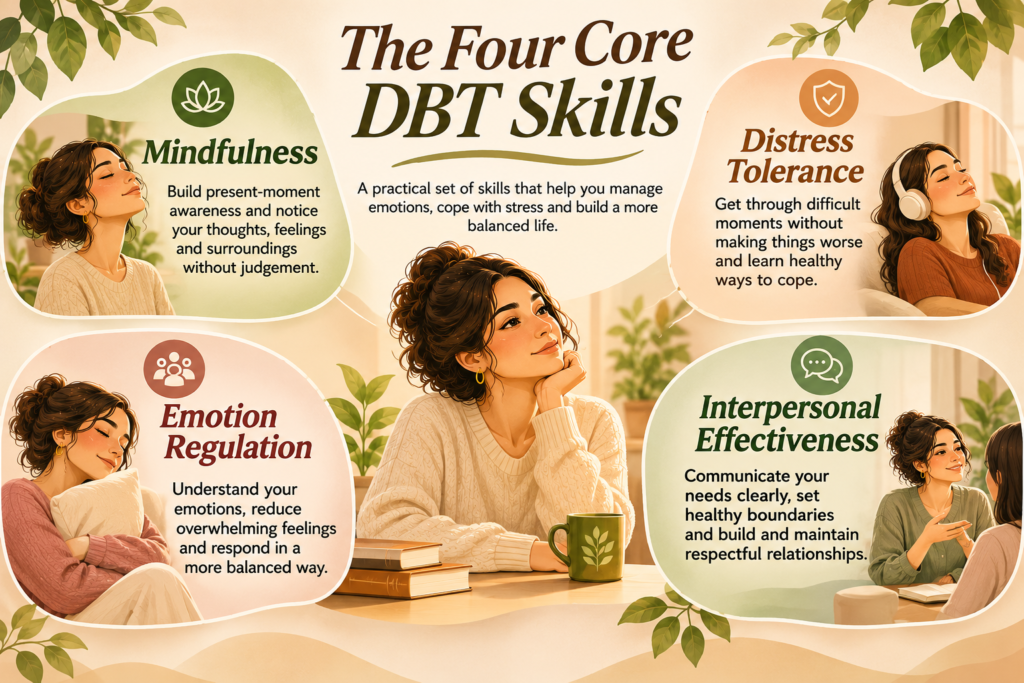
Dialectical Behaviour Therapy teaches skills that help people notice what they are experiencing manage moments understand their emotions and communicate more effectively.
The four core skill areas work together. A person might use mindfulness to recognise rising anger, distress tolerance to avoid reacting emotion regulation to understand the underlying pattern and interpersonal effectiveness to address the problem constructively.
Mindfulness Skills in DBT
Mindfulness in DBT involves paying attention to the moment intentionally while practising a less judgemental attitude towards thoughts, feelings, sensations and experiences.
It does not mean forcing the mind to become blank or eliminating unwanted thoughts. Instead, the person learns to notice what is happening without automatically reacting to it.
What mindfulness may help with
Mindfulness skills may help people practise:
- Recognising emotions before acting on them.
- Noticing physical signs of distress, such as muscle tension or a racing heartbeat.
- Separating an observation from an interpretation.
- Returning attention to the current task when distracted.
- Responding more deliberately during emotionally charged situations.
The three “What” skills
DBT mindfulness skills are commonly taught through three core activities.
The Three “What” Skills of Mindfulness
Notice it, name it, then step into it.
| Skill | Meaning | Everyday example |
|---|---|---|
1Observe |
Notice thoughts, emotions, sensations, or events | “I notice tension in my shoulders and a feeling of anger.” |
2Describe |
Put observations into words without adding assumptions | “My colleague has not replied to my message yet.” |
3Participate |
Become fully engaged in the activity at hand | Listening carefully during a conversation instead of rehearsing a response |
The “How” skills
Mindfulness practice also involves how a person observes, describes, and participates.
- Nonjudgmentally: Notice experiences without automatically labelling them as good, bad, weak, or unacceptable.
- One-mindfully: Focus on one activity or moment at a time where practical.
- Effectively: Choose actions that are more likely to support the relevant goal.
These skills do not require a person to approve of every experience or ignore genuine problems. They help distinguish the facts of a situation from immediate judgements and assumptions.
Example: Mindfulness during an argument
Suppose a person hears a critical comment and immediately thinks, “They do not respect me.”
An impulsive response might be to interrupt, shout, or leave without explaining what happened.
A mindfulness-based response could involve noticing:
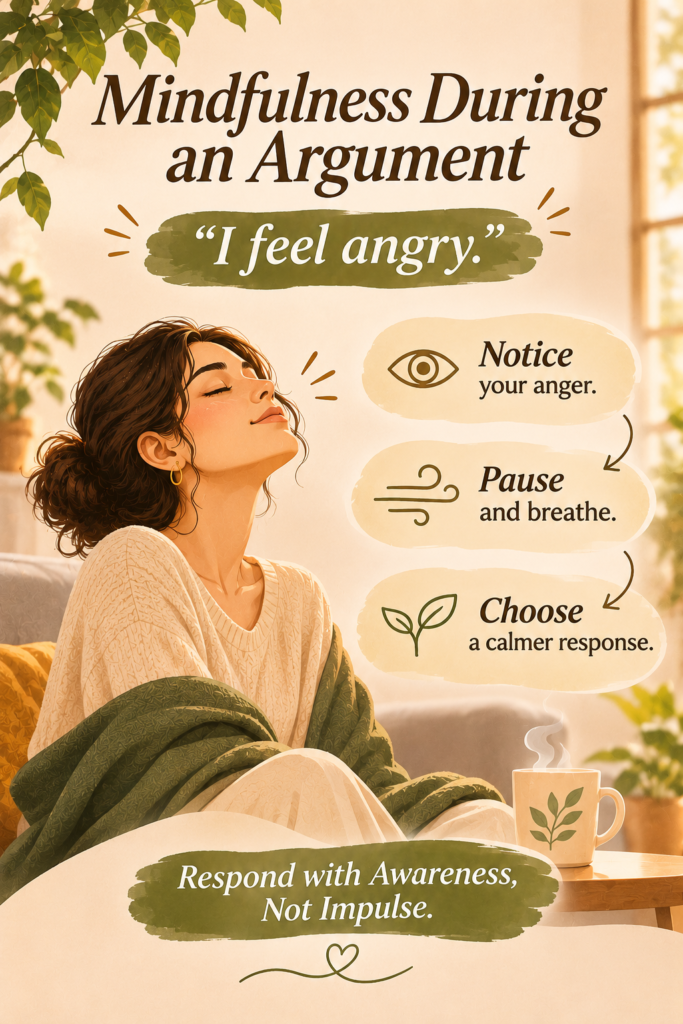
“I feel angry.”
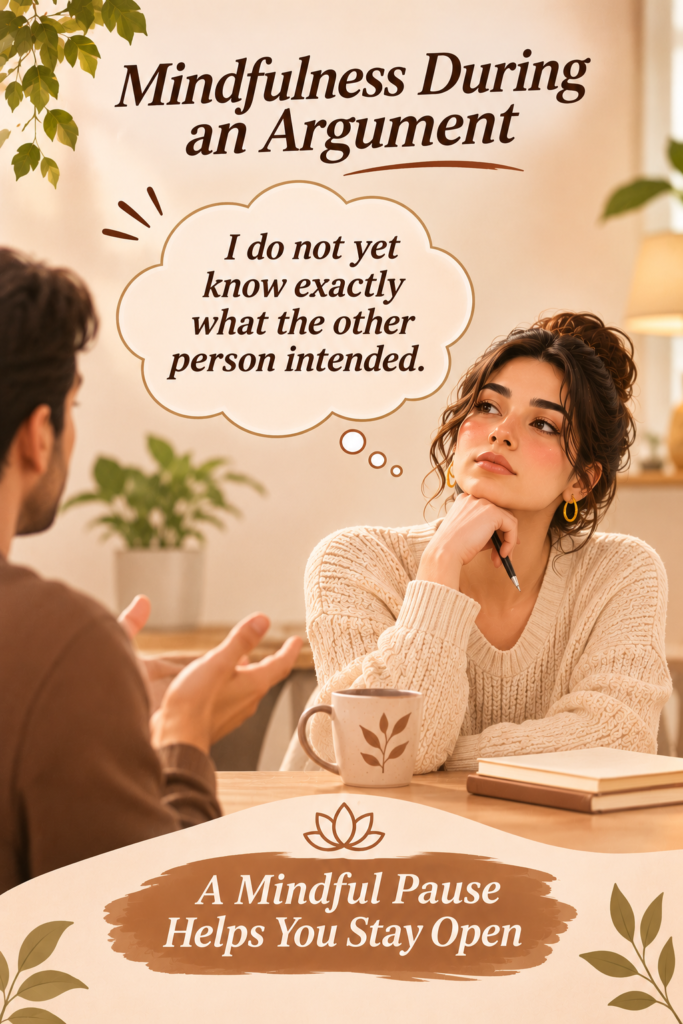
“I do not yet know exactly what the other person intended.”
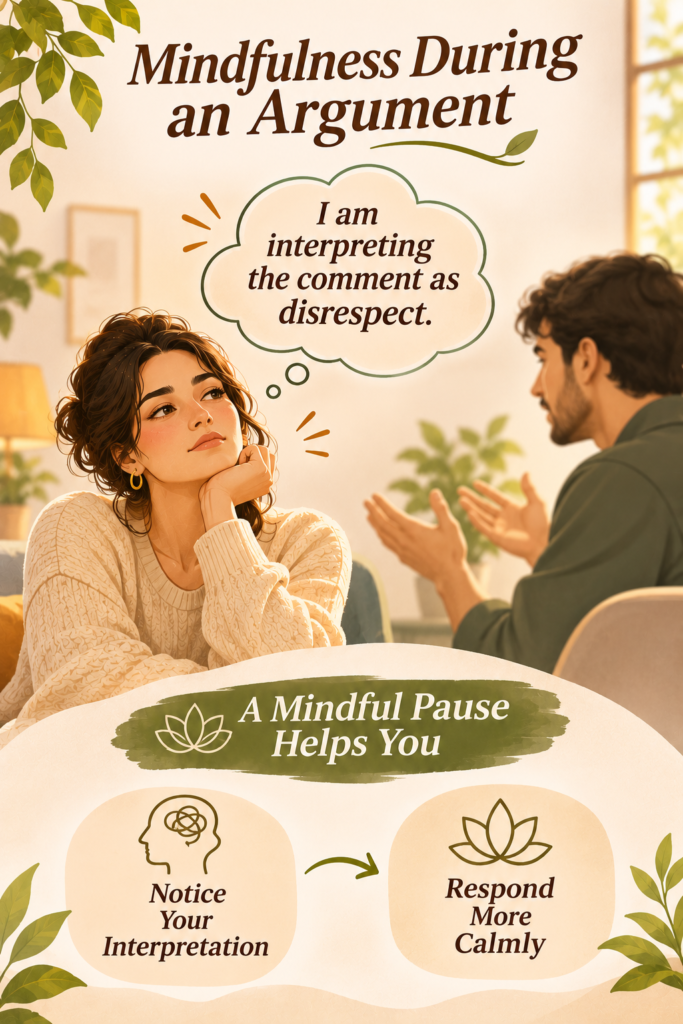
“I am interpreting the comment as disrespect.”

“I can pause and decide how I want to respond.”
A simple mindfulness practice
Try a noticing exercise
This is an educational exercise and not a substitute for DBT treatment.
- Notice what is happening around you.
- Identify one sensation for example your feet touching the floor.
- Name the emotion. Thought you notice, if you can.
- Describe the experience without trying to force it to disappear.
- Return your attention to the activity you want to complete.
If focusing inward feels overwhelming you can instead notice details in your surroundings. Stop the exercise if it significantly increases distress and seek guidance from a professional.
Clinical note: Mindfulness should be adapted to the individual. It should not be presented as a solution for severe distress or as a replacement for appropriate clinical care.
Distress Tolerance Skills: Managing Moments Without Making Them Worse
Distress tolerance is the DBT skill area focused on coping with difficult situations when distress is high and an immediate solution may not be possible. The purpose is not to encourage people to tolerate abuse, neglect or unsafe circumstances. It is to help them manage emotional discomfort while deciding what action is appropriate and safe. Distress tolerance can be particularly relevant when someone feels an urge to act immediately in order to escape an emotion.
When might distress tolerance skills be useful?
- Waiting for a decision when uncertainty feels overwhelming.
- Managing a disagreement without sending a message.
- Coping with disappointment when a situation cannot be changed immediately.
- Getting through a moment while considering the next practical step
- Recognising an urge to engage in behaviour and seeking a safer response.
The STOP skill
✦ The STOP Skill
| Step | Action | What to do |
|---|---|---|
| S | ⏸ Stop | Pause before taking the action you feel urged to take. Avoid making the situation worse through a reaction. |
| T | ↩ Take a step back | Create some space. This may mean taking a pause if it is safe to do so rather than immediately responding. |
| O | ◉ Observe | Notice your thoughts, feelings, sensations, urges and what is happening around you. |
| P | ✓ Proceed mindfully | Choose the step based on the situation your goals and safety rather than acting solely on the strongest immediate urge. |
Example: Receiving a message
A person receives a message that appears critical. They immediately want to send a reply. Using STOP they pause, notice their anger reread the message when calmer and consider whether they need clarification or a boundary-setting response. The skill does not require them to agree with the message. It helps them decide how to respond in a way that’s more likely to support their goals.
Other distress tolerance strategies
- Grounding: Directing attention to details in the immediate environment.
- Self-soothing: Using sensory experiences, such as a comfortable texture or calming music.
- Distraction: Temporarily shifting attention when appropriate to get through a moment.
- Pros-and-cons analysis: Comparing the short- and long-term consequences of acting on an urge.
- Radical acceptance: Acknowledging a reality that cannot currently be changed without suggesting that the reality is fair or desirable.
- Crisis -survival strategies: Using planned skills to manage distress while avoiding actions that create additional harm.
These skills should be. Practised appropriately. They are not a substitute for emergency help when there is danger.
What is radical acceptance?
Radical acceptance means acknowledging reality as it’s, at a particular moment even when it is painful or unwanted.
For example a person may need to acknowledge that an exam result cannot now be changed. They can recognise their disappointment while deciding what to do.
Acceptance does not mean approving of injustice abandoning a goal or refusing to change a situation that can be changed. It means reducing the struggle that can arise from denying an existing reality.
Patient takeaway: Distress tolerance helps people get through moments safely. It does not require them to remain in situations or ignore legitimate needs.
Emotion Regulation Skills: Understanding and Responding to Emotions
Emotion gives information about what we experience what we need and what we see as threats or rewards. When emotions become very strong it can be hard to think clearly or pick the best way to act. Emotion regulation skills help people notice patterns of emotion learn what causes them and create plans that lead to behaviour.
The goal is not to stop all emotion or stay happy all the time. The goal is to get better at responding to emotion without letting emotion control us.
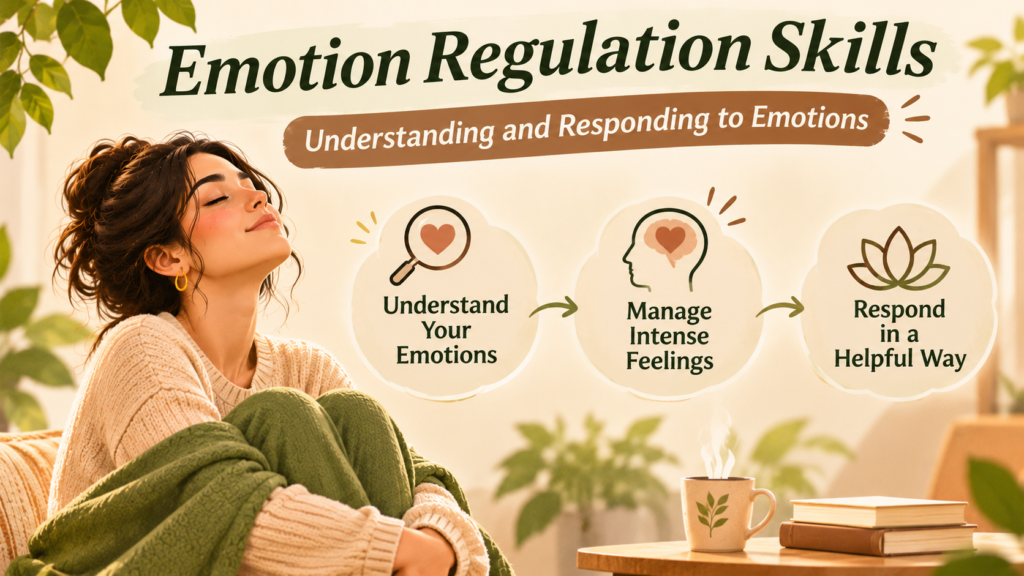
Identify and name the emotion
People can feel emotions at once during the same event.
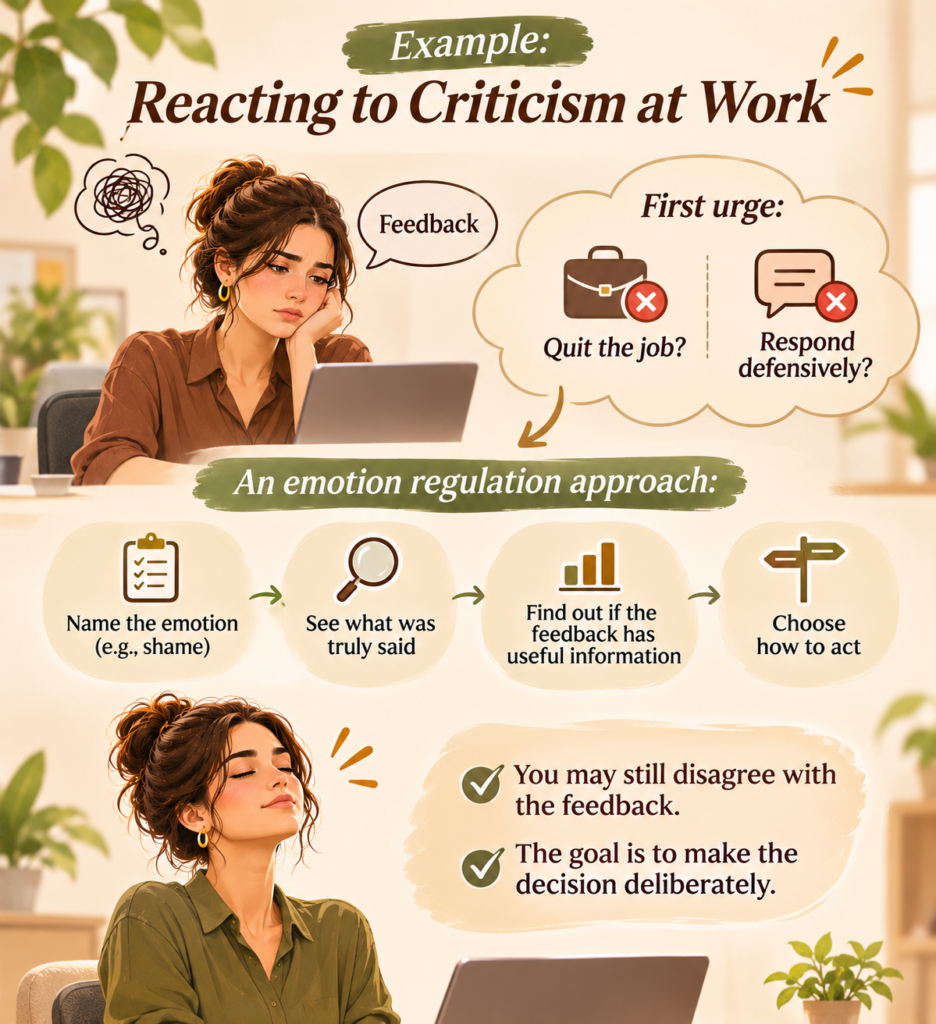
For example a person who gets feedback might feel anger, embarrassment, sadness and fear of failing. Learning to name each emotion can make it easier to see what is going on and decide how to respond.
A therapist may help the patient explore
- What happened just before the emotion appeared?
- What did the person think the event meant?
- What body feelings came with the emotion?
- What action did the emotion push?
- What happened after the person followed that urge?
Understand vulnerability factors
A persons emotion can be affected by things outside the event. Bad sleep body pain, constant stress, conflict or not enough rest can make it harder to manage emotion. Noticing these factors does not mean the person is to blame for every experience. It helps find changes that can support emotion.
Check the facts
A DBT skill called “check the facts” encourages people to see if their emotion idea matches the facts that are known.
For example:
- Event: A friend has not answered a message.
- Interpretation: “They are purposely ignoring me.”
- Known fact: No reply has come yet.
- Possibilities: The friend could be busy, unavailable or not sure how to reply.
The goal is not to pick the positive explanation. It is to separate what is known from what’s guessed then choose a sensible action. If there really is a pattern of disrespect or neglect that fact should also be looked at.
Opposite action
In DBT opposite action can help when an emotion or urge does not match the facts or when following that urge would not work and the skill fits the situation.
For example if anxiety makes someone avoid every social meeting they can slowly practice joining a safe right activity instead of always pulling back. Opposite action is not a rule to ignore danger push into contact or hide real emotion. It needs thought about the situation.
Build routines that support wellbeing
✦ Emotion Regulation & Daily Habits
-
☾
Keeping a fairly steady sleep routine.
-
♡
Eating on time and caring for body health.
-
✓
Planning tasks and duties.
-
♧
Using good social help.
-
↘
Cutting down stress when possible.
-
+
Getting professional help when symptoms last or badly affect daily life.
-
ⓘ
These ideas can add to DBT skills. They are not a substitute for specific treatment when it is needed.
Emotion gives information about what we experience what we need and what we see as threats or rewards. When emotions become very strong it can be hard to think clearly or pick the best way to act. Emotion regulation skills help people notice patterns of emotion learn what causes them and create plans that lead to behaviour.
The goal is not to stop all emotion or stay happy all the time. The goal is to get better at responding to emotion without letting emotion control us.
Interpersonal Effectiveness: Communicating Needs and Maintaining Boundaries
Relationships often have competing needs. A person might want to keep a relationship get an outcome and keep self-respect all at once. DBT interpersonal skills help people think about these goals and talk effectively. These skills are not about winning every fight or forcing others to act one way. They are about bettering the person’s talk, choices and limits.
The three interpersonal goals
Three Goals of Effectiveness
| Goal | What it means | Example |
|---|---|---|
|
◎
Objective effectiveness
|
Working towards a specific practical outcome | Asking a colleague for a clear deadline |
|
♡
Relationship effectiveness
|
Maintaining or improving a relationship where appropriate | Listening carefully and communicating respectfully during a disagreement |
|
✓
Self-respect effectiveness
|
Acting consistently with personal values and boundaries | Saying no to a request that conflicts with an important limit |
These goals may not always align perfectly. A person might need to decide which goal matters most in a particular interaction.
The DEAR MAN skill
DEAR MAN is a DBT interpersonal effectiveness strategy commonly used to help people communicate requests, explain needs, and maintain boundaries.
✦ The DEAR MAN Skill
| Skill | What it means |
|---|---|
|
D
Describe
|
Describe the relevant facts as clearly and objectively as possible. |
|
E
Express
|
Explain your feelings or perspective without assuming the other person already understands them. |
|
A
Assert
|
State what you need or request clearly. |
|
R
Reinforce
|
Explain the potential benefit of reaching an agreement where appropriate. |
|
M
Mindful
|
Stay focused on the main objective instead of being pulled into unrelated arguments. |
|
A
Appear confident
|
Communicate clearly and respectfully, even when you feel nervous. |
|
N
Negotiate
|
Consider reasonable alternatives while keeping important needs and boundaries in view. |
Example: Asking for a change in household responsibilities of saying, “You never help with anything ” a person might say:
“When I manage the household tasks alone during the week I feel overwhelmed. Can we agree on which tasks each of us will handle? I would like us to make a plan that feels manageable for both of us.” This communicates the issue expresses the impact makes a request and leaves room for negotiation.
The result is not guaranteed. The other person may. Some relationships may not be safe or appropriate for direct negotiation. In situations involving coercion, abuse or threats, safety and professional support take priority over communication techniques.
This is an example, not a fixed sequence that every person must follow. Different situations require skills and some situations call for leaving the interaction or seeking help rather than attempting to resolve the disagreement.

Maintaining self-respect
DBT also includes skills for maintaining self-respect during difficult interactions. These may involve being truthful, considering personal values, and avoiding unnecessary self-abandonment simply to prevent disagreement.
Healthy boundaries can coexist with empathy. A person can care about someone and still decline a request, ask for respectful communication, or limit an interaction that is harmful.
How the Four DBT Skill Areas Work Together
The four core skill areas are not solutions for unrelated problems. In life a person may use several skills during one challenging experience. Consider a person who feels overwhelmed after a disagreement with a family member.
Situation:-
A family member makes a comment that feels hurtful. The person experiences anger and an urge to respond immediately.
1. Mindfulness Notice the anger, physical tension and urge to argue without acting on them.
2. Distress tolerance Use an appropriate coping strategy to get through the most intense part of the reaction.
3. Emotion regulation Consider what triggered the anger check the facts and identify what outcome would be useful.
4. Interpersonal effectiveness Explain the concern clearly request a change where appropriate and maintain boundaries.
This is an example, not a fixed sequence that every person must follow. Different situations require skills and some situations call for leaving the interaction or seeking help rather than attempting to resolve the disagreement.
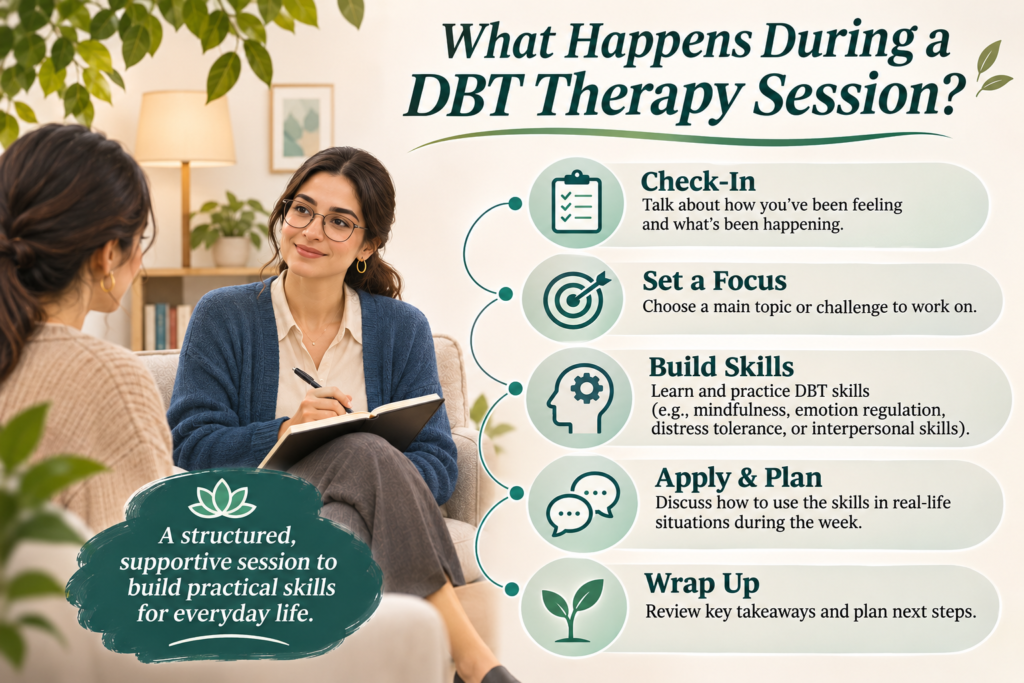
What Happens During a DBT Therapy Session?
Emotion gives information about what we experience what we need and what we see as threats or rewards. When emotions become very strong it can be hard to think clearly or pick the best way to act. Emotion regulation skills help people notice patterns of emotion learn what causes them and create plans that lead to behaviour.
The goal is not to stop all emotion or stay happy all the time. The goal is to get better at responding to emotion without letting emotion control us.
A typical individual-session structure
✦ A Typical Individual-Session Structure
| Stage | Possible activity |
|---|---|
|
◉
Check-in
|
Discuss current concerns, relevant events, and emotional state |
|
↻
Review
|
Consider progress towards agreed goals and practise reviewing recent situations |
|
◎
Identify targets
|
Decide which behaviour or difficulty is most important to address |
|
✧
Skills application
|
Practise or review an appropriate DBT skill |
|
⌘
Problem-solving
|
Identify obstacles and consider alternative responses |
|
✓
Between-session plan
|
Agree on suitable practice or observation before the next meeting |
This is a general illustration, not a guaranteed structure for every clinic or therapist.
Does DBT involve homework?
DBT commonly involves between-session practice, but the form varies by programme. A person may be asked to notice a recurring trigger, practise a skill, record a relevant behaviour, or reflect on how an interaction unfolded.
The aim is to help the person use skills in real-life situations rather than only understanding them during the appointment.
If a task feels confusing, unrealistic, or overwhelming, the patient should discuss it with the therapist so it can be clarified or adjusted appropriately.
Do patients have to discuss everything immediately?
No. Patients can ask questions about the purpose of a topic or exercise and discuss concerns about the pace of treatment. The therapist should explain relevant aspects of the approach and work within appropriate professional and clinical boundaries.
However, certain information—especially information relevant to immediate safety—may need timely discussion so that the treatment plan can respond appropriately.
What Is a DBT Diary Card?
A diary card is a tool used in many DBT programmes to track selected behaviours, emotions, urges, and skills practice over time. Its purpose is to help the patient and therapist identify patterns and review treatment targets.
The exact format varies. A diary card is not a test of whether someone is a good or bad patient.
A therapist may use the information to explore questions such as:
● What circumstances tended to precede a difficult emotional reaction?
● Which skills were attempted?
● What made a skill easier or harder to use?
● Were there changes in the intensity or frequency of selected behaviours?
● What needs to be prioritised during the next session?
Illustrative diary-card template
This simplified example is for education only. It is not a substitute for a diary card supplied as part of a DBT programme.
| 📅 Day | ♡ Emotion or urge noticed | ✦ Skill attempted | ↗ What happened afterwards |
|---|---|---|---|
| Monday | Anger during a disagreement | Paused and observed the emotion | Responded after taking time to think |
| Tuesday | Anxiety before a task | Broke the task into a manageable step | Began the task despite discomfort |
| Wednesday | Sadness after disappointing news | Contacted a trusted support person | Felt supported, though still sad |
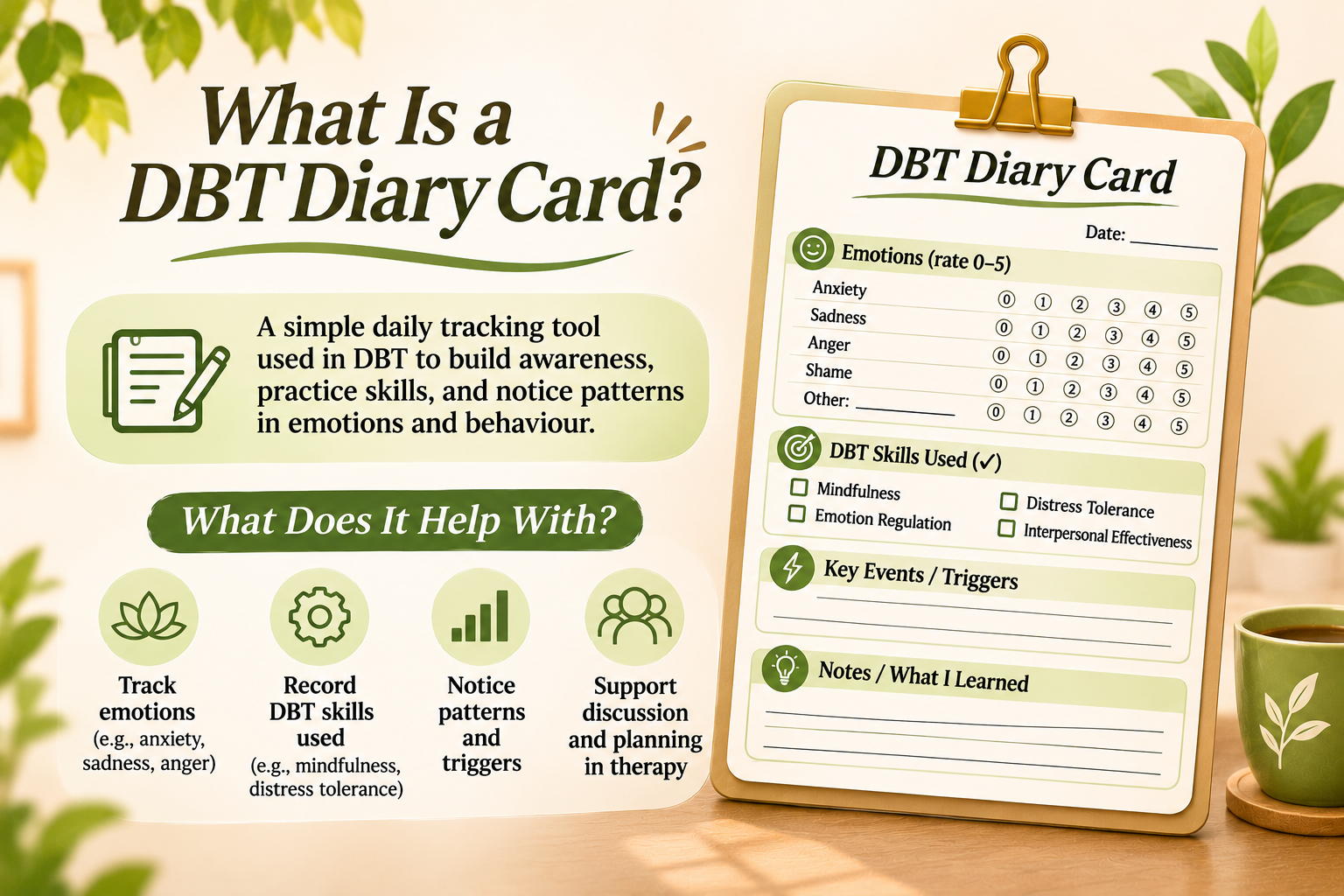
A clinician may recommend a more structured tool based on the treatment model. People should avoid recording highly sensitive details in a diary or digital application that cannot be kept appropriately private.
How Is Progress Measured in DBT?
Progress in DBT is not measured by whether a person feels happy or calm after each session. Treatment goals may involve changes in behaviour, emotional coping, relationships, functioning or other outcomes that are important to the individual.
Possible indicators of progress
Depending on the person’s goals, progress may include:
-
♡
Recognising emotions earlier.
-
↘
Reducing disruptive behaviours.
-
↻
Recovering more effectively after distress.
-
✧
Using coping skills in real life.
-
☏
Communicating needs clearly.
-
⇄
Managing disagreements with fewer unwanted consequences.
-
✓
Improving participation in daily responsibilities.
-
◎
Moving towards meaningful goals.
These are indicators, not guaranteed outcomes.
What if progresss uneven?
Progress can fluctuate. A person may use a skill successfully in one situation. May struggle to use it in another. A stressful event may temporarily increase symptoms. Make familiar patterns harder to manage. The therapist and patient can review what happened identify barriers and adjust the plan where appropriate. Limited improvement should prompt discussion than blame. Depending on the situation it may be useful to reconsider treatment goals, programme suitability, practical barriers or the need for clinical assessment.
How Long Does DBT Take?
There is no duration that applies to every DBT service or every patient. Comprehensive DBT programmes often involve treatment with several coordinated components. DBT-informed therapy may follow a structure. Duration depends on the programme the presenting concerns, treatment goals, clinical needs and response to treatment. Before starting patients can ask:
• Is the service DBT or DBT-informed therapy?
• What components are included?
• How frequently are sessions held?
• How is progress reviewed?- What costs or practical commitments should be expected?
• What happens if the treatment approach needs to change?
Do not advertise a fixed number of sessions or promise a timeline unless the actual service supports that information and it is communicated with appropriate qualifications.
DBT for Everyday Emotional Challenges: What It Can and Cannot Do
DBT skills may help people respond deliberately to everyday emotional challenges but they are not a way to control every feeling, relationship or external circumstance. For example a person may learn to communicate but cannot guarantee that another person will respond respectfully. A person may learn to tolerate uncertainty but cannot eliminate every situation. A person may learn to regulate a response without preventing all future distress.
A balanced understanding of DBT includes both its value and its limitations. DBT may help people practise:
• Noticing emotions and urges before acting.
• Getting through moments with safer coping strategies.
• Understanding recurring emotional and behavioural patterns.
• Expressing needs and setting boundaries.
• Reviewing consequences and choosing alternative behaviours.
• Building routines and actions that support meaningful goals.
DBT does not guarantee:
• Elimination of distress.
• Immediate resolution of relationship problems.
• A particular recovery timeline.
• That every person will respond well.
• That medication or other treatment will never be needed.
• That a person can safely manage an emergency without urgent support.
The appropriate treatment plan depends on assessment, the clinical concern and the service available._
Choosing a DBT Therapist or Programme in Delhi
People searching for DBT, in Delhi may encounter services described as DBT skills training or DBT-informed psychotherapy. These terms can refer to levels of treatment. Asking a practical questions can help clarify what is actually being offered.
DBT provider selection checklist:
- What are the professionals relevant qualifications and clinical experience?
- What training or experience do they have in DBT?
- Is the service DBT or DBT-informed therapy?
- Does the programme include individual therapy, skills training or both?
- How are treatment goals and progress reviewed?
- How are urgent safety concerns handled?
- What are the fees, session arrangements and cancellation policies?
- What privacy and confidentiality arrangements apply?
A provider should be able to explain the service clearly including its scope and limitations. Qualifications and relevant registration requirements should be checked according to the professional’s role and applicable Indian standards.
Explore DBT and other psychological services If you are considering DBT therapy, in Delhi you can ask about the services offered by Headspace Mind Clinic and find out which professional or assessment path fits your worries.
DBT for Borderline Personality Disorder (BPD)
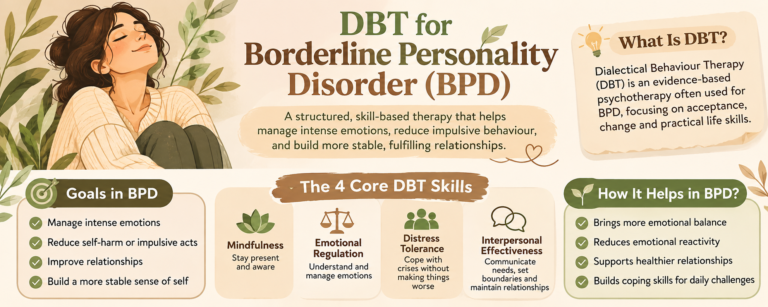
How Can DBT Help People with Borderline Personality Disorder?
Borderline personality disorder (BPD) is a mental health condition that can involve intense emotional experiences, difficulties maintaining relationships, impulsive behaviour and a strong sensitivity to rejection or abandonment. Experiences vary considerably from one person to another, and a diagnosis should only be made following an appropriate clinical assessment.
Dialectical Behaviour Therapy was developed in part to help people experiencing persistent emotional dysregulation and high-risk behaviours. It is an established treatment option for people with BPD, particularly when difficulties include intense emotions, impulsivity, recurrent self-harm or significant interpersonal distress.
DBT does not label a person as difficult or assume that their reactions are deliberate. Instead, it helps the individual understand patterns of emotion and behaviour, build practical skills and work towards a safer, more meaningful life.
Common difficulties DBT may address
Common Difficulties DBT May Address
| Difficulty | How DBT skills may help |
|---|---|
|
♡
Intense emotional reactions
|
Practising emotion identification, checking facts and responding more deliberately |
|
◇
Fear of rejection or abandonment
|
Recognising emotional triggers and developing more balanced responses |
|
↗
Impulsive decisions
|
Creating a pause between an urge and an action |
|
⇄
Repeated interpersonal conflict
|
Practising communication, boundaries and relationship skills |
|
◌
Difficulty coping with distress
|
Using crisis-survival and distress-tolerance strategies |
|
✳
Self-harm urges
|
Developing safer coping responses alongside an appropriate clinical safety plan |
These are possible treatment targets, not a diagnostic checklist. Experiencing one or more of these difficulties does not automatically mean that someone has BPD.
What might DBT treatment look like for BPD?
Treatment goals are individualised. A clinician may help a person identify the situations that trigger intense emotions, examine what happens before and after a behaviour, and practise alternative responses. Progress is reviewed over time rather than judged by a single difficult day or emotional setback.
A comprehensive DBT programme may include individual therapy, structured skills training, between-session coaching and a therapist consultation team. Not every service described as DBT offers all these components, so patients should clarify what is included.
Important: DBT is not a guarantee of recovery, and it is not the only treatment option for BPD. The appropriate approach depends on the person’s needs, preferences, risks, previous treatment and clinical assessment.
Looking for support with emotional regulation or relationship difficulties?
A professional assessment can help clarify your concerns and identify suitable treatment options. You do not need to decide on a diagnosis before seeking help.
Prepare Questions About DBT
DBT for Self-Harm and Suicidal Thoughts
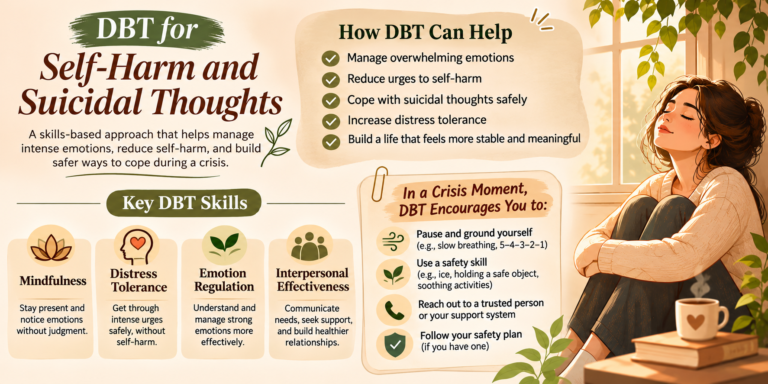
Can DBT Help with Self-Harm or Suicidal Behaviour?
Self-harm and suicidal thoughts can arise for different reasons. For some people, self-harm may function as an attempt to manage overwhelming emotions, communicate distress or interrupt a painful internal experience. Suicidal thoughts may involve a wish to escape suffering, and they require careful, individual assessment.
DBT has evidence supporting its use for reducing certain high-risk behaviours in specific populations, including some people with BPD and recurrent selfharm or suicidal behaviour. However, its suitability must be determined by a qualified clinician, and the evidence should not be interpreted as a guarantee that an individual will stop experiencing urges or thoughts.
How DBT may support safer coping
DBT can help individuals and clinicians work together to:
- Identify situations and emotional states associated with self-harm urges.
- Recognise warning signs before distress escalates.
- Practise alternatives to acting on an urge.
- Improve the ability to tolerate intense emotions safely.
- Review the sequence of events surrounding a difficult episode without blame.
- Develop a personalised safety plan with appropriate professional support.
- Strengthen communication with trusted people and treatment providers.
The aim is not to shame a person for self-harm or to demand that they simply “stay positive”. Treatment focuses on understanding what is happening, reducing risk and building safer ways to cope.
What is a safety plan?
A safety plan is a practical, individualised plan developed with an appropriate professional. Depending on the person’s circumstances, it may identify:
- Personal warning signs that distress is escalating.
- Coping strategies that may help in the moment.
- Safe places or supportive people to contact.
- Professional services and crisis resources.
- Steps to reduce access to means of serious self-harm, where relevant.
- What to do if the person’s safety cannot be maintained.
A safety plan should be specific to the individual and reviewed when circumstances change. It is not a substitute for urgent assessment when someone may be in immediate danger.
When urgent help is needed
If you or someone else may act on suicidal thoughts, has seriously harmed themselves, or cannot remain safe, seek urgent help now. In India, call 112 for emergency assistance or go to the nearest emergency department. If possible, stay with the person and involve a trusted support person while arranging professional help.
Do not wait for a routine therapy appointment when there is immediate danger.
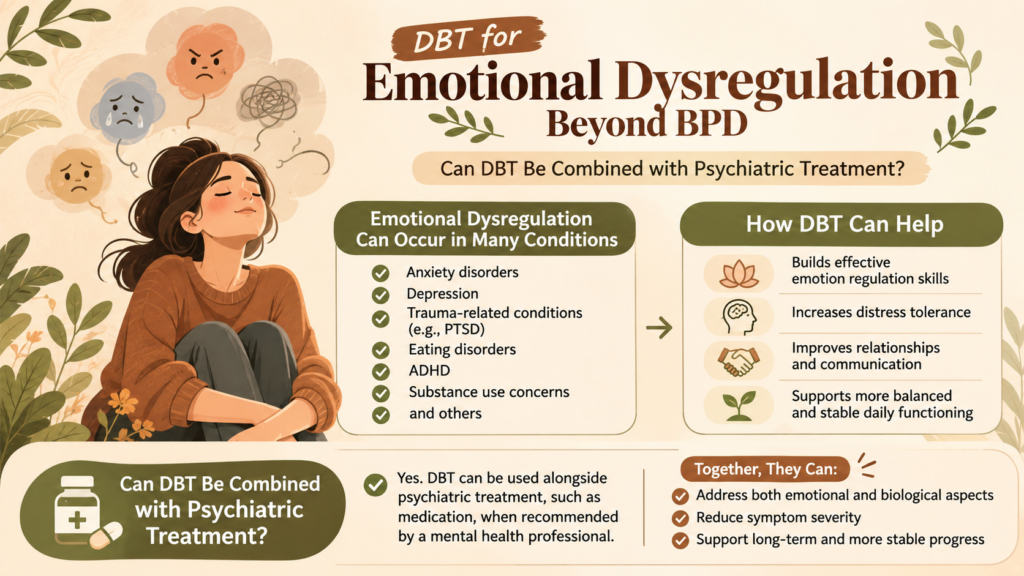
DBT for Emotional Dysregulation Beyond BPD
Can DBT Be Combined with Psychiatric Treatment?
Yes. Psychological therapy and psychiatric care can be used together when clinically indicated. They address aspects of a person’s needs and may be coordinated as part of an individualized treatment plan.
DBT focuses on patterns, emotional regulation, coping skills and interpersonal effectiveness. Psychiatric care may assess symptoms consider diagnoses review medication options where appropriate and monitor clinical changes that affect treatment.
The need for medication depends on the individuals presentation and clinical assessment. DBT does not automatically require medication and medication does not automatically remove the need, for therapy.
How coordinated care may work
| Area | Possible role |
|---|---|
|
Psychological assessment
|
Clarify concerns, functioning, history and treatment needs |
|
DBT or DBT-informed therapy
|
Develop skills and address relevant behavioural patterns |
|
Psychiatric consultation
|
Assess psychiatric symptoms and discuss treatment options |
|
Medication review
|
Consider benefits, side effects, interactions and ongoing need where medication is prescribed |
|
Progress review
|
Reassess goals, risks, functioning and whether the plan needs adjustment |
The professionals involved should coordinate appropriately, with the person’s informed consent and respect for privacy, subject to relevant safety and legal obligations.
What if symptoms change during DBT?
Tell the treating professional if symptoms worsen, daily functioning changes substantially, medication causes concerning side effects or safety becomes difficult to maintain. These changes may require reassessment rather than simply increasing skills practice.
Never start, stop or change prescribed medication solely because you have started DBT. Discuss medication decisions with the prescribing clinician.
DBT Compared with Other Psychological Therapies
DBT vs CBT, ERP and Other Therapies
Different therapies have different aims and methods. The best option depends on the person’s concerns, treatment goals, clinical needs and preferences.
Common Difficulties DBT May Address
| Difficulty | How DBT skills may help |
|---|---|
|
♡
Intense emotional reactions
|
Practising emotion identification, checking facts and responding more deliberately |
|
◇
Fear of rejection or abandonment
|
Recognising emotional triggers and developing more balanced responses |
|
↗
Impulsive decisions
|
Creating a pause between an urge and an action |
|
⇄
Repeated interpersonal conflict
|
Practising communication, boundaries and relationship skills |
|
◌
Difficulty coping with distress
|
Using crisis-survival and distress-tolerance strategies |
|
✳
Self-harm urges
|
Developing safer coping responses alongside an appropriate clinical safety plan |
These approaches are not interchangeable, and the table is not a ranking. Some people may benefit from one primary therapy; others may need a coordinated or phased approach.
Can someone receive DBT and CBT together?
In some cases, elements of different approaches may be used in a coordinated treatment plan. The clinician should explain the rationale, clarify which treatment is primary and avoid creating a confusing mix of techniques without a clear purpose.
For example, someone may use DBT skills to manage intense distress while also receiving a condition-specific intervention. Whether that combination is suitable should be assessed individually.
Questions to ask before choosing a therapy:
- What treatment goal are we prioritising?
- Why is this therapy suitable for my concern?
- Is the treatment a comprehensive programme or a skills-informed approach?
- How will we review progress?
- What should I do if my symptoms worsen between sessions?
- Would another treatment or psychiatric assessment also be appropriate?
Challenges and Limitations of DBT
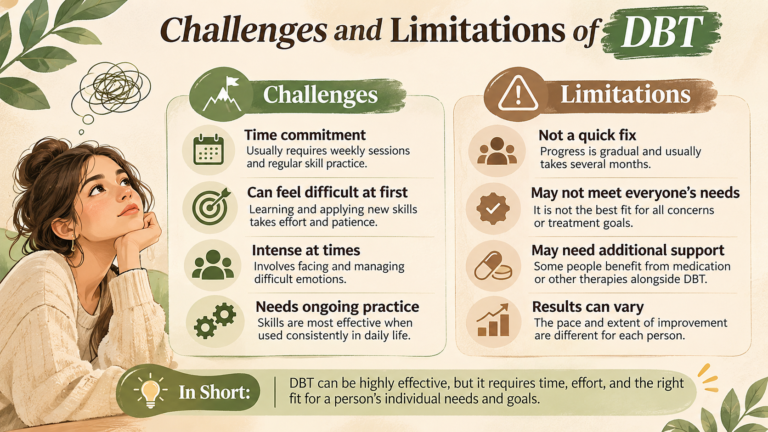
What Should You Know Before Starting DBT?
DBT can provide a structured way to learn and practise skills, but treatment can also be demanding. Being aware of its limitations helps people make an informed decision. Regular practice may be needed. Skills can be difficult to use during periods of intense distress. Learning them in a session is only one part of treatment; applying them in daily life may take time. Progress is not always linear. Difficult weeks do not automatically mean therapy is failing. They can provide information about triggers, barriers and areas that need more support.
The treatment format matters. A comprehensive DBT programme differs from occasional DBT-informed techniques used within general therapy. Neither label should be assumed to describe the exact service without checking its components. DBT may not address every clinical need. Some people require additional assessment, condition-specific therapy, psychiatric treatment or a different level of care.
Access and practical commitments matter. Availability, session frequency, travel, scheduling, language preferences and costs can affect whether a programme is feasible. Patients should ask the provider about these factors before committing.
How can a patient decide whether to continue?
Bring concerns to the therapist rather than assuming that discomfort means treatment is unsuitable. Ask for a review of goals, barriers, safety concerns and alternatives. If there is no clear plan or the treatment does not seem to address the main difficulty, a second professional opinion may be reasonable.
Common Myths About DBT
Myths and Facts About Dialectical Behaviour Therapy
Myths and Facts About Dialectical Behaviour Therapy
Understanding common misconceptions about DBT
| Myth | Fact |
|---|---|
|
×
DBT is only for people with borderline
personality disorder.
|
✓
Fact
DBT was created in that area of mental health and has proven uses for some people with borderline personality disorder but DBT-informed skills may also be helpful in other situations. The evidence and how well it works can vary. |
|
×
DBT teaches people to suppress emotions.
|
✓
Fact
DBT helps people understand emotions react in ways and make changes when behaviors are not helpful. It does not mean pretending that hard feelings are not real. |
|
×
Mindfulness alone is DBT.
|
✓
Fact
Mindfulness is one of the four parts of DBT. Full DBT includes parts that work together. |
|
×
DBT guarantees that self-harm or suicidal
thoughts will stop.
|
✓
Fact
DBT might help lower some high-risk actions in groups of people but no treatment can promise a certain result. Checking for risks and having safety help is still very important. |
|
×
Learning DBT means medication is no longer
needed.
|
✓
Fact
Whether or not medication is needed depends on the persons health situation. Should be decided with the doctor who prescribes it. Therapy and medication can be used together. |
|
×
If someone cannot use a skill during a
crisis they have failed at DBT.
|
✓
Fact
Skills can be harder to use when stress is very high. This difficulty can be talked about in therapy to find out what support or practice is needed. |
|
×
DBT means accepting treatment from other
people.
|
✓
Fact
Acceptance in DBT is not the same, as agreeing to be treated or staying in a dangerous situation. Safety setting limits and getting help are still very important. |
How to Prepare for Your First DBT Appointment
What Should You Bring Up During a DBT Consultation?
You do not need to prepare a perfect explanation of your experiences before meeting a mental health professional. It can be useful, however, to think about the difficulties that have brought you to treatment.
Consider noting:
● The main situations in which emotions become difficult to manage.
● What you tend to do when distress becomes intense.
● Any patterns affecting relationships, work, studies or everyday functioning.
● Previous therapy or psychiatric treatment, if relevant.
● Current medication and any concerns about it.
● What you hope will change through therapy.
● Practical requirements such as preferred language, appointment timing and accessibility.
● Any immediate safety concerns that the clinician needs to know about.
If writing these details down feels overwhelming, start with one or two examples. You can also ask the clinician how they prefer to gather this information.
Questions you can ask a prospective DBT provider
- What training and experience do you have in DBT?
- Is this comprehensive DBT or DBT-informed individual therapy?
- Does the programme include structured skills training?
- How often are sessions held, and what is the expected commitment?
- How is progress reviewed?
- What happens if I need support between sessions?
- How are urgent safety concerns handled?
- What are the fees, cancellation rules and confidentiality policies?
- Would psychiatric consultation or another form of treatment be advisable?
The provider should be able to explain the treatment approach in clear language and answer reasonable questions about its scope and limitations.
Choosing DBT Therapy in Delhi: Practical Considerations
How to Find a Suitable DBT Therapist in Delhi
When searching for a DBT therapist in Delhi, look beyond the name of the therapy. The important questions concern the professional’s qualifications, specific DBT training, the treatment format and whether the approach fits your needs.
Delhi is a large metropolitan area, so practical factors may also influence your choice. Consider travel time, session availability, language, accessibility and whether the provider’s schedule is sustainable for you.
A practical selection checklist
- Verify the professional's qualifications and registration where applicable.
- Ask about DBT-specific training and clinical experience.
- Clarify whether the service offers comprehensive DBT or DBT-informed therapy.
- Ask how skills are taught and practised.
- Understand the provider's approach to risk and urgent concerns.
- Discuss progress reviews and how treatment goals are set.
- Confirm session frequency, fees, cancellation terms and any additional programme costs.
- Understand confidentiality, record-keeping and information-sharing policies.
- Ask whether coordination with a psychiatrist or another professional may be useful.
- Choose a programme that is practical enough for you to attend consistently.
Confidentiality, Consent and Therapeutic Boundaries
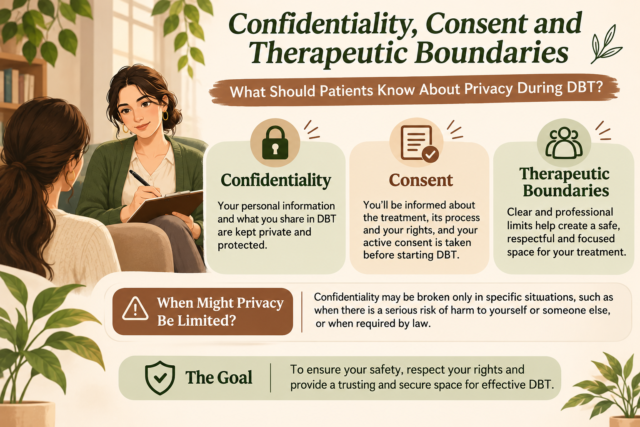
What Should Patients Know About Privacy During DBT?
Psychological therapy involves discussing personal experiences, emotions, relationships and sometimes safety concerns. Before treatment begins, patients should receive an explanation of confidentiality, record-keeping, fees, cancellation arrangements and the boundaries of the service.
A responsible provider should explain, in language the patient understands:
● What information is collected and why.
● How clinical notes and personal information are handled.
● Who may access information as part of care.
● When information may need to be shared for safety, legal or other applicable reasons.
● How consent is obtained and documented.
● How questions or complaints about the service can be raised.
Confidentiality is important, but it is not always absolute. Limits may apply where there is a serious safety concern or a legal obligation. The provider should explain the relevant policies rather than making blanket promises that all information will always remain private.
Therapeutic boundaries
Patients should be able to ask about the therapist’s role, expected communication between sessions, appointment rules and what to do during a crisis. These boundaries support clarity and safety; they should not discourage patients from disclosing urgent concerns.
If the patient is a minor, the provider should explain the applicable consent and confidentiality arrangements, including the role of parents or caregivers where relevant.
DBT may be worth discussing with a qualified mental health professional if emotional intensity, distress tolerance or interpersonal difficulties are affecting daily life. A clinical assessment can help determine whether DBT, another psychological therapy or coordinated psychiatric care is appropriate.
Frequently Asked Questions About DBT Therapy in Delhi
DBT Therapy FAQs
The following FAQs are written for patients and families. Keep answers direct, accurate and self-contained to support Google Search, featured snippets and AI-generated answers. Publish only service details verified by Headspace Mind Clinic.
Dialectical Behaviour Therapy (DBT) is a structured form of psychological treatment that combines acceptance with behavioural change. It teaches skills for mindfulness, distress tolerance, emotion regulation and interpersonal effectiveness. It may be recommended when emotional distress, impulsive behaviour or relationship difficulties significantly affect daily life.
DBT is particularly associated with the treatment of borderline personality disorder and certain patterns of recurrent self-harm or suicidal behaviour. DBT-informed skills may also be used in other clinical situations, although the strength of evidence varies. A qualified professional can assess whether DBT is appropriate for a person’s needs.
DBT is an established evidence-supported treatment option for borderline personality disorder. It may help address emotional dysregulation, self-harm, impulsive behaviour and interpersonal difficulties. Outcomes vary, and DBT is not the only available treatment. The appropriate approach depends on clinical needs, preferences and the treatment programme offered.
The four core DBT skills areas are:
- Mindfulness: Paying attention to the present moment with awareness.
- Distress tolerance: Coping with difficult situations without making them
worse. - Emotion regulation: Understanding emotions and responding to them
more effectively. - Interpersonal effectiveness: Communicating needs, maintaining
boundaries and navigating relationships.
These skills are generally taught through explanation, practice and review
Cognitive Behavioural Therapy (CBT) broadly examines the relationship
between thoughts, feelings and behaviours. DBT incorporates behavioural
change strategies alongside acceptance, mindfulness, distress-tolerance and
interpersonal-effectiveness skills. Both approaches can be useful, but their
suitability depends on the person’s presenting concern and the specific
treatment model.
Neither DBT nor CBT is universally better. The appropriate therapy depends
on the condition being treated, the individual’s needs, treatment goals and the
evidence supporting each approach. A clinician can explain why one therapy,
or a coordinated combination of approaches, may be suitable.
DBT has evidence supporting its use for reducing certain high-risk behaviours
in specific populations, including some people with recurrent self-harm. It
may help individuals identify triggers, manage distress and develop safer
coping strategies. However, it is not a substitute for urgent assessment when
someone is at immediate risk.
If someone may act on suicidal thoughts or cannot remain safe, call 112 in
India or go to the nearest emergency department.
DBT skills may help some people recognise emotional triggers, pause before
reacting and practise more effective responses. However, anger and emotional
outbursts can have different causes. An assessment can help determine
whether DBT or another approach is appropriate.
DBT-based treatment may be considered for selected adolescents experiencing
significant emotional dysregulation or high-risk behaviours. Treatment should
be developmentally appropriate and delivered by a suitably trained
professional. Caregiver involvement may be appropriate in some cases, with
attention to consent, privacy and safety.ion Content
There is no single duration that applies to everyone. Comprehensive DBT
programmes may involve a sustained, structured commitment, while DBTinformed therapy may be delivered differently. Duration depends on
treatment goals, programme format, clinical needs and progress. Ask the
provider about the expected schedule before starting.
DBT is a psychological therapy and does not automatically require medication.
Some people receive psychological treatment without medication, while others
benefit from combined care. Medication decisions should be made with the
prescribing clinician, and prescribed medication should not be stopped or
changed independently.
A DBT session may include reviewing recent situations, identifying
behavioural patterns, practising skills and setting goals for the next period.
The structure depends on whether the session is individual therapy, a skillstraining session or another part of a comprehensive programme.
Educational resources can introduce DBT concepts and basic skills. However,
self-guided learning is not equivalent to a clinical DBT programme.
Professional guidance is especially important when there is significant
impairment, recurrent self-harm, suicidal thinking or complex mental health
needs.
Comprehensive DBT typically involves a structured treatment model with
individual therapy, skills training, between-session coaching and a therapist
consultation team, although programme details should be verified with the
provider. DBT-informed therapy may incorporate selected DBT principles or
skills without delivering every component of comprehensive DBT.
Check the professional’s qualifications, relevant registration where applicable,
DBT-specific training and experience. Ask whether the service is
comprehensive DBT or DBT-informed therapy, what sessions include, how
progress is reviewed, how urgent safety concerns are managed and what fees
and scheduling commitments apply.
The availability, format and location of DBT services should be confirmed
directly with Headspace Mind Clinic before an appointment is arranged. The
clinic website should describe the service only after the relevant professional
credentials, programme components, branch availability and appointment
process have been verified.
Publishing instruction: Retain this answer as a clinic-specific FAQ only after
confirming the current service offering. Do not imply that comprehensive DBT
is available merely because DBT is discussed on the website.
If there is immediate danger, a serious injury or a risk that someone may act
on suicidal thoughts, seek emergency assistance rather than waiting for a
routine therapy appointment. In India, call 112 or go to the nearest emergency
department. Routine outpatient therapy is not a replacement for emergency
care.
Answer Engine Optimisation (AEO) and Generative Engine Optimisation (GEO)
Quick Answers About DBT Therapy
Place a concise answer section near the beginning of the page, after the
introduction and before the detailed discussion. This helps readers find
essential information quickly and provides clear, quotable answers for search
engines and AI-powered discovery systems.
What does DBT stand for?
DBT stands for Dialectical Behaviour Therapy, a structured psychological
treatment that combines acceptance with behavioural change.
What does DBT teach?
DBT teaches mindfulness, distress tolerance, emotion regulation and
interpersonal effectiveness skills.
Who may benefit from DBT?
DBT may be suitable for people whose treatment needs include emotional
dysregulation, recurrent high-risk behaviours or significant interpersonal
difficulties. A clinical assessment helps determine suitability.
Is DBT a complete treatment programme?
It depends on the service. Comprehensive DBT includes multiple coordinated
components, while DBT-informed therapy may use selected skills without
providing the full programme.
Can DBT replace emergency treatment?
No. Immediate safety concerns require urgent assessment or emergency
assistance. Routine DBT sessions are not a substitute for emergency care.
GEO writing guidelines
To improve the page’s usefulness in search and AI-generated responses:
- Answer the question in the first sentence of each major section.
- Define clinical terms before using abbreviations repeatedly
- Use specific, descriptive headings rather than vague headings such as “Know More”
- Explain both the potential benefits and limitations of DBT.
- Distinguish established evidence from emerging or less certain uses.
- Identify the actual author and clinical reviewer with verified credentials.
- Cite authoritative clinical sources where relevant.
- Use internal links that genuinely help readers explore related services.
- Keep clinic-specific claims consistent with verified information on the website.
- Avoid keyword stuffing, repeated city names and unsupported claims of being the “best” clinic.
These practices improve clarity and trustworthiness. They do not guarantee
featured snippets, AI citations or search rankings.