
Couple therapy: working on the relationship, together
Couple therapy (also called marriage or relationship counselling) helps two partners understand repeated conflicts, communicate more clearly and rebuild trust and closeness. Sessions are usually with both partners together, led by a clinical psychologist.
Research shows that structured couple therapy improves relationship satisfaction for most couples, and it can also help when one partner’s depression, anxiety or drinking is affecting the relationship. It is not about deciding who is right; it is about changing the pattern between you.
For education only. This page explains a treatment in general terms. It is not medical advice and cannot replace a consultation with a qualified doctor who knows your history. Whether a treatment suits you can only be decided after an assessment. If you are in danger or think you may harm yourself, call 112 or Tele-MANAS 14416 now.
What couple therapy involves
Most couple therapy uses a few core methods, adapted to each couple:
- Mapping the cycle of conflict that keeps repeating
- Learning to listen and speak without blame
- Understanding the feelings and needs underneath arguments
- Practical problem-solving for money, chores, in-laws or parenting
- Rebuilding trust after hurt or betrayal
- Agreeing small, specific changes to try between sessions
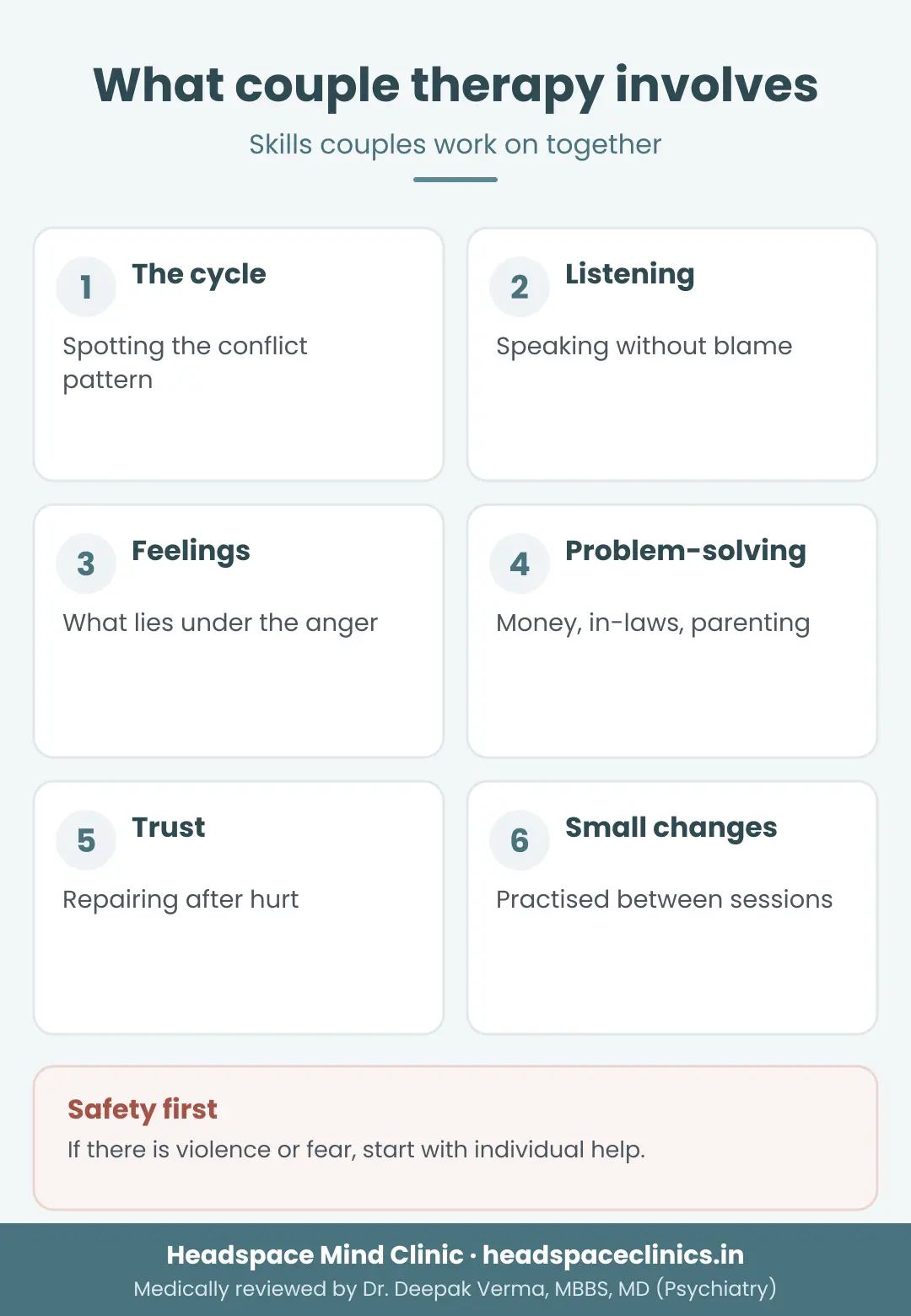
What couple therapy involves. Tap the image to enlarge.
Who couple therapy can help
Couples come to therapy for many reasons, for example:
- frequent arguments, or long silences and distance
- difficulty communicating, feeling unheard or criticised
- trust problems, including after an affair
- stress from in-laws, joint family living, finances or work
- differences over parenting
- adjusting to marriage, a new baby, illness or other life changes
- sexual difficulties, often alongside assessment of sexual problems
- when one partner has depression, anxiety or an alcohol or drug problem that affects the relationship
When couple therapy is not the right first step: if there is violence, threats or fear of your partner, joint sessions can be unsafe. Your safety comes first: speak to a professional on your own, and in an emergency call 112 or the Women Helpline 181.
Why couple therapy can help
Couples often get stuck in a cycle: one partner pursues or criticises, the other withdraws, and each reaction makes the other worse. A therapist helps you both see the cycle instead of blaming each other, and practise new ways of responding. Our psychologists draw on evidence-based approaches such as cognitive behavioural couple work and emotion-focused methods. Related pages:
Working with the wider family
Individual talking therapy
Changing unhelpful patterns
Support through a hard period
When low mood affects the relationship
When drinking or drugs are involved
What to expect from couple therapy
A typical course of sessions.
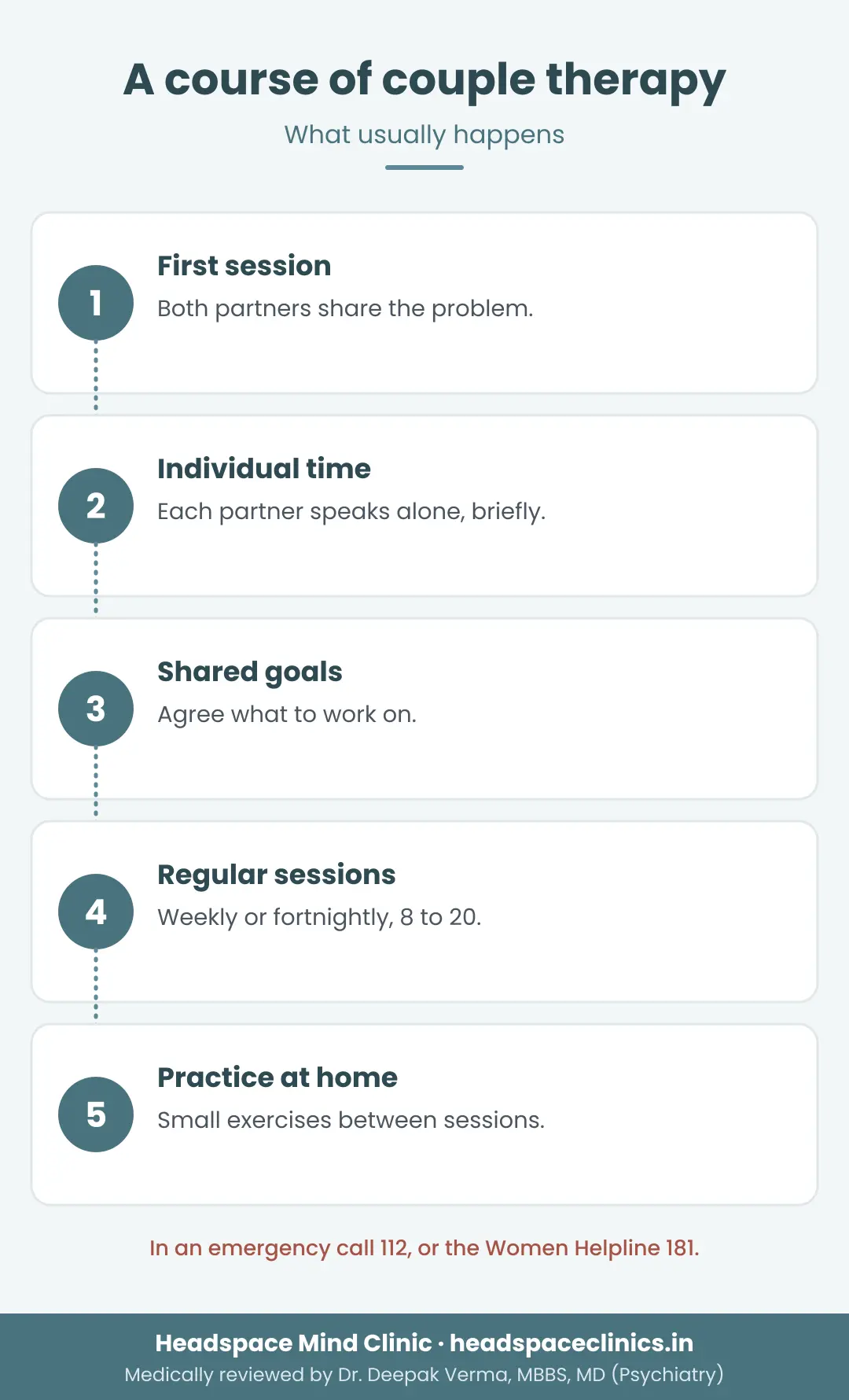
A course of couple therapy. Tap the image to enlarge.
First session. Both partners meet the psychologist to describe what is going wrong and what each hopes will change.
Individual time. Often each partner has a short session alone, so both can speak freely, including about safety.
Shared goals. Together you agree what you want to work on.
Regular sessions. Usually weekly or every two weeks, around 50 to 60 minutes each. Many couples attend for 8 to 20 sessions, depending on the difficulties.
Practice at home. Small exercises between sessions help new habits stick.
If one partner also needs treatment for depression, anxiety or addiction, our psychiatrist can see them alongside the couple work.
Is couple therapy right for us?
Couple therapy works best when both partners are willing to attend and want to understand their part in the pattern. It can help even if you are unsure about the future of the relationship; some couples use it to separate more calmly, especially when children are involved.
If only one partner is willing to come, individual sessions can still help you understand the relationship and decide on next steps.
Couple therapy at Headspace Mind Clinic
Couple sessions are offered by our RCI-registered clinical psychologists, including Dr. Tanuja Bhardwaj and Surmeet Kaur, at all three of our clinics. Sessions are confidential.
- Assessment to find the right approach for you
- Sessions with our clinical psychologists
- Medicines, when needed, prescribed and reviewed by our psychiatrist
- Video sessions for existing clients
कपल थेरेपी क्या है? (Couple therapy in Hindi)
कपल थेरेपी या मैरिज काउंसलिंग में पति-पत्नी या पार्टनर साथ बैठकर बार-बार होने वाले झगड़ों का पैटर्न समझते हैं, बेहतर बातचीत करना सीखते हैं और भरोसा दोबारा बनाते हैं। अगर रिश्ते में हिंसा या डर है, तो पहले अकेले में किसी विशेषज्ञ से बात करें; आपात स्थिति में 112 या महिला हेल्पलाइन 181 पर कॉल करें। यह जानकारी केवल शिक्षा के लिए है। अपॉइंटमेंट के लिए कॉल करें: +91 99711 66040

Founder of Headspace Mind Clinic. Dr. Verma sees patients at our Paschim Vihar, Rohini and Narela clinics. About our psychiatry service →
Three clinics in West and North Delhi
Psychiatrist consultation fee: ₹1,800 at Paschim Vihar and Rohini, ₹500 at Narela. All appointments are scheduled; please call or book online.
Frequently asked questions
No. It is for any couple in a committed relationship, married or not, and at any stage, including before marriage.
You can start with individual sessions. Understanding your own reactions can still change the pattern, and some partners join later.
No. The psychologist’s job is to help both of you understand the pattern between you, not to judge who is right.
It varies. Many couples notice change within a few sessions, and a typical course is about 8 to 20 sessions.
Yes, within the usual limits of safety. The psychologist will explain at the start how information shared in individual sessions is handled.
Yes. Couple therapy can support recovery, usually alongside individual treatment for the person who is unwell.
Related symptom guides
Explore other treatments
PsychotherapyCognitive behavioural therapy (CBT)Dialectical behaviour therapy (DBT)Exposure and response prevention (ERP)Family therapyBehaviour therapyMindfulness therapySupportive therapyClinical psychologist in DelhiPsychological assessmentsNeuromodulation (rTMS, tDCS)rTMS for depressionrTMS for OCDrTMS for anxietyAntidepressants explainedDepression medication guideAnti-anxiety medicinesAnxiety medication guide
Book a consultation
Choose your preferred clinic and our team will call you to confirm a time. This form is for appointments only; please do not use it in an emergency.
References
- Roddy MK, Walsh LM, Rothman K, Hatch SG, Doss BD. Meta-analysis of couple therapy: effects across outcomes, designs, timeframes, and other moderators. Journal of Consulting and Clinical Psychology. 2020;88(7):583–596.
- Lebow JL, Chambers AL, Christensen A, Johnson SM. Research on the treatment of couple distress. Journal of Marital and Family Therapy. 2012;38(1):145–168.
- National Institute for Health and Care Excellence (NICE). Depression in adults: treatment and management (NG222). nice.org.uk
- Tele-MANAS, National Tele Mental Health Programme, Ministry of Health and Family Welfare, Government of India. Helpline 14416.
Medically reviewed by Dr. Deepak Verma (MBBS, MD Psychiatry; DMC Reg. No. 37616). Last reviewed: 15 November 2026.
Medical disclaimer. The information on this page is provided for general educational purposes only. It is not medical advice and is not intended to diagnose, treat, cure or prevent any condition. Reading this page or using the self-check does not create a doctor–patient relationship with Dr. Deepak Verma or Headspace Mind Clinic. Please consult a qualified doctor about any symptom, diagnosis or treatment, and do not start, stop or change any medicine without talking to the doctor who prescribed it. Do not ignore professional advice, or delay seeking it, because of something you have read here. Symptoms, causes and responses to treatment differ from person to person, and no particular result is promised. Links to other websites are given for reference only, and we are not responsible for their content. If you think you or someone else may be facing a medical or mental health emergency, call 112, call Tele-MANAS on 14416 (free, 24×7) or go to the nearest hospital emergency department.