

Family Therapy in Delhi: Support for Healthier Family Relationships
Family relationships can be a source of emotional support, belonging and stability. However disagreements, communication difficulties, changing responsibilities, parenting challenges and stressful life events can sometimes create tension within a family.
When misunderstandings continue or conflicts become difficult to resolve family members may find it challenging to communicate understand each others perspectives or work together towards solutions.
Family therapy is a form of intervention that helps family members explore relationship patterns improve communication and develop healthier ways of responding to difficulties. Than focusing only on one individual family therapy considers how interactions between family members may contribute to or help resolve a concern.
At Headspace Mind Clinic, individuals interested in family therapy can enquire about psychological services and the appropriate next step for their circumstances. The suitability of family therapy depends on the concerns involved the needs of the participants and clinical assessment.
If your family is experiencing disagreements, communication problems, parenting concerns or difficulties adjusting to a major life change professional support may help you understand the situation and explore constructive ways forward.
Looking for family therapy in Delhi? Contact Headspace Mind Clinic to enquire about services, appointment arrangements and whether family therapy may be appropriate for your needs.
What is family therapy?
Family therapy is a form of psychological treatment that focuses on relationships, communication, interaction patterns, and the shared challenges experienced by family members.
A family may seek therapy because of frequent arguments, parenting difficulties, emotional distance, adjustment problems, or the impact of a member’s mental health concerns on the household.
Family therapy does not assume that one person is responsible for every difficulty. Instead, the therapist helps participants explore different perspectives, understand recurring patterns, and identify practical ways to improve interactions.
Depending on the family’s needs, sessions may involve several family members together, selected participants, or individual meetings as part of an agreed treatment process.
Key principles of family therapy
- Understanding relationship patterns: Exploring how family members communicate and respond to one another.
- Improving communication: Practising clearer, more respectful ways of expressing concerns and listening.
- Recognising different perspectives: Understanding that people may experience the same situation differently.
- Developing practical solutions: Identifying realistic steps that family members can work towards together.
- Supporting healthy boundaries: Clarifying expectations, responsibilities, privacy, and individual needs.
- Building collaboration: Helping participants work towards agreed goals without requiring everyone to have identical opinions.
Family therapy is not about deciding who is right or wrong. Its purpose is to understand the difficulties, improve constructive interaction, and support healthier family functioning.
When Should a Family Consider Therapy?
Families do not need to wait until a relationship reaches a crisis before seeking support. Therapy may be considered when a recurring concern causes distress, affects daily life, or becomes difficult to manage independently.
Frequent arguments and unresolved conflicts

Repeated disagreements about household responsibilities, finances, family decisions, or personal expectations can create frustration and resentment.
Family therapy may help participants identify what repeatedly triggers conflict, communicate their concerns more effectively, and develop fairer approaches to resolving disagreements.
Communication difficulties

Some families struggle to discuss emotions or sensitive topics without arguments. Others avoid difficult conversations until frustration builds.
A therapist can help family members practise active listening, express feelings more clearly, and respond to differences without escalating the discussion.
Parenting challenges

Parents and caregivers may disagree about discipline, routines, screen time, academic expectations, independence, or behavioural concerns.
Family therapy can help clarify expectations, strengthen cooperation between caregivers, and develop consistent approaches that consider the child’s developmental needs.
Adolescent behavioural or emotional concerns
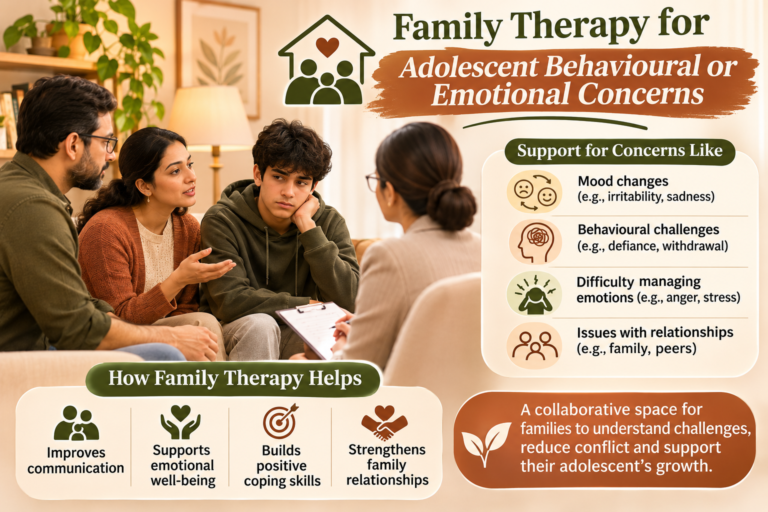
Adolescence often brings changes in independence, friendships, emotional expression, and family responsibilities. Differences between parents and teenagers can sometimes lead to repeated conflict.
Family sessions may provide a structured environment in which adolescents and caregivers can discuss concerns, establish appropriate boundaries, and improve mutual understanding.
Where a young person’s mental health symptoms are a major concern, individual assessment may also be needed.
Major family transitions

Events such as relocation, separation, remarriage, bereavement, a new baby, or changes in caregiving responsibilities can affect family relationships.
Therapy may help family members adapt to changing roles, express concerns, and develop realistic expectations during a transition.
Mental health difficulties affecting the family

When a family member experiences depression, anxiety, substance-related difficulties, or another mental health concern, other members may feel worried, confused, overwhelmed, or unsure how to help.
Family therapy may improve understanding, communication, and supportive responses. It does not replace an appropriate individual assessment or other recommended treatment.
Emotional distance and reduced trust
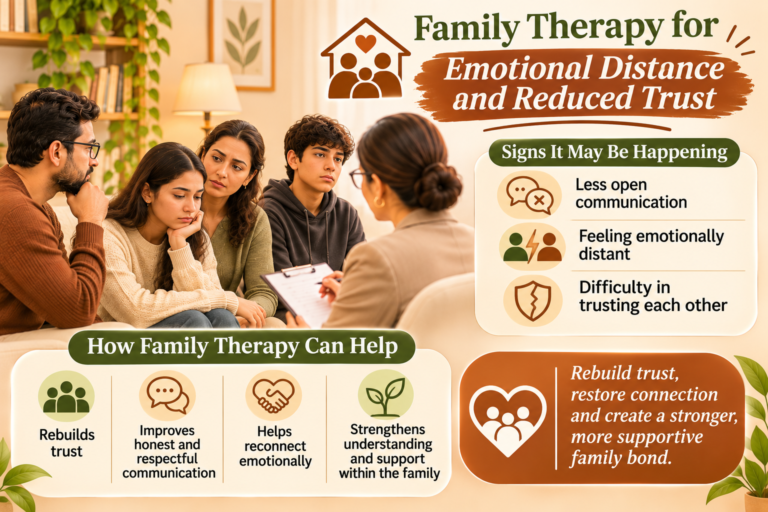
Some families experience less communication, ongoing resentment, or a sense of disconnection. Family therapy may help participants explore the factors contributing to distance and consider whether rebuilding connection is a shared goal.
The therapist’s role is to facilitate a constructive process, not to force reconciliation or require family members to remain in an unhealthy relationship.
How Does Family Therapy Work?
Initial Discussion and Assessment
The therapist explores the reasons for seeking help, the family's concerns, relevant relationship patterns, and the impact of the difficulties on everyday life.
Participants may be invited to describe their experiences and expectations. The therapist may also clarify who will attend sessions and whether individual meetings or additional assessments are appropriate.
Identifying Recurring Interaction Patterns
The therapist helps family members notice how conversations and reactions unfold.
For example, one person may repeatedly ask questions because they feel worried, while another may withdraw because they feel criticised. This withdrawal may increase the first person's worry, leading to more questioning and further withdrawal.
Understanding this pattern can help family members consider alternative responses rather than repeating the same cycle.
Setting Shared Goals
Goals depend on the family's needs and may include reducing the intensity of arguments, improving parent-child communication, agreeing on household responsibilities, or managing a family transition.
Not every family member needs to want exactly the same outcome. The therapist can help clarify individual concerns and identify realistic areas for constructive work.
Learning Communication and Problem-Solving Skills
Sessions may involve practising:
• Active listening
• Expressing needs without blame
• Recognising emotional triggers
• Setting boundaries
• Discussing disagreements more productively
The therapist may also help family members identify assumptions that contribute to misunderstandings.
Practising Changes at Home
Families may be encouraged to try specific strategies between sessions, such as scheduling a calm discussion, clarifying responsibilities, or using agreed approaches to resolve disagreements.
These activities should be realistic and suitable for the family's circumstances.
Reviewing Progress
The therapist and family review what has changed, which strategies have been helpful, and where difficulties remain.
The treatment plan may be adjusted as relationships, circumstances, and goals evolve.
Common Approaches Used in Family Therapy
Family therapy is not a single technique. Different therapeutic approaches may be used according to the family's concerns and the professional's training.
Systemic Family Therapy
Explores how family relationships, roles, expectations, and communication patterns interact. The focus is on understanding the wider relationship system rather than viewing a difficulty in isolation.
Structural Family Therapy
Explores family organisation, boundaries, roles, and patterns of interaction. It may be relevant when responsibilities or boundaries have become unclear or when family relationships need greater structure.
Communication-Focused Interventions
Help participants practise listening, express concerns more clearly, clarify misunderstandings, and discuss disagreements without unnecessary escalation.
Problem-Solving Approaches
Family members may work together to define a specific problem, consider possible solutions, agree on responsibilities, and review whether the plan is working.
Psychoeducation
When relevant, the therapist may provide information about mental health concerns, child development, stress responses, or ways family members can offer appropriate support.
Choosing the right approach: The specific methods used should be based on the assessment and the family's needs. Not every approach is suitable for every situation.
Family Therapy for Parenting and Child-Related Concerns
Family therapy is not a technique. Different therapeutic approaches may be used according to the familys concerns and the professionals training
Different therapeutic approaches may be used to explore family relationships, understand interaction patterns and address concerns together.
Systemic Family Therapy
Systemic approaches explore how family relationships, roles, expectations and communication patterns interact. The focus is on understanding the relationship system rather than viewing a difficulty in isolation.
Structural Family Therapy
This approach explores family organisation, boundaries, roles and patterns of interaction. It may be relevant when responsibilities or boundaries have become unclear or when family relationships need structure.
Communication-Focused Interventions
These interventions help participants practise listening, express concerns clearly, clarify misunderstandings and discuss disagreements without unnecessary escalation.
Problem-Solving Approaches
Family members may work together to define a problem, consider possible solutions, agree on responsibilities and review whether the plan is working.
Psychoeducation
When relevant, the therapist may provide information about health concerns, child development, stress responses or ways family members can offer appropriate support.
Choosing the right approach: The specific methods used should be based on the assessment and the family's needs. Not every approach is suitable for every situation.
Family Therapy When Mental Health Is a Concern
Family relationships can influence how children and adolescents experience support, expectations, routines and conflict. When difficulties arise it may be helpful to consider both the persons needs and the wider family environment.
● Family therapy may support families dealing with:
● Parent-child communication difficulties.
● Disagreements about discipline and household rules.
● Challenges related to independence and age-appropriate boundaries.
● Adjustment to school, relocation or other major transitions.
● Stress related to a childs behavioural difficulties.
● Differences between caregivers about parenting approaches.
The therapist may help caregivers develop expectations listen to the childs perspective and respond to concerns in developmentally appropriate ways.
However family therapy is not a substitute, for child or adolescent assessment when significant symptoms are present. A young person may need psychological care, psychiatric evaluation, educational support or a combination of services.
Children should be included in a way that respects their age, understanding, privacy and wellbeing
What Happens During a Family Therapy Session?
A session usually provides a structured space for participants to discuss concerns and practise different ways of interacting.
A session may involve:
1. Reviewing current concerns: Discussing recent events and the issues that have brought the family to therapy.
2. Listening to different perspectives: Allowing participants to describe their experiences and needs.
3. Exploring interaction patterns: Identifying recurring misunderstandings, emotional triggers, or communication difficulties.
4. Practising new skills: Working on listening, respectful expression, boundaries, or collaborative problem-solving.
5. Agreeing on next steps: Identifying practical changes to try before the next appointment.
The therapist should work to maintain a respectful and appropriately structured discussion. This does not mean that disagreements will disappear immediately or that everyone will agree on every issue.
Some discussions may feel uncomfortable, particularly when participants have different experiences of the same event. The therapist can help manage the conversation and determine whether a joint session remains appropriate.
How Many Family Therapy Sessions Are Needed?
There is no number of sessions that works for every family.
The time needed depends on what the problem’s how long it has been going on how many people are involved, what the family wants to achieve and how much progress is made during therapy. Some families come for help with one problem while others may need more time to work on long-term issues or several problems at once. The therapist can talk about what goalsre likely and check how things are going during the process. The number and length of sessions should be confirmed directly with the service provider. Be careful of promises that a certain number of sessions will fix everything. Results. The goal might be better communication, healthier limits, more cooperation or clearer decisions instead of everyone agreeing
Family Therapy vs Couples Therapy vs Individual Therapy
Different Types of Therapy
These forms of psychological treatment have different primary focuses, although they may sometimes be used together.
Family Therapy
Relationship patterns and communication among family members.
Couples Therapy
Relationship difficulties, communication, and shared goals between partners.
Individual Therapy
One person's emotional, behavioural, or psychological concerns.
Parent-Focused Support
Parenting strategies, child development, and caregiver responses.
Family therapy may include parents, children, siblings, caregivers, or other relevant family members, depending on the concern and the agreed treatment plan.
Couples therapy generally focuses on the relationship between partners. Individual therapy offers a private setting to work on personal concerns.
A qualified professional can help determine which approach is most appropriate. In some situations, more than one form of support may be useful.
Is Family Therapy Suitable for Every Family?
Family therapy can be helpful in situations but it is not the right choice for every situation or every person.
The therapist should think about what the problem’s how willing each person is to take part any mental health issues, privacy and the safety of everyone involved. If there is abuse, controlling behavior, fear or a serious risk of harm group meetings might not be safe. Safety should be the important thing and a proper check by a specialist should be done before any group meeting. No one should be forced to be in a meeting with someone they’re afraid of. Family therapy also cannot promise that relationships will get better. In some cases the best result might be limits, safer communication or decisions about how to be together. A professional check can help decide if family therapy is suitable and what steps should be taken

Choosing a Family Therapist in Delhi
When looking for family therapy in Delhi, consider the following factors:
● Professional qualifications: Check the therapist’s recognised qualifications, registration where applicable, and scope of practice.
● Relevant experience: Ask whether the professional has experience with the type of family concern you wish to address.
● Clear treatment goals: The therapist should explain how goals will be developed and reviewed.
● Respectful facilitation: Family members should be treated fairly, without assumptions about who is responsible for the problem.
● Confidentiality: Ask how privacy is handled when several family members participate, including the limits of confidentiality and the use of individual
● Practical arrangements: Confirm fees, appointment availability, session format, and cancellation policies before beginning.
It is reasonable to ask questions about the process before committing to therapy. A good fit includes clear communication, appropriate professional boundaries, and a treatment approach that reflects the family’s needs.
Family therapy at Headspace Mind Clinic
Headspace Mind Clinic provides mental health services in Delhi. Families interested in relationship-focused psychological support can enquire about current family therapy availability, the appropriate professional, and the appointment process.
The service options and suitability of treatment should be confirmed directly with the clinic. Do not assume that every therapy type is available at every branch.
Contact Headspace Mind Clinic to enquire about family therapy services in Delhi.
Frequently Asked Questions About Family Therapy
Frequently Asked Questions About Family Therapy
Find answers to common questions about the purpose, process, and suitability of family therapy.
⌂ What is the purpose of family therapy?
Family therapy helps family members understand relationship patterns, improve communication, manage disagreements, and work towards agreed goals. The focus depends on the concerns and needs of the participants.
♡ Can family therapy help with frequent arguments?
It may help families identify recurring conflict patterns, express concerns more constructively, and develop problem-solving strategies. Results vary, and progress depends on the circumstances and treatment goals.
♧ Do all family members have to attend?
Not necessarily. The participants depend on the concern, the therapist's approach, and clinical assessment. The therapist can explain who should attend and whether individual meetings may be appropriate.
✿ Can family therapy help parents and teenagers?
Family therapy may help parents and teenagers discuss disagreements, establish appropriate boundaries, and improve communication. Where significant emotional, behavioural, or developmental concerns are present, individual assessment may also be needed.
⇄ Is family therapy the same as couples counselling?
No. Family therapy focuses on family relationships and interaction patterns, while couples counselling primarily focuses on the relationship between partners. A clinician can help determine which approach best fits the situation.
◷ How long does family therapy take?
The number of sessions varies according to the family's goals, the complexity of the concerns, and progress during treatment. A therapist can discuss a treatment plan after assessing the situation.
◇ Is family therapy confidential?
Therapists should explain confidentiality, its limits, and how information is handled when several people participate. Ask how individual disclosures are managed before starting sessions, particularly if family members attend separately.
! Is family therapy suitable when there is abuse or fear within the family?
Joint family therapy may be unsafe when there is violence, coercion, intimidation, or a serious risk of harm. Safety should come first, and an appropriate professional should assess the situation before joint sessions are considered.
✉ How can I enquire about family therapy at Headspace Mind Clinic?
Contact Headspace Mind Clinic to confirm whether family therapy is currently available, which professional provides it, the fees, and appointment arrangements.
Take the Next Step Towards Healthier Family Relationships
Family difficulties can be emotionally exhausting, particularly when the same disagreements happen repeatedly or communication becomes increasingly difficult.
Family therapy offers a structured opportunity to understand different perspectives, identify unhelpful interaction patterns, and explore healthier ways of responding to challenges. The aim is not to make every family member think alike, but to work towards more constructive communication and realistic goals.
If your family is considering professional support, begin by discussing your concerns with a qualified mental health professional.
Enquire about family therapy at Headspace Mind Clinic in Delhi. Confirm current service availability, fees, the relevant professional, and appointment options directly with the clinic.
Explore other treatments
PsychotherapyCognitive behavioural therapy (CBT)Dialectical behaviour therapy (DBT)Exposure and response prevention (ERP)Behaviour therapyClinical psychologist in DelhiPsychological assessmentsNeuromodulation (rTMS, tDCS)Antidepressants explainedDepression medication guideAnti-anxiety medicinesAnxiety medication guide