
rTMS for OCD that has not improved enough with standard treatment
rTMS uses magnetic pulses from a coil placed on the head to change activity in brain circuits linked to obsessions and compulsions. It is non-invasive, you stay awake, and no anaesthesia is needed.
The first-line treatments for OCD remain exposure and response prevention (ERP) and SSRI medicines. rTMS may be considered as an add-on for OCD that has not improved enough with these, and controlled trials support this use. At Headspace Mind Clinic, rTMS is available at our Paschim Vihar clinic after a psychiatric assessment.
For education only. This page explains a treatment in general terms. It is not medical advice and cannot replace a consultation with a qualified doctor who knows your history. Whether a treatment suits you can only be decided after an assessment. If you are in danger or think you may harm yourself, call 112 or Tele-MANAS 14416 now.
How rTMS works in OCD
OCD is linked with over-activity in circuits connecting the front of the brain with deeper structures. rTMS for OCD targets areas such as the medial prefrontal and anterior cingulate cortex, or the supplementary motor area, depending on the protocol. Sessions are sometimes paired with brief, personalised symptom triggers so the circuit is active during stimulation. Key points:
- Non-invasive: a coil on the head, nothing implanted
- You are awake throughout, with no anaesthesia
- Usually given alongside ERP and medicines, not instead of them
- Sessions on most weekdays for several weeks
- You can travel and work after each session
- Progress tracked with OCD rating scales
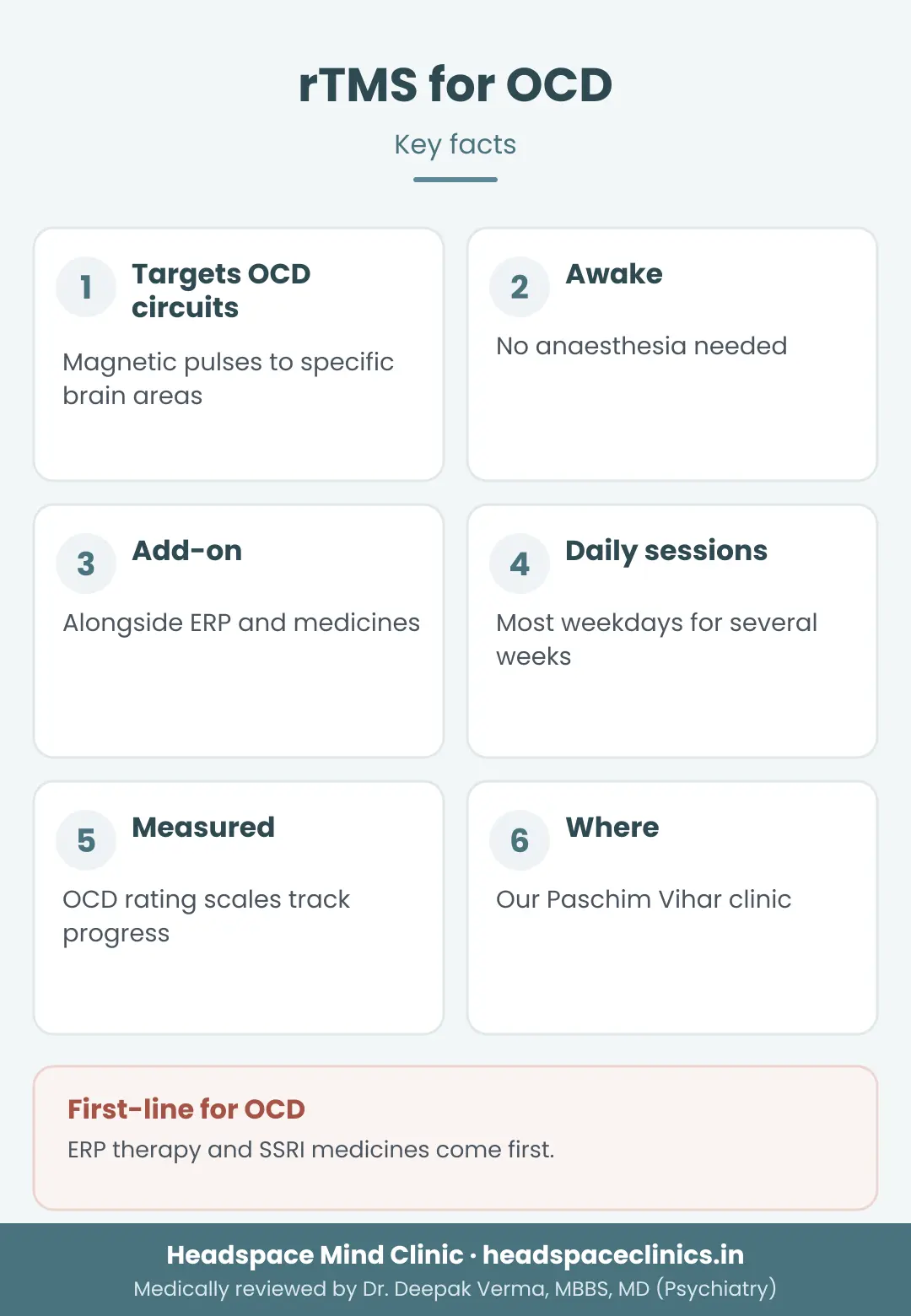
rTMS for OCD: key facts. Tap the image to enlarge.
In selected cases of OCD, I consider rTMS when symptoms remain significantly distressing despite appropriate treatment. I explain that rTMS is not a replacement for evidence-based OCD treatment such as Exposure and Response Prevention (ERP), but may be considered alongside medication and psychological therapy. The treatment plan depends on symptom severity, previous response and individual clinical assessment.
Dr. Deepak Verma, MBBS, MD (Psychiatry), Consultant Psychiatrist, Headspace Mind Clinic
Who rTMS for OCD may suit
rTMS may be considered for adults with OCD who:
- still have significant symptoms despite an adequate trial of SSRIs and ERP
- cannot tolerate effective doses of medicines
- want to add a non-medication option to their treatment plan
It is not usually the first treatment for OCD. For most people, ERP with a trained therapist and, where needed, SSRI medicines remain the starting point. Read more about OCD treatment in Delhi and ERP therapy.
What the evidence says
Randomised controlled trials, including a multicentre trial of deep TMS published in 2019, found that stimulation of OCD-related circuits reduced symptoms more than sham (placebo) treatment in people whose OCD had not responded well to standard care. Evidence-based guidelines list rTMS as a possible option for OCD, while noting that protocols vary and more research is needed. Related treatments and conditions:
Full treatment options for OCD
The leading psychological treatment for OCD
Our neuromodulation service
Brain stimulation for depression
When thoughts go round in circles
Medicines for anxiety explained
What a course of rTMS for OCD involves
Your psychiatrist will explain the plan that fits you.
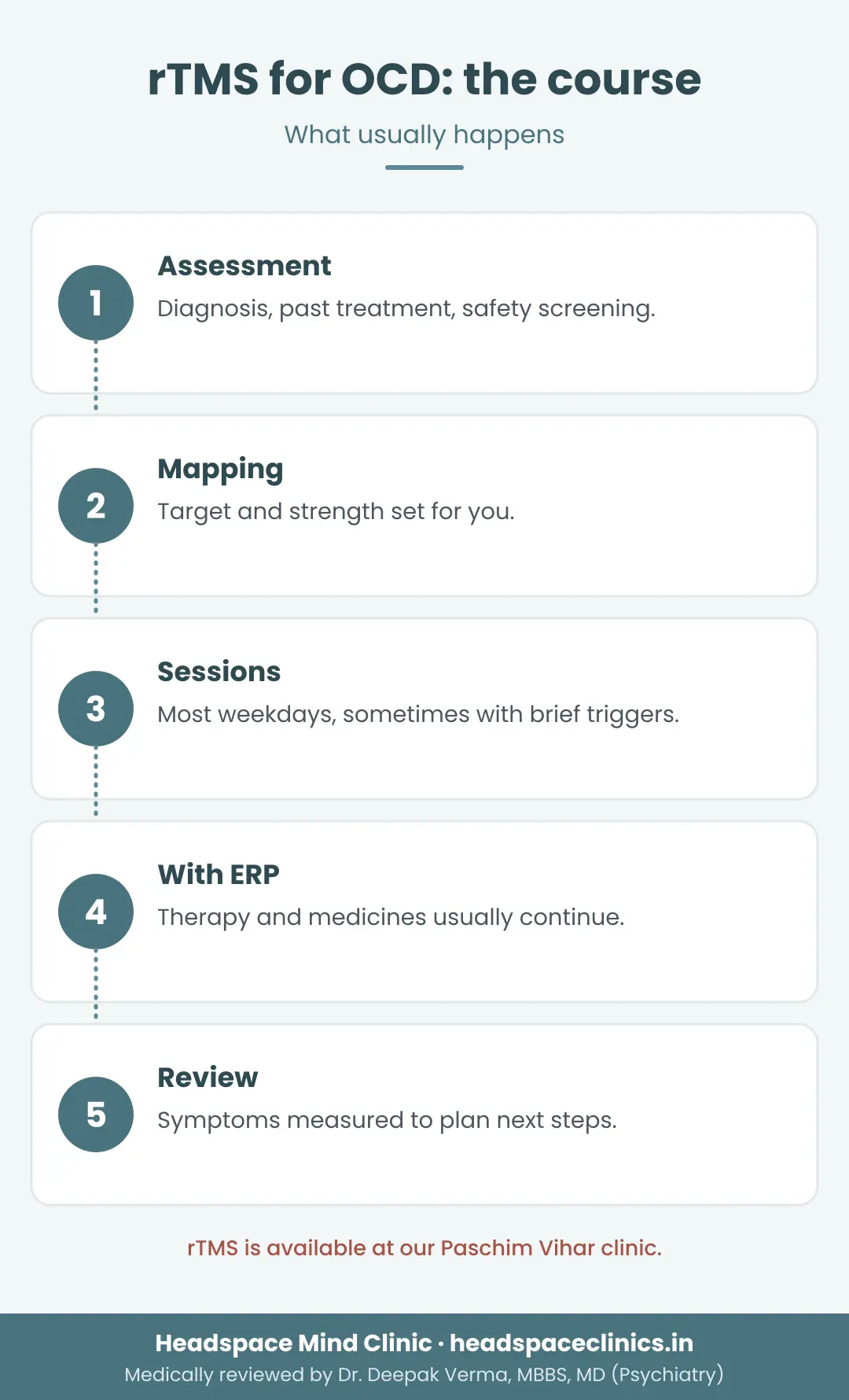
rTMS for OCD: the course. Tap the image to enlarge.
Assessment. Confirming the diagnosis, reviewing past ERP and medicines, measuring symptom severity and safety screening.
Mapping. Finding the right target and strength of stimulation for you.
Treatment course. Sessions on most weekdays for several weeks, sometimes with brief, personalised triggers before stimulation.
Alongside therapy. ERP and medicines usually continue. Combining approaches tends to work better than any single one.
Review. Symptoms are measured during and after the course to decide next steps.
Side effects and safety
Side effects are usually mild: scalp discomfort, headache and tiredness, mostly in the first week. Earplugs are used because of the clicking sound. A seizure is a very rare but serious risk, so everyone is screened first. rTMS may not be suitable for people with metal in or near the head, cochlear implants, brain stimulators, a history of seizures, or certain implanted devices.
Some people notice a temporary increase in anxiety when symptom triggers are used during sessions; this is discussed and managed with you.
Is rTMS for OCD right for me?
rTMS may be worth discussing if OCD is still affecting your life despite ERP and medicines, or if side effects have limited your treatment. The decision is made with your psychiatrist after a full assessment and safety screening.
rTMS for OCD at Headspace Mind Clinic
rTMS is provided at our Paschim Vihar clinic under the supervision of our consultant psychiatrist. Our clinical psychologists provide ERP, so stimulation, therapy and medicines can be planned together.
OCD के लिए rTMS (rTMS for OCD in Hindi)
OCD में बार-बार आने वाले अनचाहे विचार और बार-बार दोहराई जाने वाली आदतें होती हैं। rTMS में सिर पर रखी कॉइल से चुंबकीय तरंगें देकर OCD से जुड़े दिमाग़ के हिस्सों की गतिविधि बदली जाती है। यह आमतौर पर ERP थेरेपी और दवाइयों के साथ, उन मरीज़ों के लिए उपयोग होता है जिन्हें इनसे पूरा फ़ायदा नहीं मिला। rTMS हमारे पश्चिम विहार क्लिनिक में उपलब्ध है। यह जानकारी केवल शिक्षा के लिए है। अपॉइंटमेंट के लिए कॉल करें: +91 99711 66040
Founder of Headspace Mind Clinic. Dr. Verma sees patients at our Paschim Vihar, Rohini and Narela clinics. About our psychiatry service →
Three clinics in West and North Delhi
Psychiatrist consultation fee: ₹1,800 at Paschim Vihar and Rohini, ₹500 at Narela. All appointments are scheduled; please call or book online.
Frequently asked questions
No. ERP therapy and SSRI medicines are the first-line treatments. rTMS is usually considered when OCD has not improved enough with these.
Courses usually involve sessions on most weekdays for several weeks; the exact number depends on the protocol and your response.
Usually yes. rTMS tends to work best as part of a plan that includes ERP and, where needed, medicines.
Most people feel a tapping sensation on the scalp and hear clicking sounds. Some have mild scalp discomfort or a headache during the first few sessions, which usually settles. No anaesthesia is needed.
No. ECT uses an electric current under general anaesthesia to cause a brief seizure. rTMS uses magnetic pulses over a small area of the head, you stay awake, and you can usually go back to normal activities straight after a session.
rTMS is generally well tolerated. The most common side effects are scalp discomfort and headache. A seizure is a very rare but serious risk, which is why everyone is screened before starting. People with metal implants in or near the head, cochlear implants or certain other devices may not be suitable.
rTMS is available at our Paschim Vihar clinic. tDCS is available at Paschim Vihar and Narela. An assessment with our psychiatrist comes first.
Related symptom guides
Explore other treatments
PsychotherapyCognitive behavioural therapy (CBT)Dialectical behaviour therapy (DBT)Exposure and response prevention (ERP)Family therapyBehaviour therapyMindfulness therapySupportive therapyClinical psychologist in DelhiPsychological assessmentsNeuromodulation (rTMS, tDCS)rTMS for depressionrTMS for anxietyAntidepressants explainedDepression medication guideAnti-anxiety medicinesAnxiety medication guide
Book a consultation
Choose your preferred clinic and our team will call you to confirm a time. This form is for appointments only; please do not use it in an emergency.
References
- Carmi L, Tendler A, Bystritsky A, et al. Efficacy and safety of deep transcranial magnetic stimulation for obsessive-compulsive disorder: a prospective multicenter randomized double-blind placebo-controlled trial. American Journal of Psychiatry. 2019;176(11):931–938.
- Lefaucheur JP, Aleman A, Baeken C, et al. Evidence-based guidelines on the therapeutic use of repetitive transcranial magnetic stimulation (rTMS): an update (2014–2018). Clinical Neurophysiology. 2020;131(2):474–528.
- Rossi S, Antal A, Bestmann S, et al. Safety and recommendations for TMS use in healthy subjects and patient populations, with updates on training, ethical and regulatory issues: expert guidelines. Clinical Neurophysiology. 2021;132(1):269–306.
- World Health Organization. International Classification of Diseases, 11th Revision (ICD-11). icd.who.int: 6B20 Obsessive-compulsive disorder.
- Tele-MANAS, National Tele Mental Health Programme, Ministry of Health and Family Welfare, Government of India. Helpline 14416.
Medically reviewed by Dr. Deepak Verma (MBBS, MD Psychiatry; DMC Reg. No. 37616). Last reviewed: 15 November 2026.
Medical disclaimer. The information on this page is provided for general educational purposes only. It is not medical advice and is not intended to diagnose, treat, cure or prevent any condition. Reading this page or using the self-check does not create a doctor–patient relationship with Dr. Deepak Verma or Headspace Mind Clinic. Please consult a qualified doctor about any symptom, diagnosis or treatment, and do not start, stop or change any medicine without talking to the doctor who prescribed it. Do not ignore professional advice, or delay seeking it, because of something you have read here. Symptoms, causes and responses to treatment differ from person to person, and no particular result is promised. Links to other websites are given for reference only, and we are not responsible for their content. If you think you or someone else may be facing a medical or mental health emergency, call 112, call Tele-MANAS on 14416 (free, 24×7) or go to the nearest hospital emergency department.