
rTMS for anxiety: a careful look at when it may help
rTMS is an established treatment for depression and is used for OCD. For anxiety disorders such as generalised anxiety disorder, research is promising but still developing, and rTMS is not a first-line treatment.
It may be considered in selected cases, most often when anxiety comes with depression that has not responded to medicines, or when anxiety has not improved with well-delivered CBT and medicines. The first steps for most people remain CBT and, where needed, medicines. At Headspace Mind Clinic, rTMS is available at our Paschim Vihar clinic after a psychiatric assessment.
For education only. This page explains a treatment in general terms. It is not medical advice and cannot replace a consultation with a qualified doctor who knows your history. Whether a treatment suits you can only be decided after an assessment. If you are in danger or think you may harm yourself, call 112 or Tele-MANAS 14416 now.
What we know about rTMS for anxiety
We want to be clear about where the evidence stands:
- Strong evidence: rTMS for major depression
- Good evidence: rTMS as an add-on for OCD
- Promising but limited: rTMS for generalised anxiety, PTSD and panic
- Often helps anxiety symptoms that come with depression
- Protocols for anxiety are still being refined
- Not a replacement for CBT and medicines
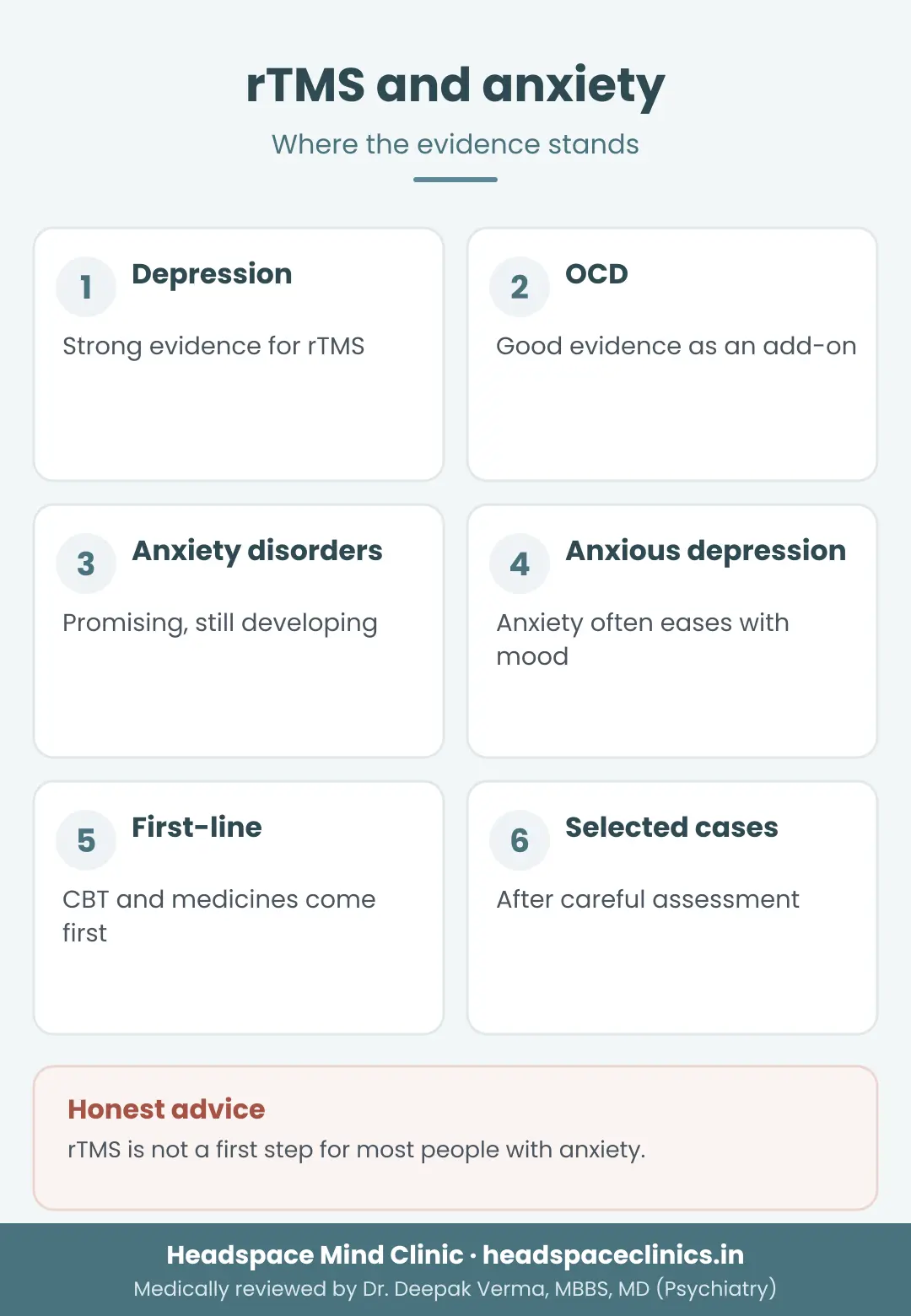
rTMS and anxiety: where the evidence stands. Tap the image to enlarge.

I am careful about recommending rTMS simply because someone experiences anxiety. Anxiety can arise from several different conditions, and rTMS is not an established first-line treatment for every anxiety disorder. My first step is to identify the underlying diagnosis and consider established treatments such as psychological therapy and medication where appropriate. rTMS may be discussed in selected situations based on the clinical profile and available evidence.
Dr. Deepak Verma, MBBS, MD (Psychiatry), Consultant Psychiatrist, Headspace Mind Clinic
When rTMS may be considered for anxiety
A meta-analysis of controlled trials found that rTMS reduced anxiety symptoms compared with sham treatment in anxiety and trauma-related disorders, but the studies were small and varied in method. Because of this, rTMS for anxiety is usually considered only in specific situations:
- Anxiety with depression (anxious depression) that has not responded to antidepressants
- Anxiety that has not improved after well-delivered CBT and adequate medicine trials
- People who cannot tolerate medicines, after discussion of the evidence and alternatives
For panic attacks, worry and fear, start with the treatments that have the strongest evidence. See anxiety treatment in Delhi and panic disorder treatment.
Treatments with the strongest evidence for anxiety
For most anxiety problems, the treatments with the strongest evidence are cognitive behavioural therapy (CBT) and, when needed, medicines such as SSRIs. Lifestyle steps such as regular exercise, good sleep and less caffeine also help. rTMS, where considered, is added to these rather than replacing them.
Full treatment options for anxiety
The leading talking therapy for anxiety
Medicines used for anxiety
Where rTMS evidence is strongest
Symptom guide
Symptom guide
If rTMS is recommended for you
Your psychiatrist will explain the plan and the evidence.
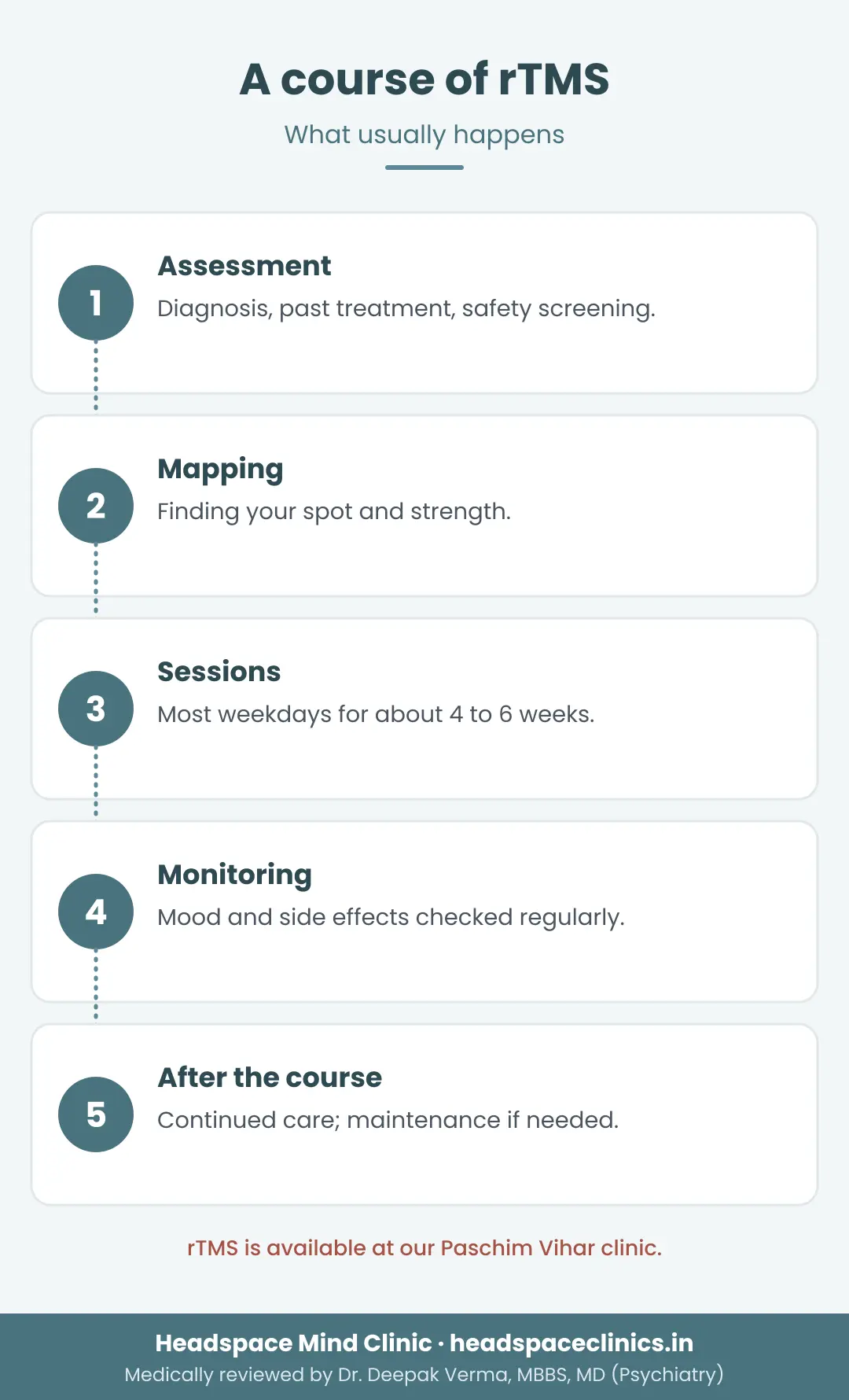
A course of rTMS. Tap the image to enlarge.
Assessment. Diagnosis, review of previous CBT and medicines, and safety screening.
Informed decision. Your psychiatrist explains the evidence, possible benefits, risks and alternatives, so you can decide.
Treatment course. Sessions on most weekdays for several weeks, at our Paschim Vihar clinic.
Monitoring. Anxiety and mood are measured regularly with rating scales.
Ongoing care. CBT and medicines usually continue alongside, and progress is reviewed at the end of the course.
Side effects and safety
rTMS is generally well tolerated. Scalp discomfort and headache are the most common side effects. Some people with anxiety feel more on edge during the first sessions, which usually settles. A seizure is a very rare but serious risk, so everyone is screened beforehand. rTMS may not be suitable for people with metal in or near the head, cochlear implants, brain stimulators, a seizure history or certain implanted devices.
Is rTMS for anxiety right for me?
rTMS may be worth discussing if you have anxiety together with depression that has not responded to treatment, or if anxiety has persisted despite CBT and medicines. For most people with anxiety, it is not the first step. Your psychiatrist will help you weigh the options.
Anxiety care at Headspace Mind Clinic
Our team offers CBT with clinical psychologists, medicines prescribed and reviewed by our psychiatrist, and rTMS at Paschim Vihar for selected patients after careful assessment.
घबराहट और चिंता के लिए rTMS (rTMS for anxiety in Hindi)
rTMS डिप्रेशन के लिए एक स्थापित इलाज है और OCD में भी उपयोग होता है। चिंता (anxiety) के लिए इस पर शोध उम्मीद जगाने वाला है, लेकिन अभी यह पहली पंक्ति का इलाज नहीं है। ज़्यादातर लोगों के लिए CBT थेरेपी और ज़रूरत पड़ने पर दवाइयाँ पहला क़दम हैं। rTMS कुछ ख़ास मामलों में, जैसे डिप्रेशन के साथ चिंता, विचार किया जा सकता है। यह जानकारी केवल शिक्षा के लिए है। अपॉइंटमेंट के लिए कॉल करें: +91 99711 66040
Founder of Headspace Mind Clinic. Dr. Verma sees patients at our Paschim Vihar, Rohini and Narela clinics. About our psychiatry service →
Three clinics in West and North Delhi
Psychiatrist consultation fee: ₹1,800 at Paschim Vihar and Rohini, ₹500 at Narela. All appointments are scheduled; please call or book online.
Frequently asked questions
rTMS is well established for depression and used for OCD. For anxiety disorders the evidence is still developing, so it is used selectively, usually when anxiety comes with depression or has not responded to standard treatment.
Usually not. CBT and, where needed, medicines have much stronger evidence for anxiety and are the recommended first steps.
Research on rTMS for panic disorder is limited. CBT for panic and medicines such as SSRIs are the established treatments.
Most people feel a tapping sensation on the scalp and hear clicking sounds. Some have mild scalp discomfort or a headache during the first few sessions, which usually settles. No anaesthesia is needed.
No. ECT uses an electric current under general anaesthesia to cause a brief seizure. rTMS uses magnetic pulses over a small area of the head, you stay awake, and you can usually go back to normal activities straight after a session.
rTMS is generally well tolerated. The most common side effects are scalp discomfort and headache. A seizure is a very rare but serious risk, which is why everyone is screened before starting. People with metal implants in or near the head, cochlear implants or certain other devices may not be suitable.
rTMS is available at our Paschim Vihar clinic. tDCS is available at Paschim Vihar and Narela. An assessment with our psychiatrist comes first.
Related symptom guides
Explore other treatments
PsychotherapyCognitive behavioural therapy (CBT)Dialectical behaviour therapy (DBT)Exposure and response prevention (ERP)Family therapyBehaviour therapyMindfulness therapySupportive therapyClinical psychologist in DelhiPsychological assessmentsNeuromodulation (rTMS, tDCS)rTMS for depressionrTMS for OCDAntidepressants explainedDepression medication guideAnti-anxiety medicinesAnxiety medication guide
Book a consultation
Choose your preferred clinic and our team will call you to confirm a time. This form is for appointments only; please do not use it in an emergency.
References
- Cirillo P, Gold AK, Nardi AE, et al. Transcranial magnetic stimulation in anxiety and trauma-related disorders: a systematic review and meta-analysis. Brain and Behavior. 2019;9(6):e01284.
- Lefaucheur JP, Aleman A, Baeken C, et al. Evidence-based guidelines on the therapeutic use of repetitive transcranial magnetic stimulation (rTMS): an update (2014–2018). Clinical Neurophysiology. 2020;131(2):474–528.
- National Institute for Health and Care Excellence (NICE). Generalised anxiety disorder and panic disorder in adults: management (CG113). nice.org.uk
- Gautam S, Jain A, Gautam M, Vahia VN, Gautam A. Clinical Practice Guidelines for the Management of Generalised Anxiety Disorder (GAD) and Panic Disorder (PD). Indian Journal of Psychiatry. 2017;59(Suppl 1):S67–S73. Indian Psychiatric Society
- Rossi S, Antal A, Bestmann S, et al. Safety and recommendations for TMS use in healthy subjects and patient populations, with updates on training, ethical and regulatory issues: expert guidelines. Clinical Neurophysiology. 2021;132(1):269–306.
- Tele-MANAS, National Tele Mental Health Programme, Ministry of Health and Family Welfare, Government of India. Helpline 14416.
Medically reviewed by Dr. Deepak Verma (MBBS, MD Psychiatry; DMC Reg. No. 37616). Last reviewed: 15 November 2026.
Medical disclaimer. The information on this page is provided for general educational purposes only. It is not medical advice and is not intended to diagnose, treat, cure or prevent any condition. Reading this page or using the self-check does not create a doctor–patient relationship with Dr. Deepak Verma or Headspace Mind Clinic. Please consult a qualified doctor about any symptom, diagnosis or treatment, and do not start, stop or change any medicine without talking to the doctor who prescribed it. Do not ignore professional advice, or delay seeking it, because of something you have read here. Symptoms, causes and responses to treatment differ from person to person, and no particular result is promised. Links to other websites are given for reference only, and we are not responsible for their content. If you think you or someone else may be facing a medical or mental health emergency, call 112, call Tele-MANAS on 14416 (free, 24×7) or go to the nearest hospital emergency department.