
How to stop overthinking, and when it points to something more
Overthinking means going over the same thoughts again and again, replaying the past or rehearsing what might go wrong, without reaching a decision. Everyone does it sometimes. It becomes a problem when you cannot switch it off and it starts to cost you sleep, peace of mind or time with people.
The habits that help most are simple: notice the loop and name it, give worries a fixed time each day, turn what you can control into one small step, and protect your sleep. If overthinking has gone on for more than two weeks or is affecting daily life, it may be linked to anxiety, depression or OCD, and these respond well to treatment.
Signs of overthinking
Overthinking usually takes one of two shapes. Rumination looks back (“Why did I say that?”). Worry looks ahead (“What if I fail the interview?”). Both feel like problem-solving while they are happening, yet they rarely end in a decision. Common signs:
- Replaying conversations or mistakes
- Picturing the worst possible outcome
- Struggling with small decisions and second-guessing them
- Lying awake with a busy mind
- Asking others for reassurance, or searching online, again and again
- Feeling mentally drained and finding it hard to focus
- Tension headaches, tight shoulders or an unsettled stomach
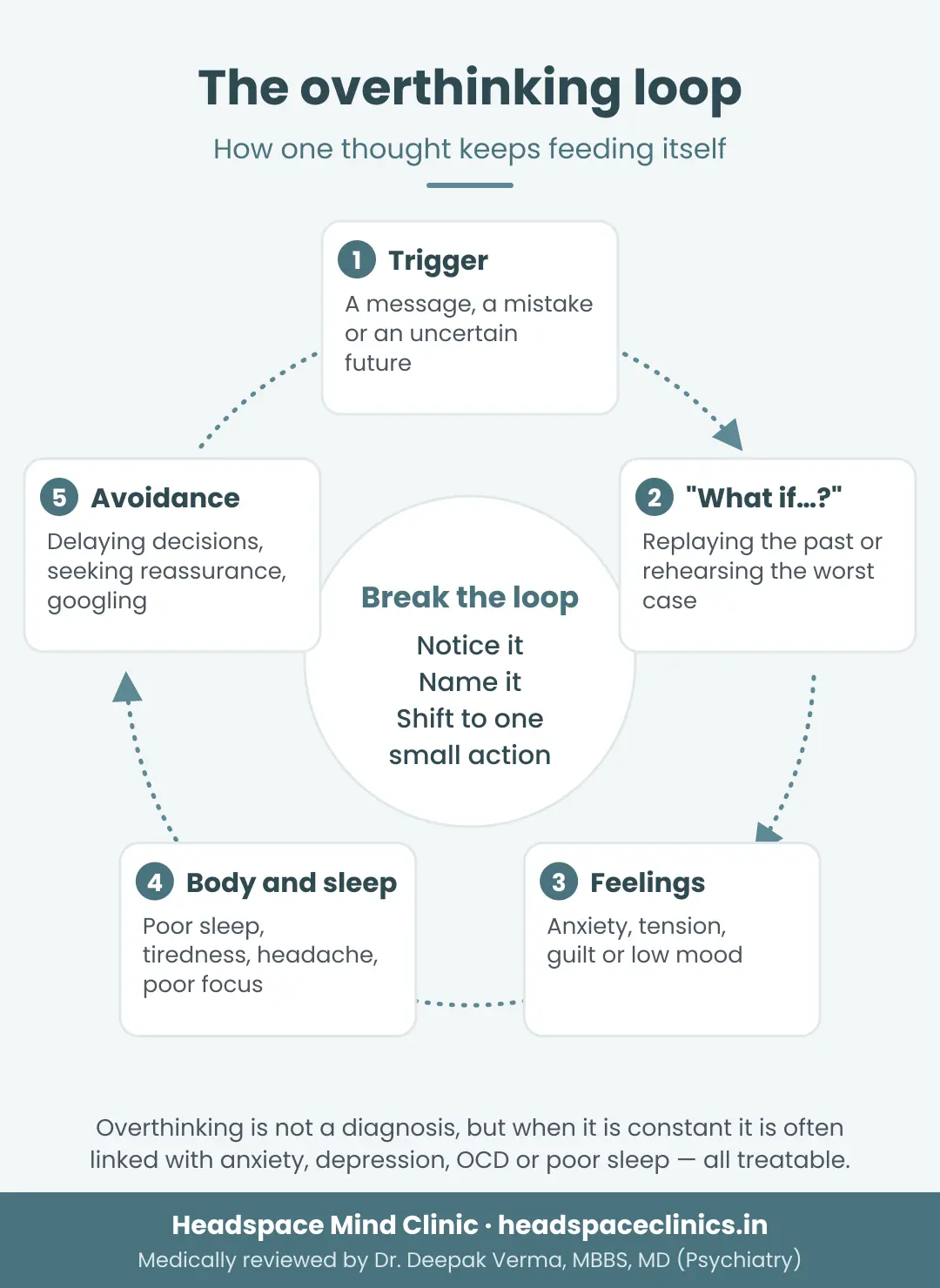
The overthinking loop: each step feeds the next. Tap the image to enlarge.

One pattern I frequently explore during consultations is overthinking that continues even when a person wants to stop. Repeatedly analysing conversations, imagining negative outcomes and struggling to switch off the mind can affect sleep, relationships and everyday functioning. The important question is not simply how much someone thinks, but how much control they feel they have over their thoughts.
Dr. Deepak Verma, MBBS, MD (Psychiatry), Consultant Psychiatrist, Headspace Mind Clinic
Being cautious or overthinking?
In Dr. Verma’s experience, many people do not see their overthinking as a problem at all. They have thought this way since childhood, so it feels like part of who they are, and they often describe it as simply being careful.
Caution is useful. It looks at a real situation, weighs the risk and leads to a decision, after which the mind settles. Overthinking can feel the same from the inside, but it keeps going after the decision is made and usually leaves you more anxious than before.
A quick test: ask yourself, “Is this thought helping me decide my next step?” If it is, you are planning. If you are going round the same ground again with no new step, you are overthinking.
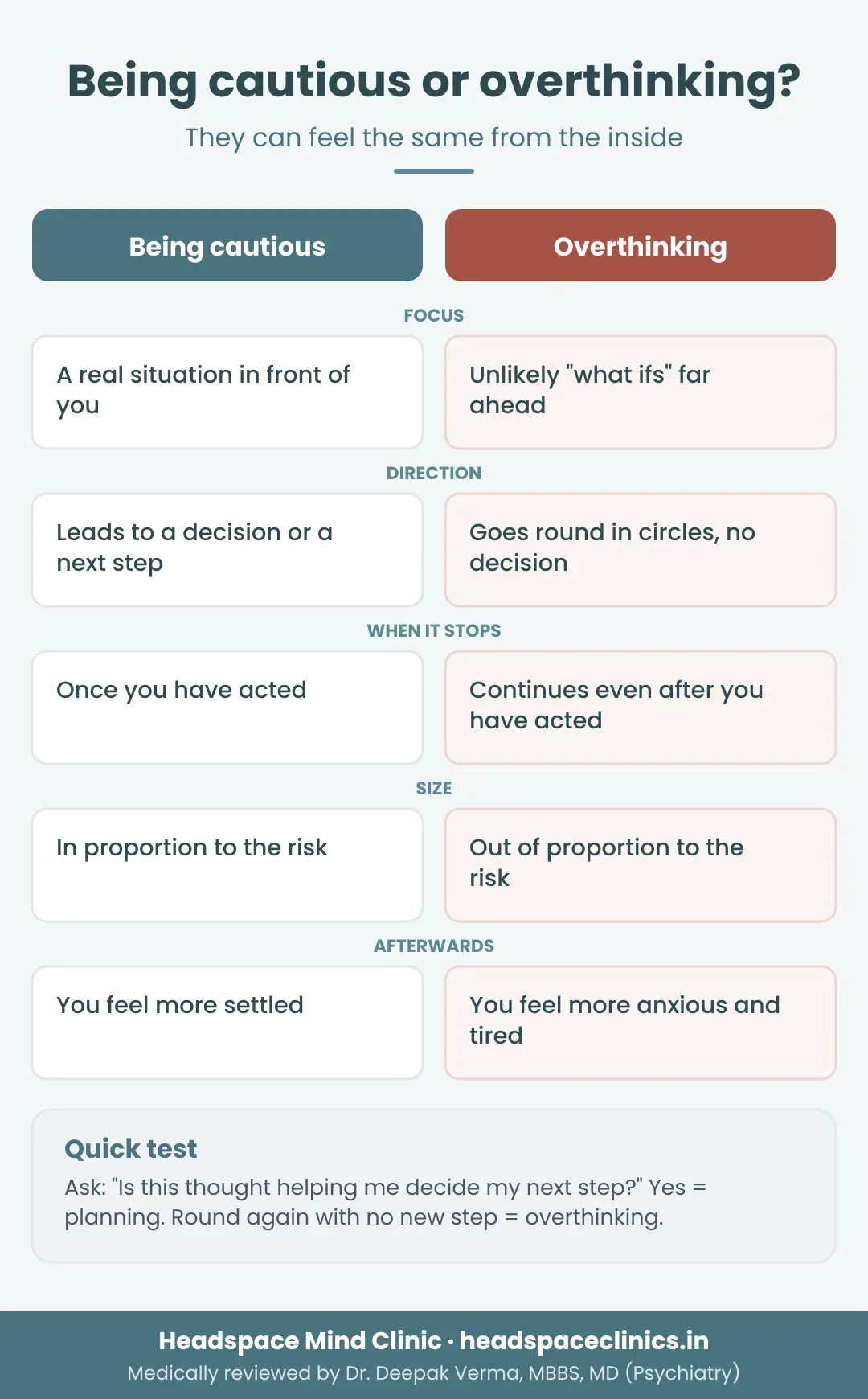
Being cautious vs overthinking. Tap the image to enlarge.
What causes overthinking?
Stress and uncertainty are the usual triggers: exams, a job change, money, a relationship under strain or a health scare. Overthinking is more likely when you are short of sleep and in people who are perfectionists or who feel responsible for how everything turns out. Some people learned early in life that thinking everything through was the way to stay safe.
Overthinking is not a diagnosis. When it is constant and hard to control, though, it is often part of a condition that can be treated:
Ongoing worry about many things, with restlessness and tension
Brooding over the past, guilt and low mood
Unwanted intrusive thoughts with checking or rituals
A racing mind at bedtime and broken sleep
A constant sense that something will go wrong
Sudden waves of fear with a racing heart
Is the internet feeding your overthinking?
Information has never been so easy to reach, and for someone who overthinks that is a mixed blessing. A single search answers one question and raises several new “what ifs”. Frightening stories are more memorable than ordinary ones, and the comfort of reading something reassuring fades quickly, so you search again. When this happens with health worries, researchers call it cyberchondria: repeated searching that leaves people more anxious, not less. Late-night news and comparing yourself with others on social media keep the mind busy in a similar way.
Things that help:
- Decide what you need to know before you search, and stop once you have it.
- Stick to one or two trusted sources instead of forums and videos.
- If you catch yourself searching the same thing again, treat that as the signal to stop and write the worry down for later.
- Keep the phone out of reach for the last hour before sleep.
- For a health worry, ask your doctor once instead of searching many times.
How to stop overthinking: 6 practical steps
Small habits practised every day weaken the loop over a few weeks.
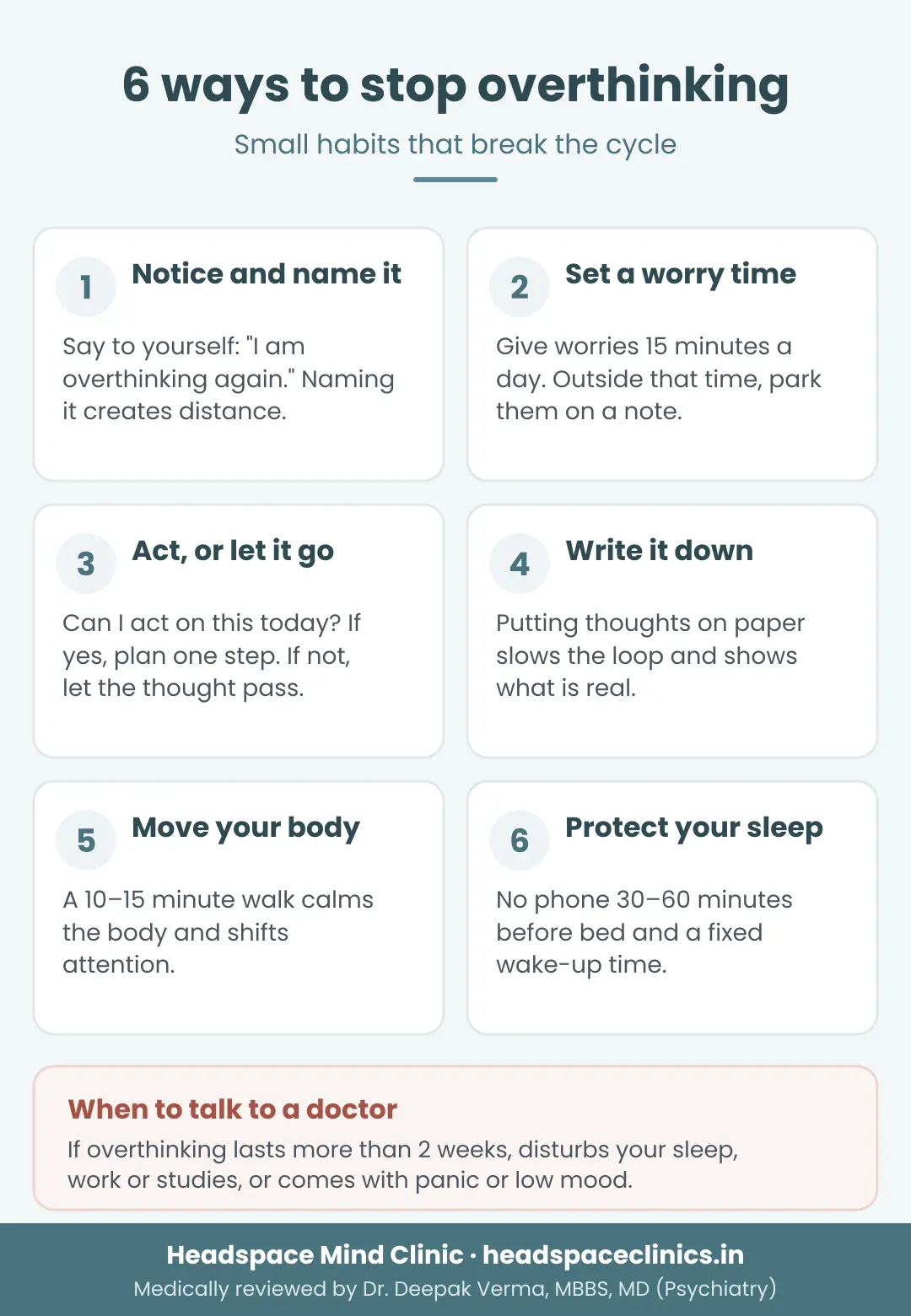
6 ways to stop overthinking. Tap the image to enlarge.
1. Notice and name it. When you catch yourself going round in circles, say “I am overthinking again.” Naming the habit puts a little distance between you and the thought.
2. Set a daily worry time. Choose 15 minutes, not close to bedtime. When a worry turns up at other times, jot it down and save it for then. Many worries look smaller by the time you come back to them.
3. Act, or let it go. Ask, “Can I do something about this today?” If yes, decide one small step. If the thing is in the past or out of your hands, let the thought pass without arguing with it.
4. Write it down. Putting thoughts on paper slows them and helps separate facts from fears.
5. Move your body. A brisk 10 to 15 minute walk, yoga or any activity that needs your attention calms the body and interrupts the loop.
6. Protect your sleep. Keep a fixed wake-up time and avoid screens for the last 30 to 60 minutes before bed. If you have been awake for about 20 minutes, get up and do something quiet until you feel sleepy.
What usually makes it worse: trying hard to push thoughts away, asking for reassurance over and over, and using alcohol or sleeping pills that were not prescribed for you.
Is my overthinking a sign to get help?
A quick way to decide whether to talk to a professional. It is not a diagnosis.
Tick the statements that apply to you. Nothing you tick is stored or sent anywhere.
This self-check is an educational aid, not a diagnostic test. Only a qualified professional can assess you properly.
When overthinking needs professional help
See a doctor if overthinking has lasted more than two weeks, is disturbing your sleep, or is getting in the way of work, studies or relationships. The same applies if it comes with low mood, panic attacks, repeated checking or heavy drinking. You do not need to know what is wrong before you come; working that out is what the first visit is for.
A psychiatrist is a medical doctor who can diagnose the cause and prescribe medicines if they are needed. A clinical psychologist provides talking therapy. At Headspace Mind Clinic they work as one team. Psychiatrist or psychologist: which should I see?
How overthinking is treated
Treatment depends on what lies underneath. CBT helps you spot unhelpful thinking patterns and test fears against reality. Many people who overthink also hold beliefs about worrying itself, for example that it keeps them prepared or that they cannot control it, and therapy works on those beliefs directly. When overthinking is part of anxiety, depression or OCD, medicines prescribed by a psychiatrist can reduce its intensity so that therapy works better. For selected patients with depression or OCD who have not improved with standard treatment, we also offer neuromodulation (rTMS, tDCS).
- Assessment by our consultant psychiatrist
- Talking therapy, including CBT, with our clinical psychologists
- Medicines only when they are needed, with regular reviews
- Video follow-ups for existing patients
ओवरथिंकिंग क्या है? (Overthinking meaning in Hindi)
ओवरथिंकिंग का मतलब है एक ही बात के बारे में बार-बार सोचते रहना, चाहे वह बीती बात हो या आने वाले कल की चिंता, और फिर भी किसी फ़ैसले पर न पहुँच पाना। इसे “ज़रूरत से ज़्यादा सोचना” भी कहते हैं। अगर यह दो हफ़्ते से ज़्यादा चले, या नींद, काम और रिश्तों पर असर डाले, तो यह चिंता (anxiety), डिप्रेशन या OCD का लक्षण हो सकता है, जिसका इलाज संभव है। यह जानकारी केवल शिक्षा के लिए है, डॉक्टर की सलाह का विकल्प नहीं। अपॉइंटमेंट के लिए कॉल करें: +91 99711 66040
Founder of Headspace Mind Clinic. Dr. Verma sees patients at our Paschim Vihar, Rohini and Narela clinics. About our psychiatry service →
Three clinics in West and North Delhi
Psychiatrist consultation fee: ₹1,800 at Paschim Vihar and Rohini, ₹500 at Narela. All appointments are scheduled; please call or book online.
Frequently asked questions
No. Overthinking is a habit, not a diagnosis. When it is constant, hard to control and affects daily life, it is often a symptom of an anxiety disorder, depression or OCD, which can be treated.
No. Being careful deals with a real situation and leads to a decision, after which the thinking stops. Overthinking carries on after the decision and leaves you more anxious. Many people mistake overthinking for caution because they have thought this way for most of their lives.
At night there are fewer distractions and tiredness makes it harder to steer your attention elsewhere, so worries feel louder. A worry time earlier in the evening, a screen-free wind-down and getting up if you cannot sleep usually help. If poor sleep continues for weeks, see a doctor.
No. Overthinking does not cause schizophrenia. Schizophrenia involves different experiences, such as hearing voices others do not hear or holding fixed beliefs that are not true. If you notice these in yourself or someone close, please see a psychiatrist soon. Read about hearing voices.
Notice when you are reading meaning into small things, such as a late reply or a change in tone, and check the facts before reacting. Talk openly instead of guessing, and avoid asking for reassurance again and again, which keeps the loop going. If insecurity is causing frequent conflict, therapy for you or for the couple can help.
There is no medicine for overthinking itself. When overthinking is part of anxiety, depression or OCD, medicines prescribed by a psychiatrist can help, usually together with therapy. Please do not take sleeping pills or anti-anxiety tablets without a prescription; some can cause dependence.
A psychiatrist or a clinical psychologist. A psychiatrist can check for an underlying condition and prescribe if needed; a psychologist offers therapy such as CBT. At Headspace Mind Clinic both work at the same clinics.
Book a consultation
Choose your preferred clinic and our team will call you to confirm a time. This form is for appointments only; please do not use it in an emergency.
References
- Watkins ER. Constructive and unconstructive repetitive thought. Psychological Bulletin. 2008;134(2):163–206.
- Nolen-Hoeksema S, Wisco BE, Lyubomirsky S. Rethinking rumination. Perspectives on Psychological Science. 2008;3(5):400–424.
- Wells A. Metacognitive Therapy for Anxiety and Depression. New York: Guilford Press; 2009.
- Starcevic V, Berle D. Cyberchondria: towards a better understanding of excessive health-related Internet use. Expert Review of Neurotherapeutics. 2013;13(2):205–213. PubMed
- Gautam S, Jain A, Gautam M, Vahia VN, Gautam A. Clinical Practice Guidelines for the Management of Generalised Anxiety Disorder (GAD) and Panic Disorder (PD). Indian Journal of Psychiatry. 2017;59(Suppl 1):S67–S73. Indian Psychiatric Society
- Tele-MANAS, National Tele Mental Health Programme, Ministry of Health and Family Welfare, Government of India. Helpline 14416.
Medically reviewed by Dr. Deepak Verma (MBBS, MD Psychiatry; DMC Reg. No. 37616). Last reviewed: 15 November 2026.
Medical disclaimer. The information on this page is provided for general educational purposes only. It is not medical advice and is not intended to diagnose, treat, cure or prevent any condition. Reading this page or using the self-check does not create a doctor–patient relationship with Dr. Deepak Verma or Headspace Mind Clinic. Please consult a qualified doctor about any symptom, diagnosis or treatment, and do not start, stop or change any medicine without talking to the doctor who prescribed it. Do not ignore professional advice, or delay seeking it, because of something you have read here. Symptoms, causes and responses to treatment differ from person to person, and no particular result is promised. Links to other websites are given for reference only, and we are not responsible for their content. If you think you or someone else may be facing a medical or mental health emergency, call 112, call Tele-MANAS on 14416 (free, 24×7) or go to the nearest hospital emergency department.