
Hearing voices when no one is speaking
Hearing voices means hearing speech, often a voice or several voices, when no one is there. Voices can be friendly, neutral, critical or threatening, and they can be confusing, distressing or frightening.
Voices have different causes, including stress, trauma, lack of sleep, grief, drugs, medical conditions and psychotic disorders such as schizophrenia. A careful assessment of what the voices say, when they happen, how often and how you respond helps decide the right support and treatment. If voices are telling you to harm yourself or someone else, get help now: call 112 or Tele-MANAS 14416.
What hearing voices can be like
People describe voices in many different ways:
- A voice that sounds like it comes from outside, or from inside the head
- One voice, or several talking to each other
- Voices commenting on what you are doing
- Critical, insulting or threatening voices
- Voices giving instructions or commands
- Voices that are worse when you are stressed, alone or tired
- Hearing your own thoughts spoken aloud
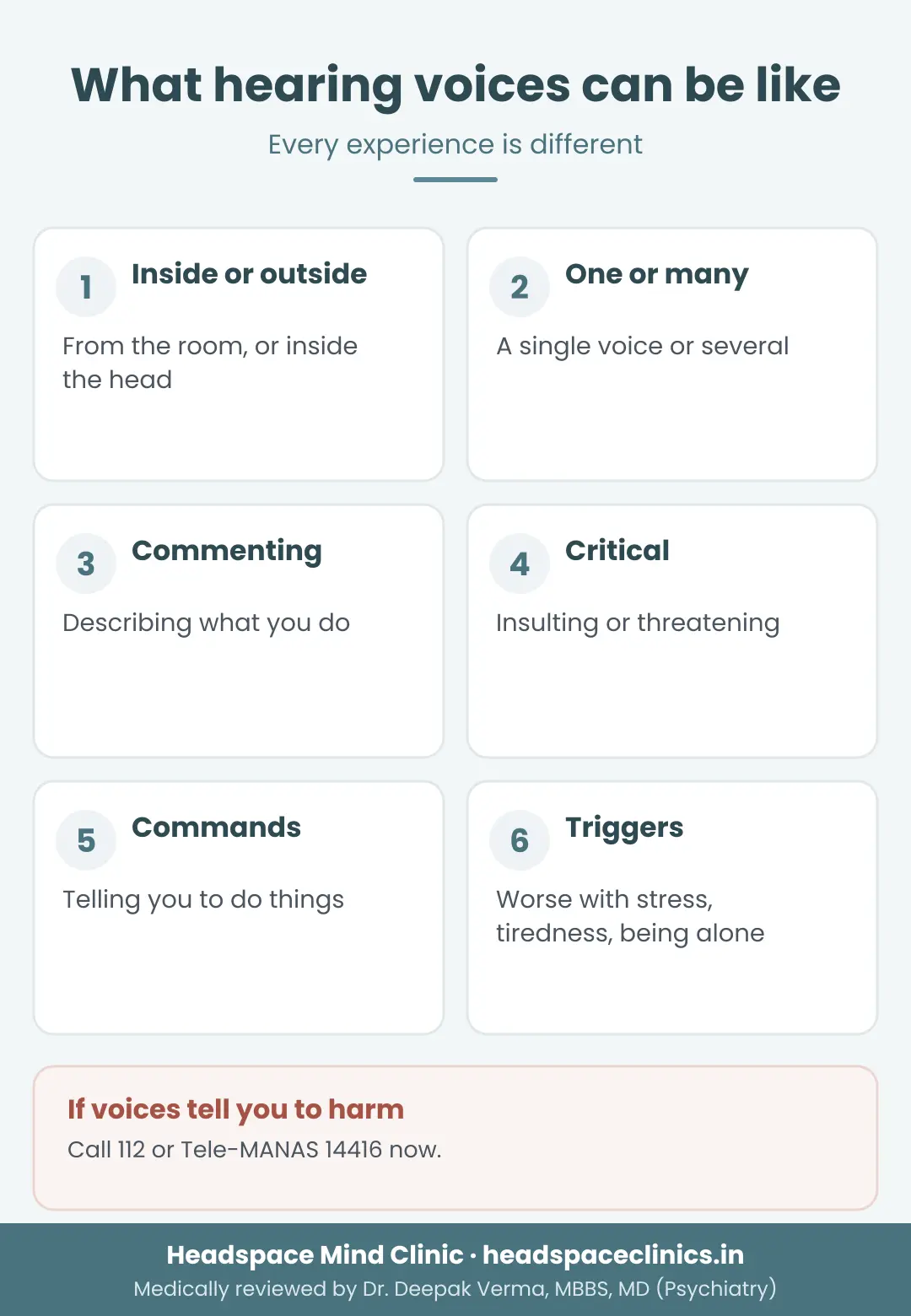
What hearing voices can be like. Tap the image to enlarge.

Hearing voices when no one is speaking can be confusing, distressing or frightening. In clinical practice, I explore what the voices say, when they occur, how frequently they happen and how the person responds to them. Hearing voices can have different causes, and a careful assessment helps determine the appropriate support and treatment.
Dr. Deepak Verma, MBBS, MD (Psychiatry), Consultant Psychiatrist, Headspace Mind Clinic
What a psychiatrist will ask about the voices
Dr. Verma explores four things in detail, because together they point to the cause and to the kind of help that fits:
- What the voices say: are they kind, critical, threatening or giving commands?
- When they occur: only when falling asleep, during stress, after drinking or using drugs, or at any time?
- How often: a few times in a lifetime, or every day?
- How you respond: do you feel able to ignore them, or do you feel you must obey or argue with them?
He will also ask about sleep, mood, stress, past trauma, substance use, medicines and physical health. You will not be judged for anything you share, and it is all kept confidential.
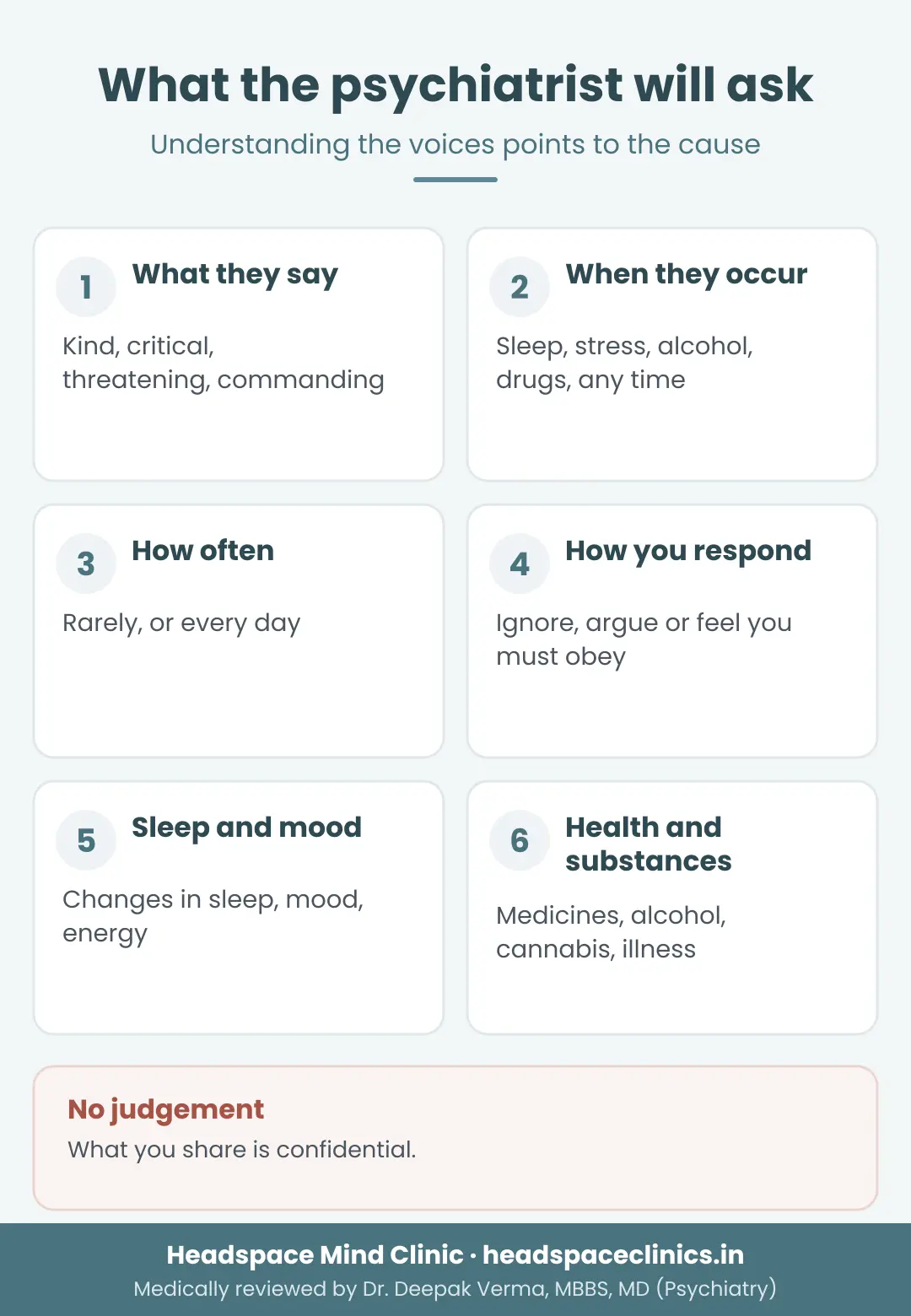
What the psychiatrist will ask. Tap the image to enlarge.
What can cause hearing voices?
Some people hear voices briefly during extreme stress, after severe sleep loss or in grief, when hearing a loved one’s voice is common. Trauma, especially in childhood, is linked with hearing voices later. Cannabis and other drugs, alcohol withdrawal, some medicines, hearing loss and some neurological conditions can cause voices. Voices are also a common feature of psychotic disorders.
Hearing voices may be part of:
Voices with unusual beliefs or confused thinking
Voices during severe high or low episodes
Critical voices in depression with psychosis
Voices with cannabis use or withdrawal
Our guide to all types of hallucinations
Severe sleep loss can trigger voices
Ways people cope with voices
These can help alongside, not instead of, professional care.
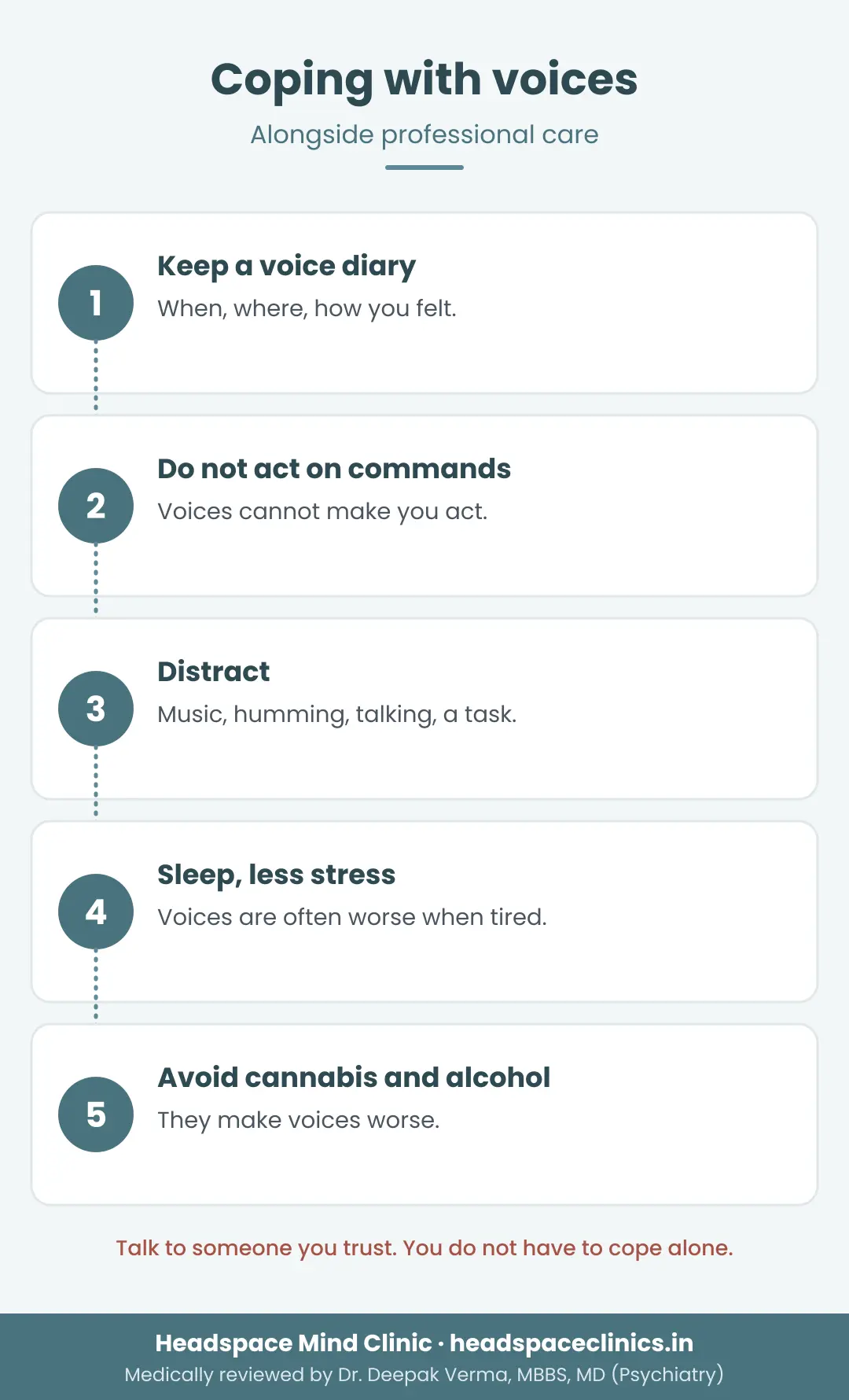
Coping with voices. Tap the image to enlarge.
Keep a voice diary. Note when voices happen, what was going on and how you felt. Patterns often emerge, such as stress, tiredness or being alone.
Do not act on commands. Voices cannot make you do anything. If they tell you to harm yourself or others, get help straight away.
Use distraction. Many people find music through headphones, humming, talking to someone or a focused activity turns the volume down.
Look after sleep and stress. Voices are often worse when tired or under pressure.
Avoid cannabis, alcohol and drugs. They can make voices more frequent and harder to treat.
Talk to someone you trust. Keeping voices secret can make them more frightening.
If you are a family member: listen without arguing about whether the voices are real, focus on how the person feels, and help them get an assessment.
Do my voices need an assessment?
A quick way to decide whether to talk to a professional. It is not a diagnosis.
Tick the statements that apply to you. Nothing you tick is stored or sent anywhere.
This self-check is an educational aid, not a diagnostic test. Only a qualified professional can assess you properly.
When to see a doctor about voices
See a doctor if voices are recent, frequent, distressing, or affecting your life, and especially if they come with unusual beliefs, poor sleep or withdrawal from people. Seek help urgently if voices are commanding you to harm yourself or others, or if you feel unable to keep yourself safe.
Early assessment leads to better outcomes. Bringing a family member or friend can help, and you can share as much or as little as you feel comfortable with at first.
How hearing voices is treated
Treatment depends on the cause. When voices are part of a psychotic disorder, antipsychotic medicines can reduce how often and how loudly they occur, and psychological therapy (including CBT for psychosis) helps people cope and feel less controlled by them. Family support, sleep, and stopping cannabis or other drugs also matter. Where voices are linked to trauma, stress or grief, therapy focused on those experiences can help.
- Assessment by our consultant psychiatrist
- Talking therapy, including CBT, with our clinical psychologists
- Medicines only when they are needed, with regular reviews
- Video follow-ups for existing patients
आवाज़ें सुनाई देना (Hearing voices in Hindi)
जब आसपास कोई न हो फिर भी आवाज़ें सुनाई दें, तो यह उलझन भरा और डरावना हो सकता है। इसकी कई वजहें हो सकती हैं, जैसे बहुत ज़्यादा तनाव, नींद की कमी, नशा, शराब छोड़ना, कुछ बीमारियाँ या सिज़ोफ्रेनिया जैसी मानसिक बीमारी। आवाज़ें क्या कहती हैं, कब और कितनी बार आती हैं, यह समझना इलाज के लिए ज़रूरी है। अगर आवाज़ें ख़ुद को या किसी और को नुक़सान पहुँचाने को कहें, तो तुरंत 112 या टेली-मानस 14416 पर कॉल करें। यह जानकारी केवल शिक्षा के लिए है। अपॉइंटमेंट के लिए कॉल करें: +91 99711 66040
Founder of Headspace Mind Clinic. Dr. Verma sees patients at our Paschim Vihar, Rohini and Narela clinics. About our psychiatry service →
Three clinics in West and North Delhi
Psychiatrist consultation fee: ₹1,800 at Paschim Vihar and Rohini, ₹500 at Narela. All appointments are scheduled; please call or book online.
Frequently asked questions
Not necessarily. Voices can be caused by stress, trauma, sleep loss, grief, drugs, alcohol withdrawal, medicines and medical conditions, as well as psychotic disorders. An assessment is needed to understand the cause.
Yes, briefly hearing or sensing a loved one who has died is common in grief and is not, on its own, a sign of mental illness. If it is very distressing or continues for a long time, talking to someone can help.
Severe stress, especially with lack of sleep, can sometimes lead to hearing voices. If voices continue, they should be assessed.
Get help straight away: call 112 or Tele-MANAS 14416, go to the nearest hospital emergency, and stay with someone you trust. Voices cannot make you act, and urgent help is available.
Listen calmly, avoid arguing about whether the voices are real, and focus on how they are feeling. Encourage an assessment and offer to go with them. If there is any risk to safety, call 112.
Yes. Depending on the cause, treatment may include medicines, psychological therapy, family support and help with sleep, stress or substance use. Many people find the voices become less frequent and less distressing.
Related symptom guides
Book a consultation
Choose your preferred clinic and our team will call you to confirm a time. This form is for appointments only; please do not use it in an emergency.
References
- Beavan V, Read J, Cartwright C. The prevalence of voice-hearers in the general population: a literature review. Journal of Mental Health. 2011;20(3):281–292.
- Waters F, Fernyhough C. Hallucinations: a systematic review of points of similarity and difference across diagnostic classes. Schizophrenia Bulletin. 2017;43(1):32–43.
- National Institute for Health and Care Excellence (NICE). Psychosis and schizophrenia in adults: prevention and management (CG178). nice.org.uk
- Tele-MANAS, National Tele Mental Health Programme, Ministry of Health and Family Welfare, Government of India. Helpline 14416.
Medically reviewed by Dr. Deepak Verma (MBBS, MD Psychiatry; DMC Reg. No. 37616). Last reviewed: 15 November 2026.
Medical disclaimer. The information on this page is provided for general educational purposes only. It is not medical advice and is not intended to diagnose, treat, cure or prevent any condition. Reading this page or using the self-check does not create a doctor–patient relationship with Dr. Deepak Verma or Headspace Mind Clinic. Please consult a qualified doctor about any symptom, diagnosis or treatment, and do not start, stop or change any medicine without talking to the doctor who prescribed it. Do not ignore professional advice, or delay seeking it, because of something you have read here. Symptoms, causes and responses to treatment differ from person to person, and no particular result is promised. Links to other websites are given for reference only, and we are not responsible for their content. If you think you or someone else may be facing a medical or mental health emergency, call 112, call Tele-MANAS on 14416 (free, 24×7) or go to the nearest hospital emergency department.