
Panic attack symptoms, what to do, and how panic is treated
A panic attack is a sudden surge of intense fear with strong physical symptoms such as a racing heart, breathlessness, chest tightness, trembling, dizziness or a fear of dying. It usually peaks within about 10 minutes and settles within 20 to 30 minutes. During an attack, slow your breathing (in for 4, out for 6) and ground yourself in your surroundings.
Panic attacks respond well to treatment, mainly cognitive behavioural therapy (CBT) and, where needed, medicines prescribed by a psychiatrist. Chest pain that is new or unexplained should always be checked by a doctor first.
Panic attack symptoms
A panic attack comes on suddenly. Sometimes there is an obvious trigger; sometimes it arrives out of the blue, even waking you from sleep. Many people say it is the most frightening thing they have experienced and fear they are having a heart attack or losing their mind. Symptoms can include:
- Racing or pounding heart, palpitations
- Shortness of breath or a choking feeling
- Chest tightness, discomfort or pain
- Trembling, sweating, chills or hot flushes
- Dizziness, light-headedness or feeling faint
- Nausea or an upset stomach
- Numbness or tingling in the hands, feet or face
- Feeling unreal or detached from yourself
- Fear of losing control, going mad or dying
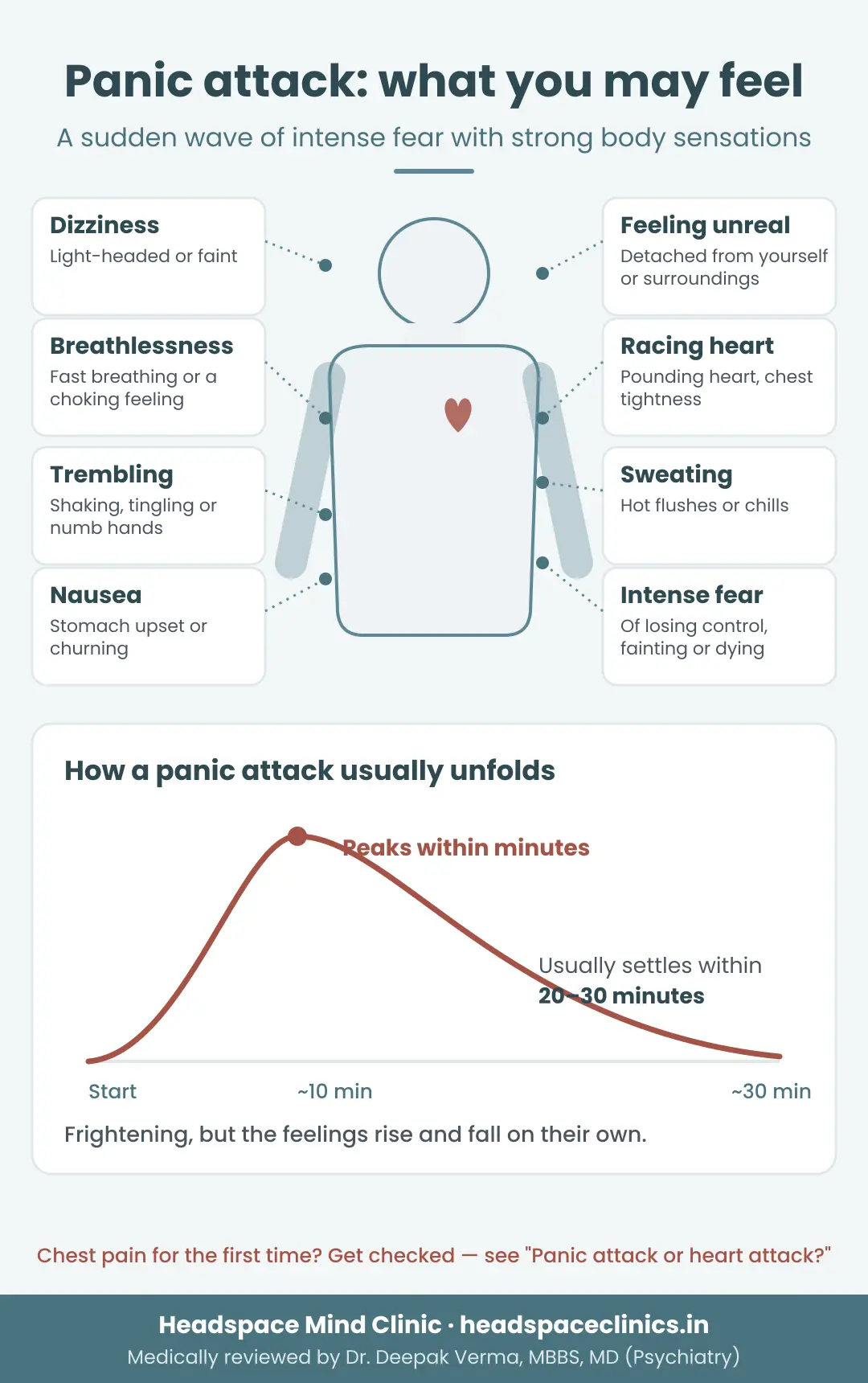
What a panic attack can feel like, and how it usually rises and falls. Tap the image to enlarge.

A panic attack can feel frightening because symptoms such as a racing heart, breathlessness, sweating, dizziness and chest discomfort may resemble a medical emergency. I always emphasise that new or unexplained physical symptoms need appropriate medical evaluation. Recurrent episodes, especially with fear of another attack, deserve assessment for panic disorder and other possible causes.
Dr. Deepak Verma, MBBS, MD (Psychiatry), Consultant Psychiatrist, Headspace Mind Clinic
Fear of another attack, and why normal reports do not end it
Dr. Verma finds that the most common complaint from people with panic attacks is not the attack itself but the fear of having another one. After a first attack the brain stays on alert. You start watching your heartbeat and breathing, and ordinary sensations, such as a skipped beat after tea or breathlessness on the stairs, are read as danger. That fear releases adrenaline, which brings on the very symptoms you feared. This “fear of fear” is a central feature of panic disorder.
Why normal reports bring only brief relief. Because the symptoms feel like a heart problem, most people go through ECGs, heart tests and emergency visits. Even with normal reports, many find it very hard to accept that it was a panic attack. The tests answer “Is my heart healthy?” but not “Why do I feel like this?”, so doubt returns and leads to more tests and more searching online.
What helps is one proper medical evaluation followed by a clear understanding of what panic is and why the body reacts this way. That understanding is the first step of CBT. Normal reports are good news: they mean your heart is healthy and that what you are experiencing has a name and an effective treatment.
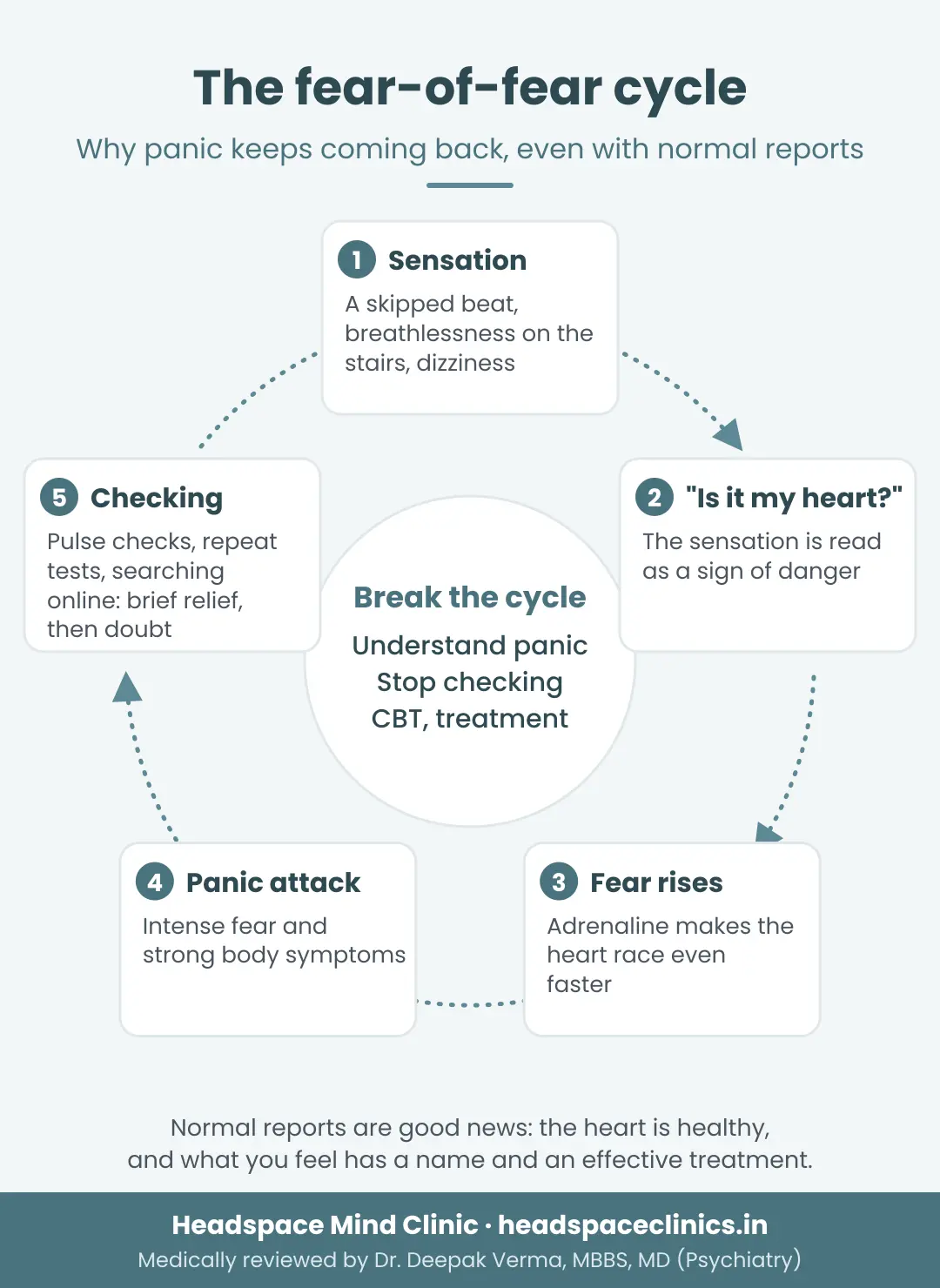
The fear-of-fear cycle. Tap the image to enlarge.
Why panic attacks happen
A panic attack is the body’s alarm system, the “fight or flight” response, going off when there is no real danger. Attacks are more likely during stress or after big life changes, with too little sleep, and after too much caffeine, nicotine, alcohol (especially the morning after), cannabis or stimulants. They can run in families.
Some medical problems cause similar symptoms, including an overactive thyroid, heart rhythm problems, low blood sugar and asthma, so a first assessment may include a physical check, an ECG or blood tests.
Panic attack or panic disorder? One or two panic attacks in a lifetime are common. Panic disorder means repeated, unexpected attacks plus a month or more of worrying about the next one or changing your life to avoid it, for example avoiding the metro, crowded markets or travelling alone. Panic attacks can also occur with other conditions:
Repeated unexpected attacks and fear of the next one
Ongoing worry, tension and restlessness
Low mood, loss of interest and poor sleep
A constant sense that something will go wrong
Night-time panic and broken sleep
Panic during a hangover or withdrawal
What to do during a panic attack
These steps will not stop every attack at once, but they help it pass sooner and feel less frightening.
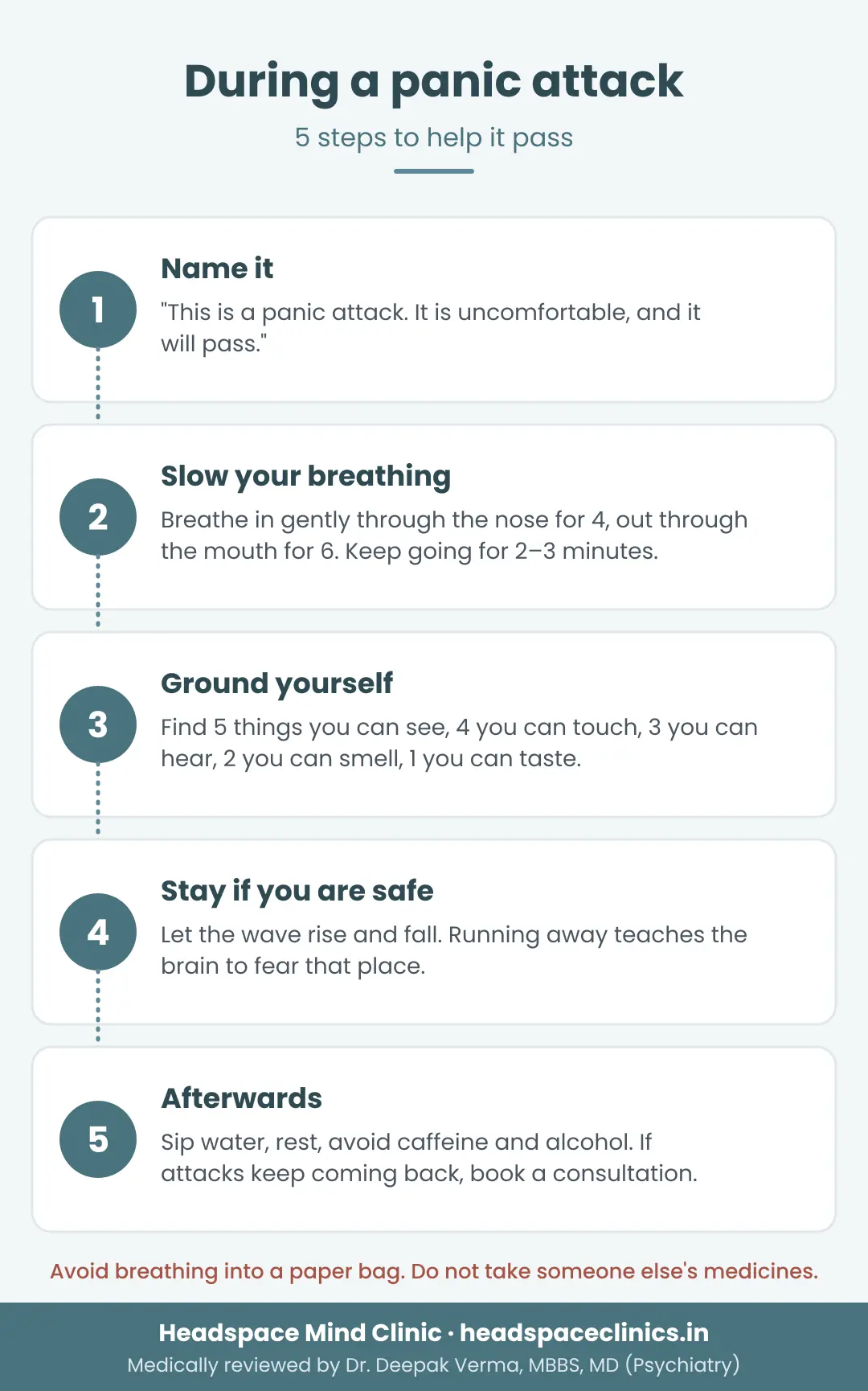
5 steps to help a panic attack pass. Tap the image to enlarge.
1. Name it. Tell yourself: “This is a panic attack. It is uncomfortable, and it will pass.” Recognising it reduces the fear that something worse is happening.
2. Slow your breathing. Breathe in gently through your nose for a count of 4 and out through your mouth for a count of 6. Keep going for 2 to 3 minutes. A longer out-breath calms the body’s alarm.
3. Ground yourself. Notice 5 things you can see, 4 you can touch, 3 you can hear, 2 you can smell and 1 you can taste. Press your feet into the floor.
4. Stay where you are if it is safe. Let the wave rise and fall. Leaving teaches the brain that the place was dangerous, which makes future attacks there more likely.
5. Afterwards. Sip water, rest, and skip caffeine and alcohol for the day. Note when and where it happened. If attacks keep coming back, book a consultation.
Helping someone else: stay calm and stay with them, speak slowly, breathe slowly with them and avoid saying “just calm down”. If they have chest pain or any warning sign below, call 112.
Avoid breathing into a paper bag, and never take someone else’s tablets.
Panic attack or heart attack?
The two can feel alike, and panic should only be diagnosed once heart and other medical causes have been considered. Panic is more likely if the symptoms began at rest or under stress, peaked within about 10 minutes and then eased, and if similar episodes have already been checked by a doctor.
Call 112 or go to the nearest hospital emergency now if:
- the chest pain is crushing, heavy or squeezing
- it spreads to the arm, jaw, neck or back
- it started with exertion or lasts more than 15 minutes
- there is cold sweating, vomiting or fainting
- it is a first episode, especially if you are over 40 or have diabetes, high blood pressure, heart disease or smoke
If you are not sure, treat it as a heart problem. Being checked and reassured is always better than waiting.
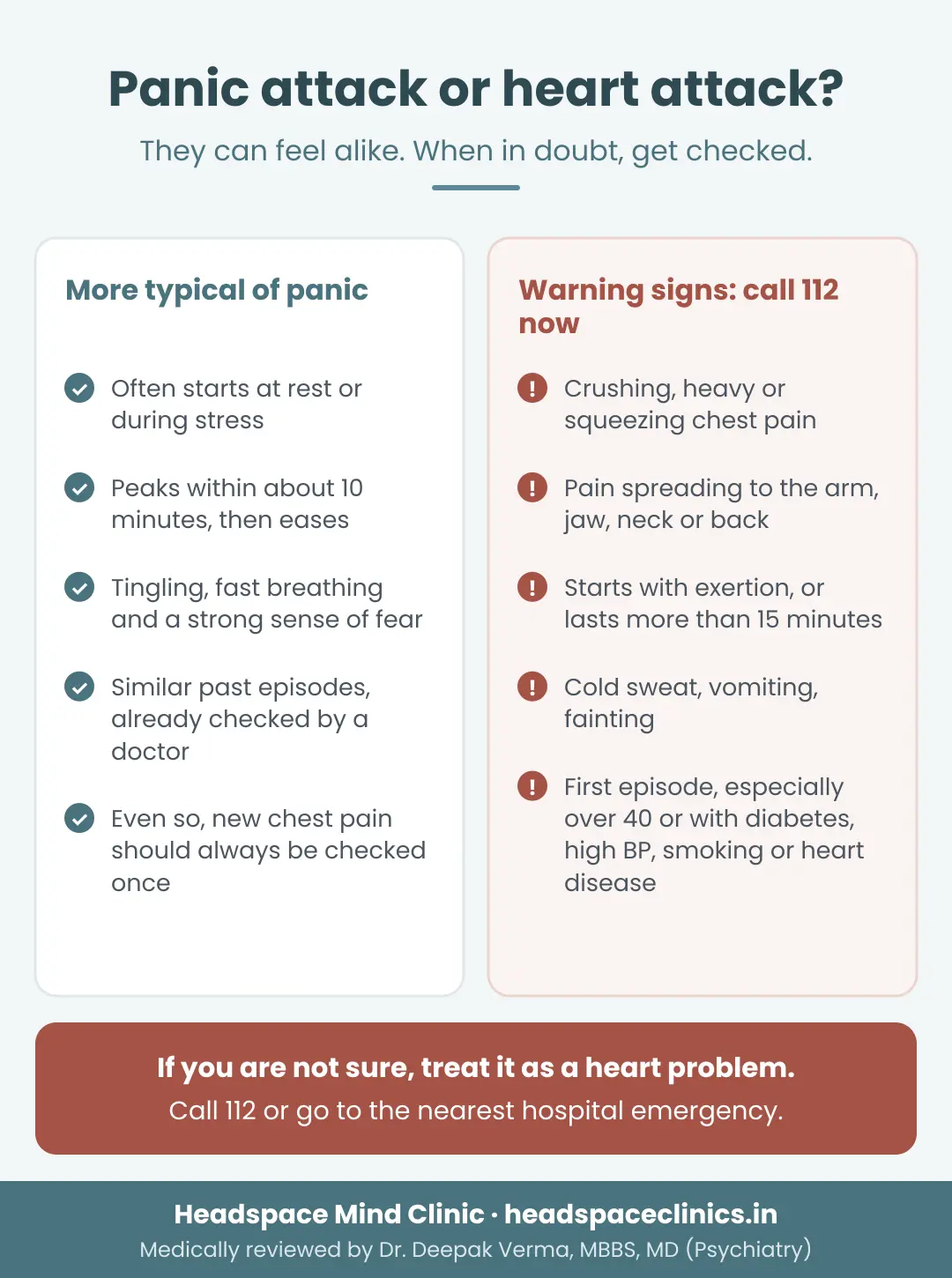
When in doubt, get checked. Tap the image to enlarge.
Are my panic attacks a sign to get help?
A quick way to decide whether to talk to a professional. It is not a diagnosis.
Tick the statements that apply to you. Nothing you tick is stored or sent anywhere.
This self-check is an educational aid, not a diagnostic test. Only a qualified professional can assess you properly.
When to see a doctor for panic attacks
See a doctor if you have had more than one panic attack, if you keep worrying about the next one, or if you have started avoiding places or activities. New or unexplained chest pain should always be checked medically first.
A psychiatrist will ask about your attacks, health, caffeine, alcohol and medicines, and may suggest an ECG or blood tests (for example thyroid) to rule out physical causes. You then agree a plan together.
How panic attacks are treated
CBT for panic is the most effective talking treatment. You learn what happens in the body during panic, how to stop fearing the sensations and how to return step by step to places you have been avoiding. Medicines such as SSRIs are often used when attacks are frequent; they are taken daily and take a few weeks to work. Sedatives such as alprazolam can calm an attack quickly, but they can cause dependence and guidelines advise against relying on them for panic disorder. Most people improve a great deal with treatment. Read about panic disorder treatment in Delhi.
- Assessment by our consultant psychiatrist
- Talking therapy, including CBT, with our clinical psychologists
- Medicines only when they are needed, with regular reviews
- Video follow-ups for existing patients
पैनिक अटैक क्या है? (Panic attack in Hindi)
पैनिक अटैक अचानक आने वाला तेज़ डर या घबराहट का दौरा है, जिसमें दिल की धड़कन तेज़ होना, साँस फूलना, सीने में जकड़न, काँपना, पसीना, चक्कर आना या मरने का डर महसूस हो सकता है। यह आमतौर पर कुछ मिनटों में चरम पर पहुँचता है और 20 से 30 मिनट में शांत हो जाता है। उस समय धीरे-धीरे साँस लें: 4 तक गिनकर साँस अंदर, 6 तक गिनकर बाहर। अगर सीने में दर्द पहली बार हो, बहुत तेज़ हो या हाथ-जबड़े तक फैले, तो तुरंत 112 पर कॉल करें। यह जानकारी केवल शिक्षा के लिए है। अपॉइंटमेंट के लिए कॉल करें: +91 99711 66040
Founder of Headspace Mind Clinic. Dr. Verma sees patients at our Paschim Vihar, Rohini and Narela clinics. About our psychiatry service →
Three clinics in West and North Delhi
Psychiatrist consultation fee: ₹1,800 at Paschim Vihar and Rohini, ₹500 at Narela. All appointments are scheduled; please call or book online.
Frequently asked questions
In a healthy person a panic attack does not damage the heart, even though it feels terrifying. Chest pain must still be taken seriously: if it is a first episode, if you are over 40 or have heart risk factors, or if the pain is crushing or spreads to the arm or jaw, call 112 or go to an emergency.
Most peak within about 10 minutes and settle within 20 to 30 minutes. You may feel tired or shaky for a while afterwards.
Tests show that your heart is healthy, but they do not explain why your body reacts as it does. Without that explanation, fear of another attack keeps the symptoms going. Understanding how panic works, usually as part of CBT, breaks the cycle. After a proper medical evaluation, repeated tests tend to add worry rather than reassurance.
“Anxiety attack” is not a medical term. People usually use it for anxiety that builds gradually. A panic attack comes on suddenly, peaks within minutes and has strong physical symptoms.
It is uncommon. Blood pressure usually rises during a panic attack, so fainting is unlikely even though people often feel faint. If you actually lose consciousness, get a medical check-up.
If you are driving, pull over when it is safe and breathe slowly until the wave passes. In the metro or a crowd, stay where you are if you can and ground yourself. Avoiding these situations makes the fear grow; treatment helps you return to them step by step.
Most people improve a great deal with treatment, and many become free of attacks. Practising the skills learned in CBT helps prevent them coming back.
Related symptom guides
Book a consultation
Choose your preferred clinic and our team will call you to confirm a time. This form is for appointments only; please do not use it in an emergency.
References
- World Health Organization. International Classification of Diseases, 11th Revision (ICD-11). icd.who.int: 6B01 Panic disorder.
- National Institute of Mental Health (NIMH). Panic Disorder: When Fear Overwhelms. nimh.nih.gov
- National Institute for Health and Care Excellence (NICE). Generalised anxiety disorder and panic disorder in adults: management (CG113). nice.org.uk
- Gautam S, Jain A, Gautam M, Vahia VN, Gautam A. Clinical Practice Guidelines for the Management of Generalised Anxiety Disorder (GAD) and Panic Disorder (PD). Indian Journal of Psychiatry. 2017;59(Suppl 1):S67–S73. Indian Psychiatric Society
- Tele-MANAS, National Tele Mental Health Programme, Ministry of Health and Family Welfare, Government of India. Helpline 14416.
Medically reviewed by Dr. Deepak Verma (MBBS, MD Psychiatry; DMC Reg. No. 37616). Last reviewed: 15 November 2026.
Medical disclaimer. The information on this page is provided for general educational purposes only. It is not medical advice and is not intended to diagnose, treat, cure or prevent any condition. Reading this page or using the self-check does not create a doctor–patient relationship with Dr. Deepak Verma or Headspace Mind Clinic. Please consult a qualified doctor about any symptom, diagnosis or treatment, and do not start, stop or change any medicine without talking to the doctor who prescribed it. Do not ignore professional advice, or delay seeking it, because of something you have read here. Symptoms, causes and responses to treatment differ from person to person, and no particular result is promised. Links to other websites are given for reference only, and we are not responsible for their content. If you think you or someone else may be facing a medical or mental health emergency, call 112, call Tele-MANAS on 14416 (free, 24×7) or go to the nearest hospital emergency department.