
When sleep will not come, or will not last
Sleep problems include difficulty falling asleep, waking repeatedly, waking too early or feeling unrefreshed despite enough time in bed. Short spells of poor sleep are common during stress. When they happen at least three nights a week for three months, this is called chronic insomnia.
Poor sleep is not always about bad habits. It can be linked to anxiety, depression, mood changes, medicines, lifestyle or a sleep disorder such as sleep apnoea, and long-term insomnia affects concentration, mood and health. Cognitive behavioural therapy for insomnia (CBT-I) is the recommended first treatment for chronic insomnia.
Common sleep problems
Sleep problems take different forms, and the pattern gives useful clues:
- Taking more than 30 minutes to fall asleep
- Waking several times and struggling to get back to sleep
- Waking very early and being unable to sleep again
- Feeling unrefreshed, tired or irritable during the day
- Loud snoring, gasping or pauses in breathing (reported by a partner)
- Restless, uncomfortable legs in the evening
- Sleeping much more than usual and still feeling tired
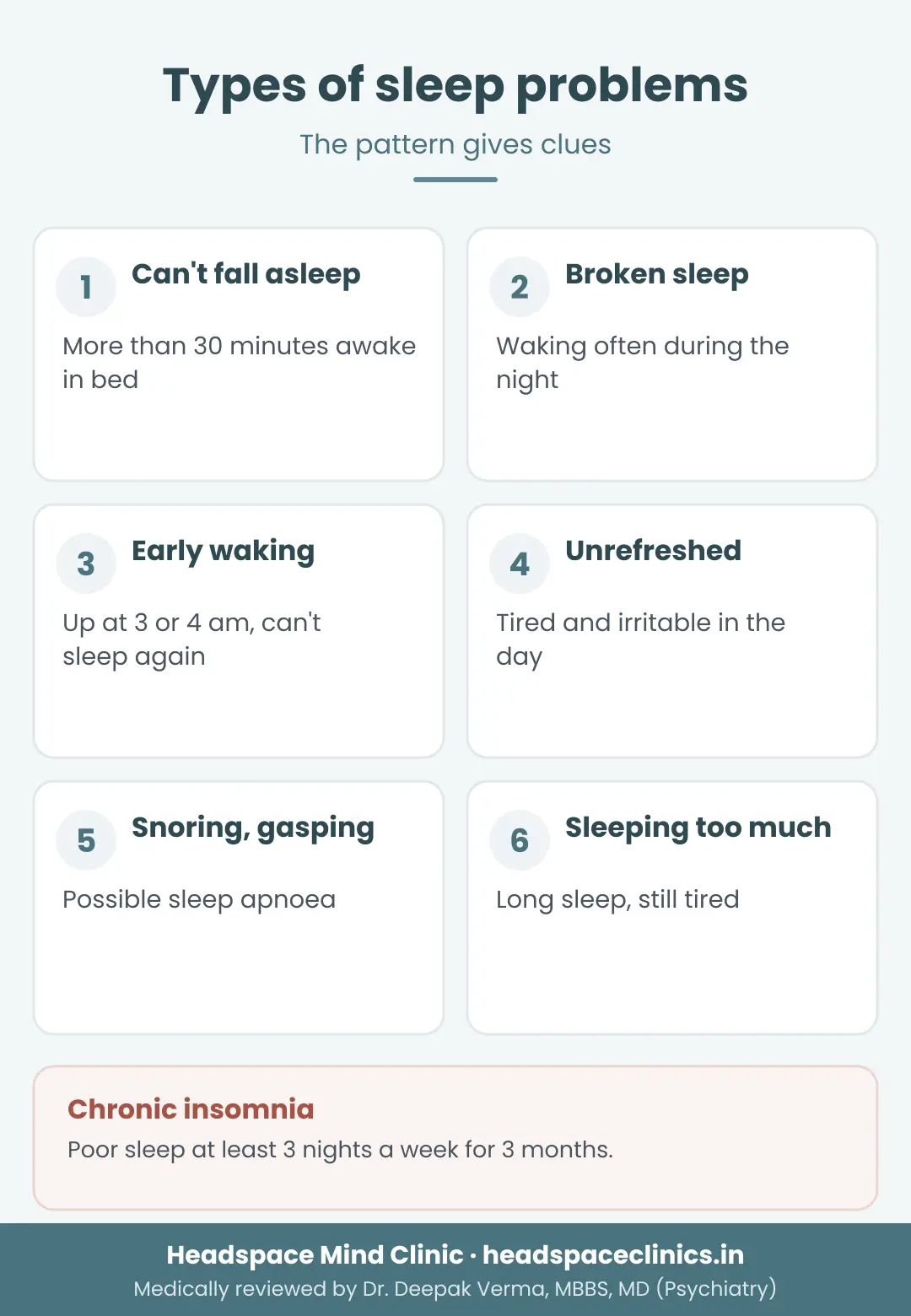
Types of sleep problems. Tap the image to enlarge.

Sleep problems are not always just a matter of poor sleep habits. I assess whether difficulty sleeping is associated with anxiety, depression, mood changes, medication, lifestyle factors or an underlying sleep disorder. Persistent insomnia can affect concentration, emotional regulation and overall mental well-being.
Dr. Deepak Verma, MBBS, MD (Psychiatry), Consultant Psychiatrist, Headspace Mind Clinic
Why sleep problems are often more than bad habits
Advice about screens and tea is useful, but it does not explain every case. Dr. Verma looks for what sits behind the sleeplessness. Early-morning waking with low mood can point to depression. A racing mind at bedtime often goes with anxiety. Sleeping very little without feeling tired may be part of a high mood episode. Loud snoring and daytime sleepiness suggest sleep apnoea, which needs a different kind of test.
Medicines (including some for blood pressure, asthma and steroids), caffeine, alcohol, nicotine, shift work, pain and a new baby can all play a part. Finding the right explanation matters, because sleeping pills alone rarely fix the underlying problem.
What can cause sleep problems?
Stress, worry, irregular routines, late-night screen use, caffeine after lunch, alcohol, shift work, pain and physical illness are common causes. Sleep also changes with age and around pregnancy and menopause.
Long-term sleep problems are often linked with:
Ongoing difficulty falling or staying asleep
A busy, worried mind at bedtime
Early waking, or sleeping too much
Very little sleep during high periods
Thoughts that will not switch off
Alcohol breaks up sleep later in the night
What helps you sleep better
The core steps used in CBT for insomnia.
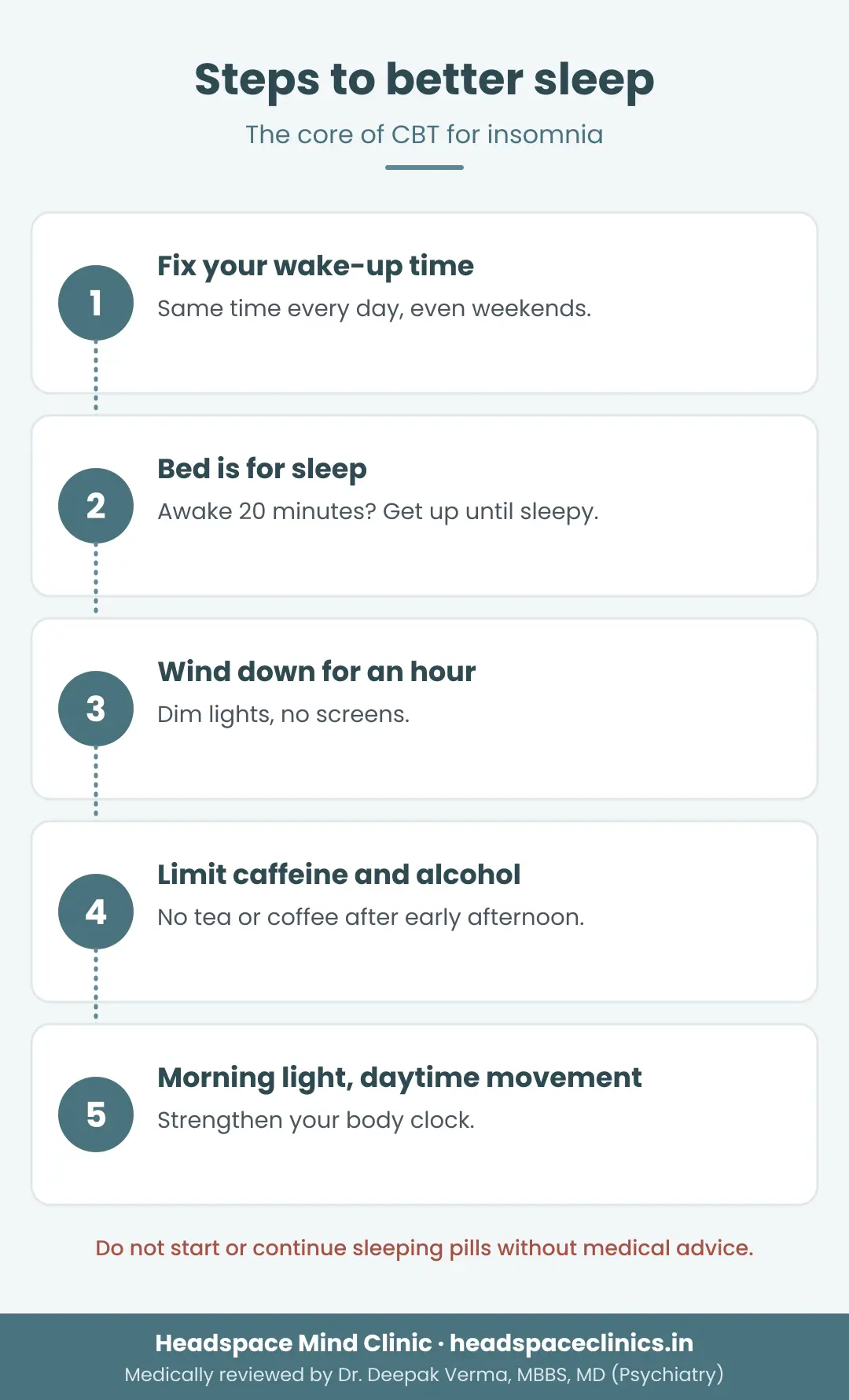
Steps to better sleep. Tap the image to enlarge.
Fix your wake-up time. Get up at the same time every day, including weekends, however you slept. This is the single most useful step.
Use the bed only for sleep. If you have been awake for about 20 minutes, get up, go to another room and do something quiet in dim light until you feel sleepy.
Wind down for an hour. Lower the lights, put screens away and do something calm.
Watch caffeine and alcohol. No tea, coffee or cola after early afternoon. Alcohol helps you fall asleep but breaks up sleep later.
Get morning daylight and move during the day. Both strengthen your body clock.
Do not nap long. If you must nap, keep it under 20 minutes and before 3 pm.
Please do not start sleeping tablets on your own or continue them without medical advice; some can cause dependence.
Are my sleep problems a sign to get help?
A quick way to decide whether to talk to a professional. It is not a diagnosis.
Tick the statements that apply to you. Nothing you tick is stored or sent anywhere.
This self-check is an educational aid, not a diagnostic test. Only a qualified professional can assess you properly.
When to see a doctor about sleep
See a doctor if poor sleep has continued for more than a few weeks, if it is affecting your mood or daily life, or if you rely on sleeping pills or alcohol. Get checked promptly for loud snoring with pauses in breathing, or if you are falling asleep while driving.
Your psychiatrist will ask about your sleep pattern, mood, stress, medicines, caffeine, alcohol and health. A two-week sleep diary is very helpful to bring along. If a sleep disorder such as sleep apnoea is suspected, we can arrange referral for a sleep study.
How sleep problems are treated
CBT for insomnia (CBT-I) is recommended as the first treatment for chronic insomnia. It works on sleep timing, habits and the worry about sleep that keeps insomnia going, and its benefits tend to last. When sleep problems come from anxiety, depression or another condition, treating that condition is central. Sleeping medicines may be used for a short time in selected cases, with a plan for stopping. Read about insomnia treatment in Delhi.
- Assessment by our consultant psychiatrist
- Talking therapy, including CBT, with our clinical psychologists
- Medicines only when they are needed, with regular reviews
- Video follow-ups for existing patients
नींद न आना (Sleep problems in Hindi)
रात को नींद न आना, बार-बार नींद टूटना, बहुत जल्दी आँख खुल जाना या सोने के बाद भी थकान रहना नींद की समस्या के संकेत हैं। यह हमेशा ग़लत आदतों की वजह से नहीं होता। चिंता, डिप्रेशन, मूड में बदलाव, दवाइयाँ, शराब या स्लीप एपनिया जैसी बीमारी भी इसकी वजह हो सकती है। रोज़ एक ही समय पर उठें और बिना डॉक्टर की सलाह के नींद की गोली न लें। यह जानकारी केवल शिक्षा के लिए है। अपॉइंटमेंट के लिए कॉल करें: +91 99711 66040
Founder of Headspace Mind Clinic. Dr. Verma sees patients at our Paschim Vihar, Rohini and Narela clinics. About our psychiatry service →
Three clinics in West and North Delhi
Psychiatrist consultation fee: ₹1,800 at Paschim Vihar and Rohini, ₹500 at Narela. All appointments are scheduled; please call or book online.
Frequently asked questions
Most adults need about 7 to 9 hours. What matters most is whether you feel refreshed and function well during the day.
Early-morning waking can come from stress, alcohol, ageing or an irregular routine. When it comes with low mood and loss of interest, it can be a sign of depression and is worth discussing with a doctor.
Some sleeping medicines can be useful for a short time, but many cause dependence, morning drowsiness and a higher risk of falls, especially in older adults. They should only be taken on prescription with a plan for how long.
Yes. Anxiety keeps the body alert and the mind busy, which makes it hard to fall and stay asleep. Insomnia can then make anxiety worse, so the two are often treated together.
In sleep apnoea, breathing stops and starts repeatedly during sleep, usually with loud snoring. It causes daytime sleepiness and raises the risk of high blood pressure and other problems. It needs a sleep study for diagnosis.
Yes. Screens keep the mind active and their light can delay the body’s sleep signal. Putting the phone away for the last hour before bed helps many people.
Related symptom guides
Book a consultation
Choose your preferred clinic and our team will call you to confirm a time. This form is for appointments only; please do not use it in an emergency.
References
- Riemann D, Baglioni C, Bassetti C, et al. European guideline for the diagnosis and treatment of insomnia. Journal of Sleep Research. 2017;26(6):675–700.
- Qaseem A, Kansagara D, Forciea MA, Cooke M, Denberg TD. Management of chronic insomnia disorder in adults: a clinical practice guideline from the American College of Physicians. Annals of Internal Medicine. 2016;165(2):125–133.
- World Health Organization. International Classification of Diseases, 11th Revision (ICD-11). icd.who.int: 7A00 Chronic insomnia.
- Tele-MANAS, National Tele Mental Health Programme, Ministry of Health and Family Welfare, Government of India. Helpline 14416.
Medically reviewed by Dr. Deepak Verma (MBBS, MD Psychiatry; DMC Reg. No. 37616). Last reviewed: 15 November 2026.
Medical disclaimer. The information on this page is provided for general educational purposes only. It is not medical advice and is not intended to diagnose, treat, cure or prevent any condition. Reading this page or using the self-check does not create a doctor–patient relationship with Dr. Deepak Verma or Headspace Mind Clinic. Please consult a qualified doctor about any symptom, diagnosis or treatment, and do not start, stop or change any medicine without talking to the doctor who prescribed it. Do not ignore professional advice, or delay seeking it, because of something you have read here. Symptoms, causes and responses to treatment differ from person to person, and no particular result is promised. Links to other websites are given for reference only, and we are not responsible for their content. If you think you or someone else may be facing a medical or mental health emergency, call 112, call Tele-MANAS on 14416 (free, 24×7) or go to the nearest hospital emergency department.