
Forgetfulness: what is normal and what needs a check-up
Memory problems range from everyday forgetfulness, like misplacing keys or forgetting a name, to changes that affect daily life. Many causes are common and treatable, including stress, depression, anxiety, poor sleep, vitamin B12 deficiency, thyroid problems, alcohol and side effects of medicines.
Memory involves several steps: paying attention, storing the information and recalling it later. Working out which step is affected helps find the cause. Memory changes that are getting worse, or that worry family members, should be assessed.
Signs of memory problems
Memory complaints can look like:
- Forgetting names, appointments or recent conversations
- Losing things more often than before
- Repeating the same question or story
- Walking into a room and forgetting why
- Difficulty following conversations, films or books
- Needing more reminders and notes than usual
- Family members noticing changes before you do
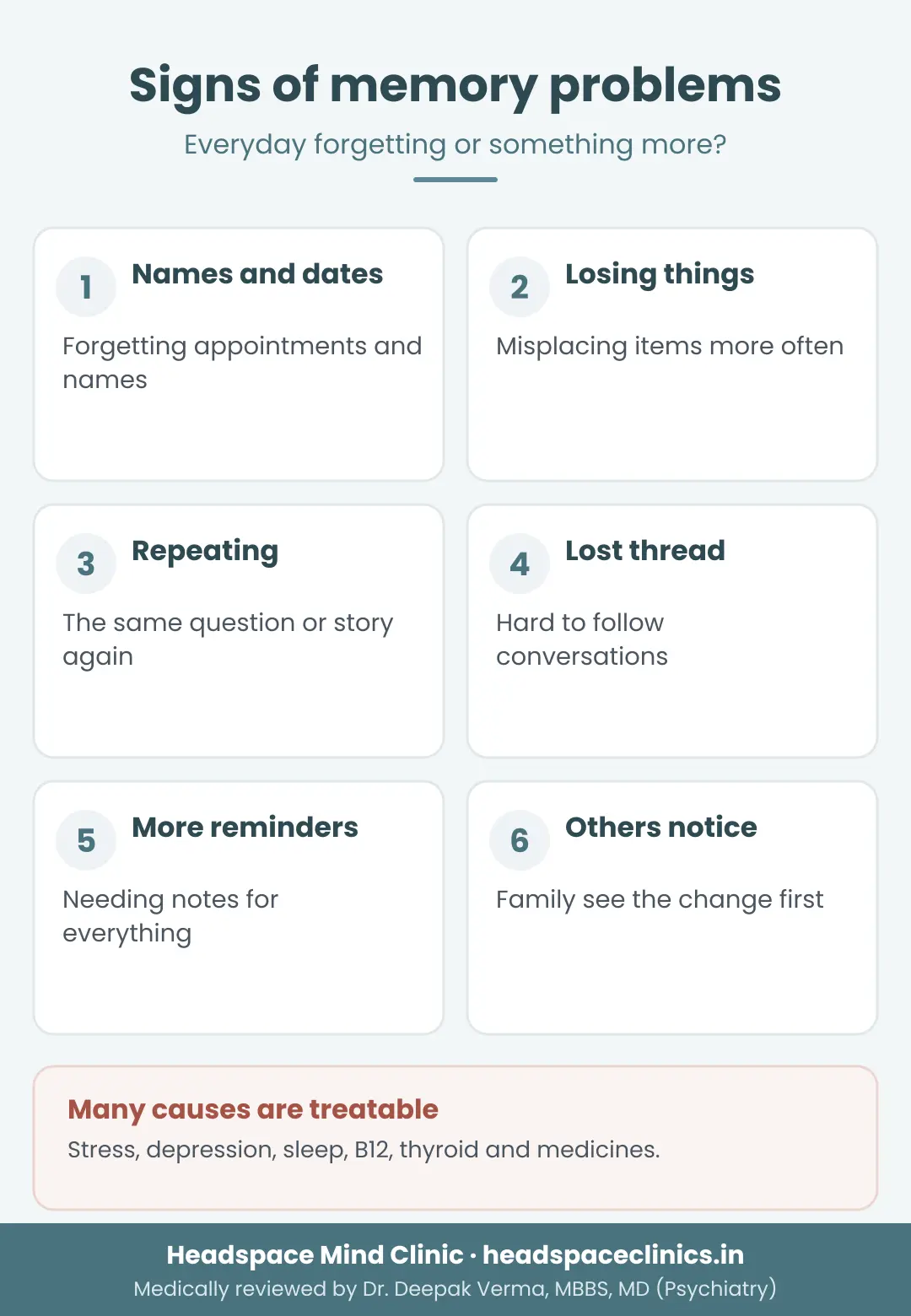
Signs of memory problems. Tap the image to enlarge.

People often become concerned when they start forgetting names, appointments or recently discussed information. During assessment, I explore whether the problem involves attention, memory storage or recall, as these are different processes. Sleep disturbance, stress, depression, medication effects and neurological conditions can all contribute to memory complaints.
Dr. Deepak Verma, MBBS, MD (Psychiatry), Consultant Psychiatrist, Headspace Mind Clinic
Attention, storage and recall
Dr. Verma explains memory as three linked steps, because a problem at any one of them can feel like “my memory is bad”.
- Attention: if you were distracted, anxious or exhausted when the information came in, it may never have been taken in properly. This is the most common reason for forgetfulness in younger adults, and it improves when the cause is treated.
- Storage: the brain has to file the information away. Conditions affecting the brain, such as dementia, mainly affect this step, so new information is lost quickly.
- Recall: the memory is stored but hard to retrieve on demand. The “tip of the tongue” feeling is an example. Cues and reminders usually help.
A careful history and simple memory tests help tell these apart.
Normal forgetfulness or a sign to get checked?
Some forgetfulness is part of normal life and normal ageing: misplacing glasses, forgetting a name and remembering it later, or needing a list for shopping. These do not stop you managing your life.
Get checked if forgetfulness is getting steadily worse, if you get lost in familiar places, repeat questions within minutes, struggle to manage money or medicines, or if personality or behaviour is changing. Sudden confusion, especially in an older person or with fever, weakness or slurred speech, needs urgent medical attention.
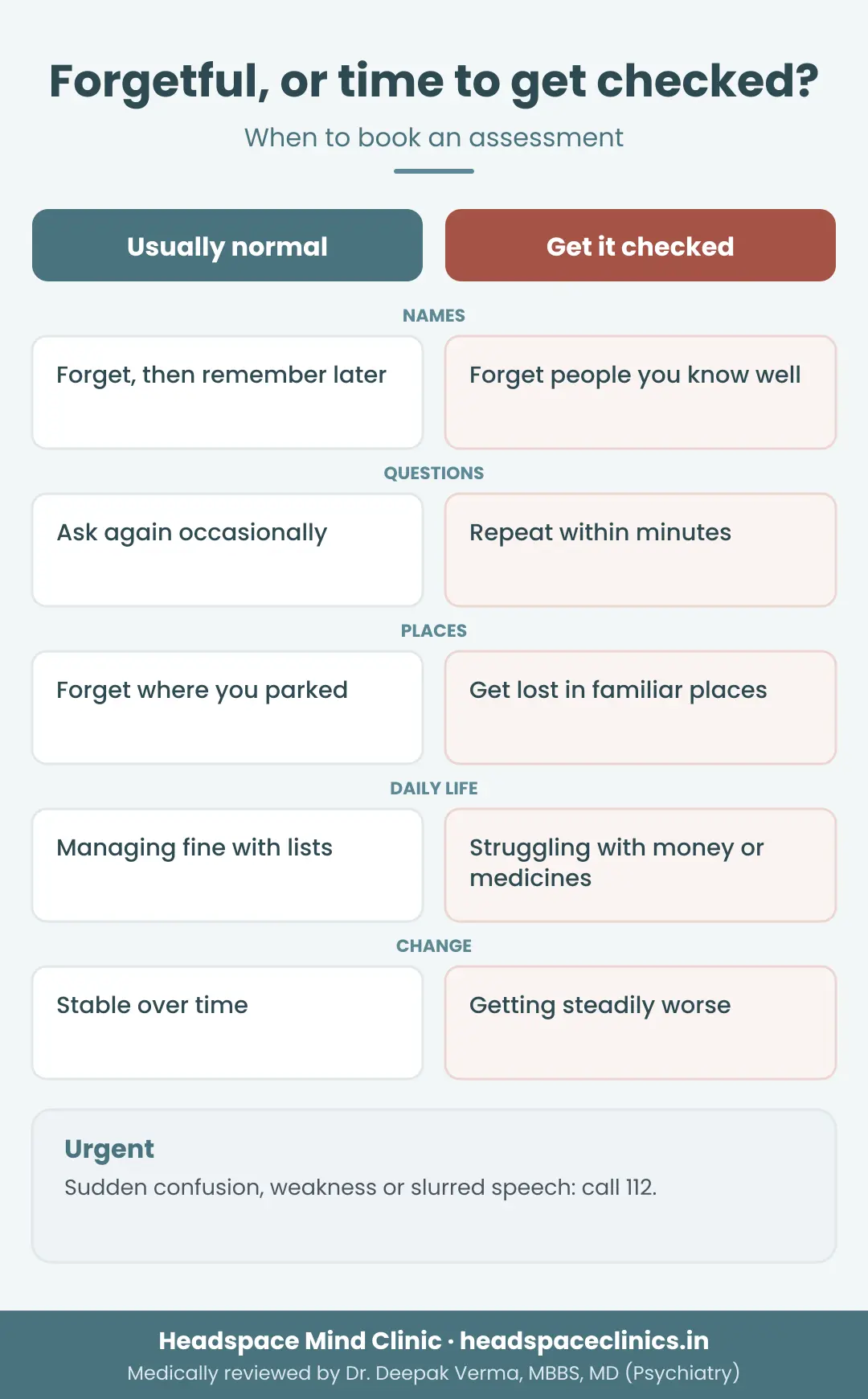
Normal forgetfulness vs signs to get checked. Tap the image to enlarge.
What can cause memory problems?
Many causes are reversible. Stress, depression and anxiety reduce attention and are very common reasons for poor memory. Poor sleep, sleep apnoea, thyroid problems, low vitamin B12, heavy alcohol use, and medicines such as some sleeping pills, anti-anxiety tablets and older allergy medicines can all affect memory. Head injury, stroke, Parkinson’s disease and dementias such as Alzheimer’s disease are neurological causes.
Memory complaints can be part of:
Memory loss that steadily affects daily life
Poor attention and slowed thinking
A busy mind leaves little room to take things in
Information not taken in properly
Sleep is needed to store memories
Heavy drinking damages memory
What helps memory day to day
Habits that support memory while the cause is looked into.
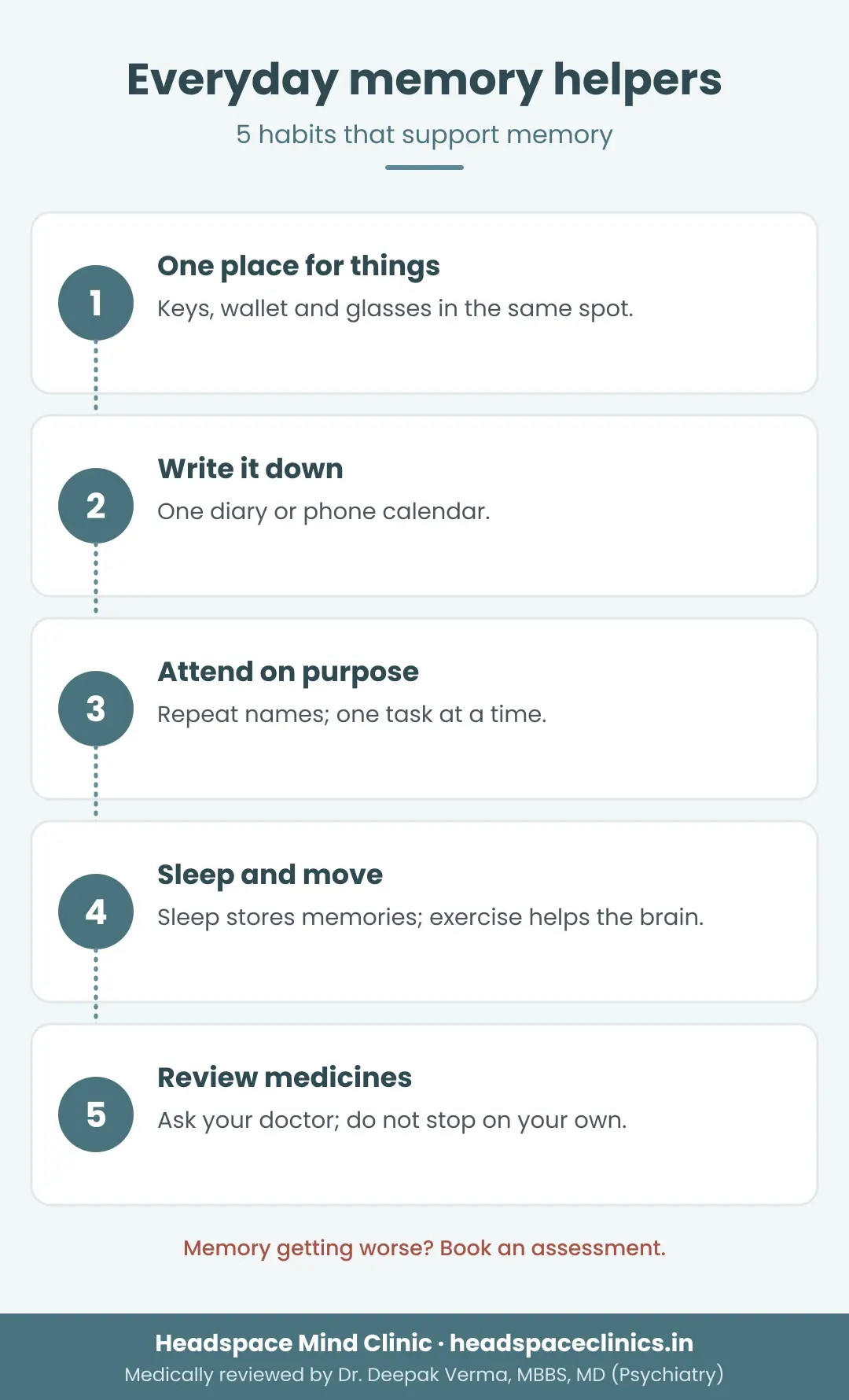
Everyday memory helpers. Tap the image to enlarge.
Use one place for important things. Keys, wallet and glasses always go in the same spot.
Write it down. A single diary or phone calendar for appointments and to-do lists works better than many scraps of paper.
Pay attention on purpose. When you meet someone, repeat their name. Do one thing at a time.
Sleep well and stay active. Sleep helps store memories, and regular physical activity is good for the brain.
Keep your mind and social life busy. Reading, puzzles, learning something new and time with people all help.
Review your medicines. Ask your doctor whether any of your medicines could be affecting memory. Do not stop them on your own.
Is my forgetfulness a sign to get checked?
A quick way to decide whether to talk to a professional. It is not a diagnosis.
Tick the statements that apply to you. Nothing you tick is stored or sent anywhere.
This self-check is an educational aid, not a diagnostic test. Only a qualified professional can assess you properly.
When to get memory problems checked
Book an assessment if forgetfulness is getting worse, is affecting daily life or is worrying your family. Bring a family member if you can, and a list of all your medicines. Sudden confusion, weakness on one side, slurred speech or a head injury needs emergency care: call 112.
Assessment includes a detailed history, memory and thinking tests, a review of medicines and usually blood tests (for example B12 and thyroid). Brain imaging may be suggested in some cases.
How memory problems are treated
Treatment depends on the cause. Memory often improves when depression, anxiety, poor sleep, vitamin deficiency or medicine side effects are treated. For dementia, medicines can help some symptoms for a time, and support for the person and family makes a large difference to daily life. Our clinical psychologists can carry out detailed psychological assessments of memory and thinking.
- Assessment by our consultant psychiatrist
- Memory and thinking tests
- Review of medicines and treatment of reversible causes
- Guidance and support for families
भूलने की आदत (Memory problems in Hindi)
नाम, अपॉइंटमेंट या हाल की बातें भूल जाना कई वजहों से हो सकता है, जैसे तनाव, डिप्रेशन, चिंता, नींद की कमी, विटामिन B12 की कमी, थायरॉइड, शराब या कुछ दवाइयाँ। इनमें से कई कारण ठीक हो सकते हैं। अगर भूलने की समस्या लगातार बढ़ रही है, परिवार वाले चिंतित हैं, या पैसों और दवाइयों को सँभालना मुश्किल हो रहा है, तो जाँच करवाएँ। अचानक भ्रम या कमज़ोरी हो तो तुरंत 112 पर कॉल करें। यह जानकारी केवल शिक्षा के लिए है। अपॉइंटमेंट के लिए कॉल करें: +91 99711 66040
Founder of Headspace Mind Clinic. Dr. Verma sees patients at our Paschim Vihar, Rohini and Narela clinics. About our psychiatry service →
Three clinics in West and North Delhi
Psychiatrist consultation fee: ₹1,800 at Paschim Vihar and Rohini, ₹500 at Narela. All appointments are scheduled; please call or book online.
Frequently asked questions
Usually not. Most forgetfulness is caused by stress, poor attention, poor sleep or normal ageing. Dementia involves memory loss that steadily gets worse and affects daily life. If you are concerned, an assessment can give a clear answer.
Yes. Stress and anxiety take up attention, so information is not taken in properly. This kind of forgetfulness usually improves when the stress or anxiety is treated.
Yes. Depression often causes poor concentration and slowed thinking, which can look like memory loss, especially in older adults. Memory usually improves when the depression is treated.
Vitamin B12 deficiency is a well-known reversible cause. Thyroid problems can have a similar effect. A simple blood test can check for both.
Yes. Some sleeping pills, anti-anxiety tablets, older allergy medicines and medicines for bladder problems can affect memory, particularly in older adults. Ask your doctor for a review, and do not stop any medicine on your own.
A list of all your medicines, any previous reports and, if possible, a family member who has noticed the changes.
Related symptom guides
Book a consultation
Choose your preferred clinic and our team will call you to confirm a time. This form is for appointments only; please do not use it in an emergency.
References
- Livingston G, Huntley J, Sommerlad A, et al. Dementia prevention, intervention, and care: 2020 report of the Lancet Commission. The Lancet. 2020;396(10248):413–446.
- National Institute for Health and Care Excellence (NICE). Dementia: assessment, management and support for people living with dementia and their carers (NG97). nice.org.uk
- World Health Organization. Dementia: fact sheet. who.int
- Tele-MANAS, National Tele Mental Health Programme, Ministry of Health and Family Welfare, Government of India. Helpline 14416.
Medically reviewed by Dr. Deepak Verma (MBBS, MD Psychiatry; DMC Reg. No. 37616). Last reviewed: 15 November 2026.
Medical disclaimer. The information on this page is provided for general educational purposes only. It is not medical advice and is not intended to diagnose, treat, cure or prevent any condition. Reading this page or using the self-check does not create a doctor–patient relationship with Dr. Deepak Verma or Headspace Mind Clinic. Please consult a qualified doctor about any symptom, diagnosis or treatment, and do not start, stop or change any medicine without talking to the doctor who prescribed it. Do not ignore professional advice, or delay seeking it, because of something you have read here. Symptoms, causes and responses to treatment differ from person to person, and no particular result is promised. Links to other websites are given for reference only, and we are not responsible for their content. If you think you or someone else may be facing a medical or mental health emergency, call 112, call Tele-MANAS on 14416 (free, 24×7) or go to the nearest hospital emergency department.