
Why focus slips, and how to get it back
Poor concentration means finding it hard to keep your attention on a task, reading or conversation. Everyone loses focus when tired or stressed. When it lasts for weeks, common reasons include poor sleep, anxiety, depression, stress, constant phone use and ADHD.
Difficulty concentrating is not only an ADHD symptom. One of the most useful questions is when it started: a lifelong pattern since childhood points in a different direction from a recent change.
Signs of poor concentration
Poor concentration can show up at work, in studies and at home:
- Reading the same page several times without taking it in
- Drifting off during conversations or meetings
- Making careless mistakes
- Starting many tasks and finishing few
- Being easily distracted by noise or the phone
- Taking much longer than usual to get things done
- Forgetting what you were about to do
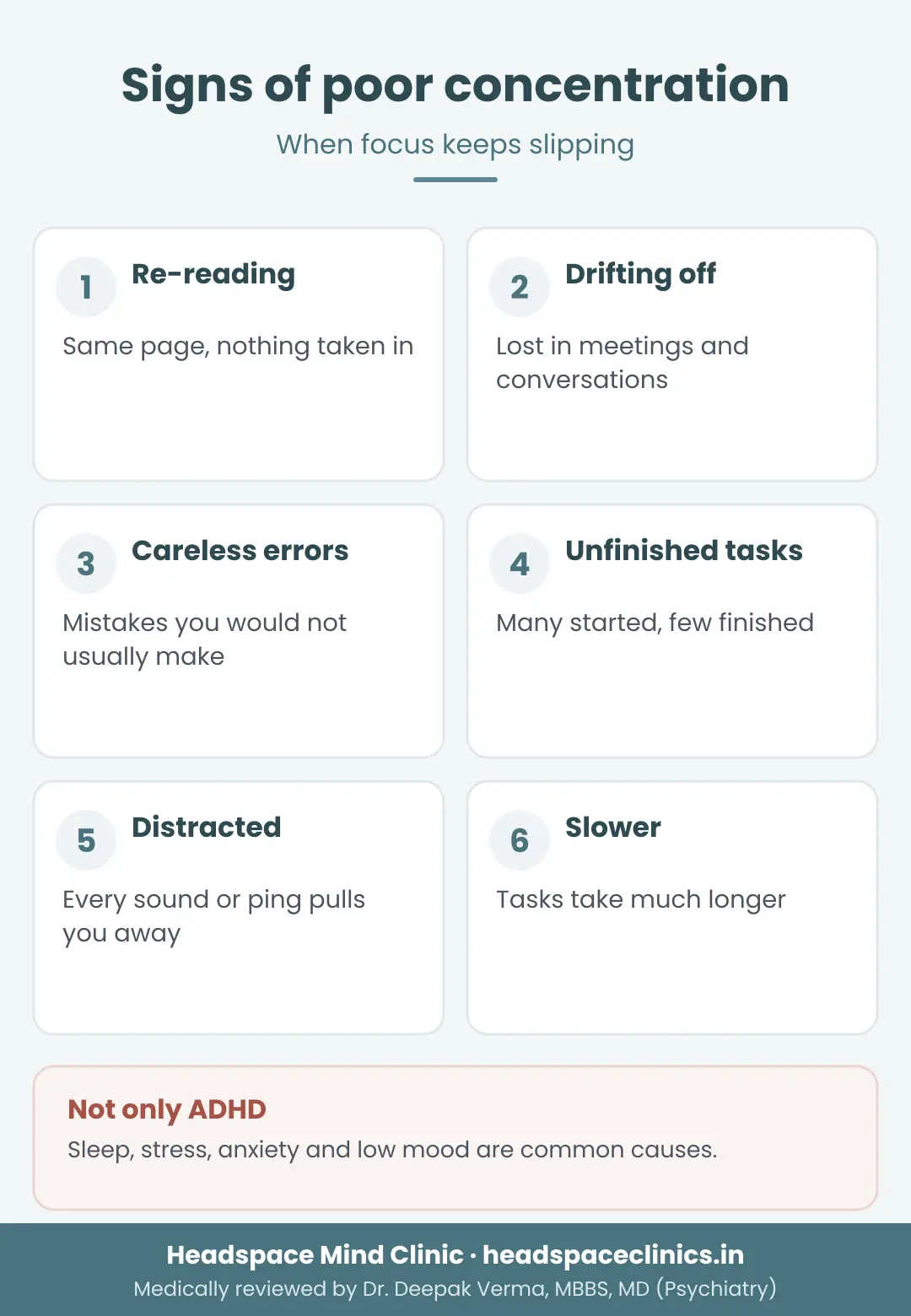
Signs of poor concentration. Tap the image to enlarge.

Difficulty concentrating is not exclusive to ADHD. I assess whether attention problems are longstanding or have developed recently, and whether they are associated with sleep deprivation, anxiety, depression, stress or other conditions. Understanding when the concentration difficulty began is often more useful than looking at the symptom alone.
Dr. Deepak Verma, MBBS, MD (Psychiatry), Consultant Psychiatrist, Headspace Mind Clinic
When did the concentration problem start?
Dr. Verma finds the timeline more revealing than the symptom itself.
A lifelong pattern, present since childhood, seen at school and at home, often with restlessness, impulsivity or disorganisation, raises the possibility of ADHD. School reports and a parent’s memories help.
A recent change, where focus used to be fine and has slipped over weeks or months, points more towards sleep problems, stress, anxiety, depression, a physical illness, a new medicine or substance use.
Both deserve attention, but the treatment is quite different, so it is worth getting the history right.
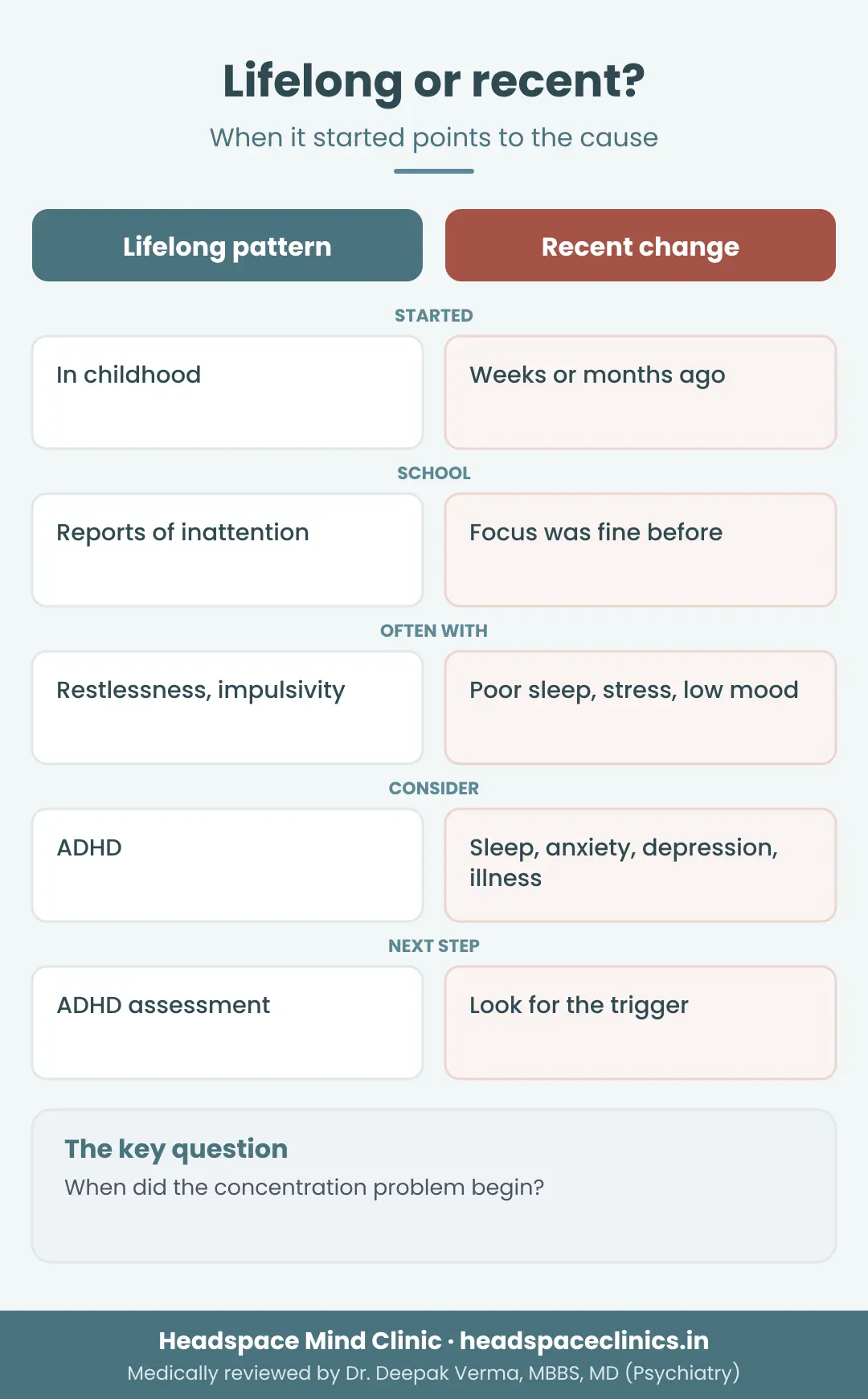
Lifelong vs recent concentration problems. Tap the image to enlarge.
What can cause poor concentration?
Sleep deprivation is one of the most common causes; even one short night reduces attention. Stress, worry, low mood, multitasking and constant notifications also break focus. Physical causes include thyroid problems, anaemia, low blood sugar, pain and some medicines. Alcohol and cannabis affect attention, sometimes for days.
Poor concentration can be part of:
Lifelong inattention, restlessness, impulsivity
Worry takes up mental space
Slowed thinking and low energy
Tired brains cannot focus
A mind that will not settle
When information is not taken in
How to improve concentration
Habits that help most people focus better.
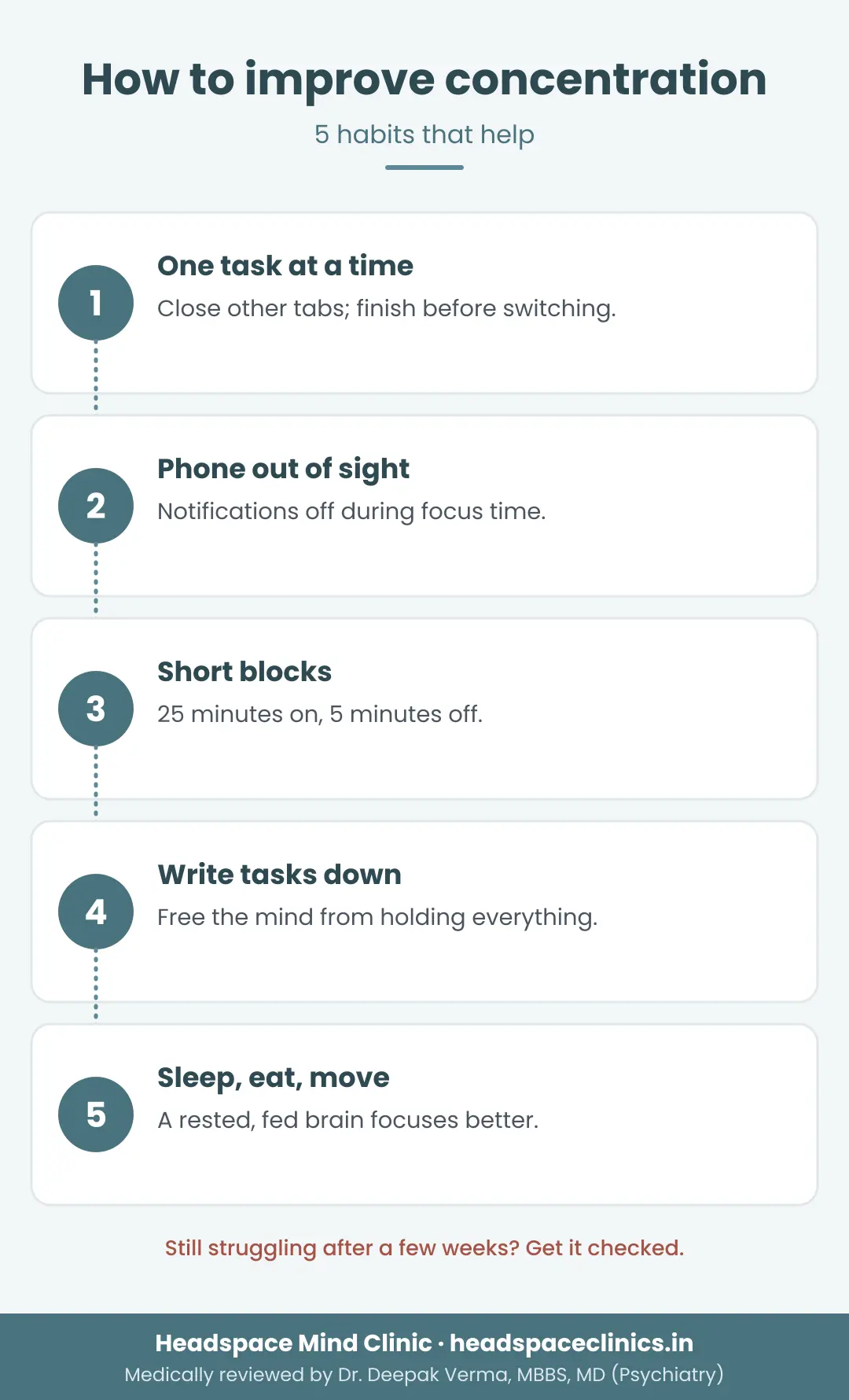
How to improve concentration. Tap the image to enlarge.
One task at a time. Multitasking feels efficient but splits attention. Close other tabs and finish one thing before starting the next.
Put the phone away. Out of sight, ideally in another room, with notifications off during focus time.
Work in short blocks. Try 25 minutes of focused work followed by a 5-minute break. Lengthen the blocks as focus improves.
Write tasks down. A short list frees the mind from holding everything at once.
Sleep, eat and move. Regular sleep, meals and a short walk between blocks keep the brain alert.
Choose your best time. Do the hardest work when you are usually most alert.
Is my poor concentration a sign to get help?
A quick way to decide whether to talk to a professional. It is not a diagnosis.
Tick the statements that apply to you. Nothing you tick is stored or sent anywhere.
This self-check is an educational aid, not a diagnostic test. Only a qualified professional can assess you properly.
When to see a doctor about concentration
See a doctor if poor concentration lasts for weeks, affects work, studies or safety, or comes with low mood, worry, poor sleep or memory problems. A lifelong pattern of inattention since childhood is worth assessing for ADHD at any age.
Your psychiatrist will ask when it started, how it affects your life, and about sleep, mood, stress, substances and medicines. Rating scales, school history and information from family may be used, and blood tests may be suggested.
How poor concentration is treated
The approach depends on the cause. Treating poor sleep, anxiety or depression usually brings concentration back. Adult ADHD can be treated with medicines and practical coaching or CBT for organisation and time management. Our psychologists can also carry out detailed assessments of attention and thinking.
- Assessment by our consultant psychiatrist
- Talking therapy, including CBT, with our clinical psychologists
- Medicines only when they are needed, with regular reviews
- Video follow-ups for existing patients
ध्यान न लगना (Poor concentration in Hindi)
पढ़ाई या काम में ध्यान न लगना, एक ही पेज बार-बार पढ़ना, बातों के बीच ध्यान भटक जाना, ये कमज़ोर एकाग्रता के संकेत हैं। इसकी वजह हमेशा ADHD नहीं होती। नींद की कमी, तनाव, चिंता, डिप्रेशन, मोबाइल का ज़्यादा इस्तेमाल, थायरॉइड या ख़ून की कमी भी कारण हो सकते हैं। यह समस्या कब से है, यह जानना सबसे ज़रूरी है। यह जानकारी केवल शिक्षा के लिए है। अपॉइंटमेंट के लिए कॉल करें: +91 99711 66040
Founder of Headspace Mind Clinic. Dr. Verma sees patients at our Paschim Vihar, Rohini and Narela clinics. About our psychiatry service →
Three clinics in West and North Delhi
Psychiatrist consultation fee: ₹1,800 at Paschim Vihar and Rohini, ₹500 at Narela. All appointments are scheduled; please call or book online.
Frequently asked questions
No. Poor sleep, stress, anxiety, depression, physical illness and some medicines are common causes. ADHD is more likely when attention problems have been present since childhood and affect several areas of life.
Yes. ADHD begins in childhood, but many people are only diagnosed as adults, especially if they coped well at school or were never assessed. Adult ADHD treatment.
Yes. Worry takes up mental space and keeps the brain scanning for threats, so it is harder to focus. Concentration usually improves as anxiety is treated.
Study in short focused blocks, keep the phone in another room, sleep regularly, take short active breaks and start with the hardest subject when you are freshest. If concentration problems persist with low mood or anxiety, talk to a professional.
Yes, strongly. Even one night of short sleep reduces attention and reaction time. Ongoing sleep problems are one of the most common causes of poor focus.
Some can, including certain antihistamines, sleeping tablets and anti-anxiety medicines. Ask your doctor for a review rather than stopping anything on your own.
Related symptom guides
Book a consultation
Choose your preferred clinic and our team will call you to confirm a time. This form is for appointments only; please do not use it in an emergency.
References
- National Institute for Health and Care Excellence (NICE). Attention deficit hyperactivity disorder: diagnosis and management (NG87). nice.org.uk
- Lim J, Dinges DF. A meta-analysis of the impact of short-term sleep deprivation on cognitive variables. Psychological Bulletin. 2010;136(3):375–389.
- World Health Organization. International Classification of Diseases, 11th Revision (ICD-11). icd.who.int: 6A05 Attention deficit hyperactivity disorder.
- Gautam S, Jain A, Gautam M, Vahia VN, Gautam A. Clinical Practice Guidelines for the Management of Generalised Anxiety Disorder (GAD) and Panic Disorder (PD). Indian Journal of Psychiatry. 2017;59(Suppl 1):S67–S73. Indian Psychiatric Society
- Tele-MANAS, National Tele Mental Health Programme, Ministry of Health and Family Welfare, Government of India. Helpline 14416.
Medically reviewed by Dr. Deepak Verma (MBBS, MD Psychiatry; DMC Reg. No. 37616). Last reviewed: 15 November 2026.
Medical disclaimer. The information on this page is provided for general educational purposes only. It is not medical advice and is not intended to diagnose, treat, cure or prevent any condition. Reading this page or using the self-check does not create a doctor–patient relationship with Dr. Deepak Verma or Headspace Mind Clinic. Please consult a qualified doctor about any symptom, diagnosis or treatment, and do not start, stop or change any medicine without talking to the doctor who prescribed it. Do not ignore professional advice, or delay seeking it, because of something you have read here. Symptoms, causes and responses to treatment differ from person to person, and no particular result is promised. Links to other websites are given for reference only, and we are not responsible for their content. If you think you or someone else may be facing a medical or mental health emergency, call 112, call Tele-MANAS on 14416 (free, 24×7) or go to the nearest hospital emergency department.