
No motivation to do anything? It is not always laziness
Lack of motivation means finding it hard to start or keep going with things, even things that matter to you. Everyone has low days. When it lasts for weeks, it can come from exhaustion, low mood, loss of interest, burnout, a physical health problem or difficulty getting started, and each of these needs a different approach.
Persistent loss of motivation is common in depression and several other conditions. It should not be written off as laziness or a lack of willpower.
Signs of low motivation
Low motivation can affect work, studies, self-care and relationships. You might notice:
- Putting things off, even simple or important tasks
- Struggling to get out of bed or start the day
- Losing interest in hobbies, friends or goals
- Feeling that nothing is worth the effort
- Starting tasks but not finishing them
- Neglecting meals, hygiene or household chores
- Feeling guilty about not doing enough
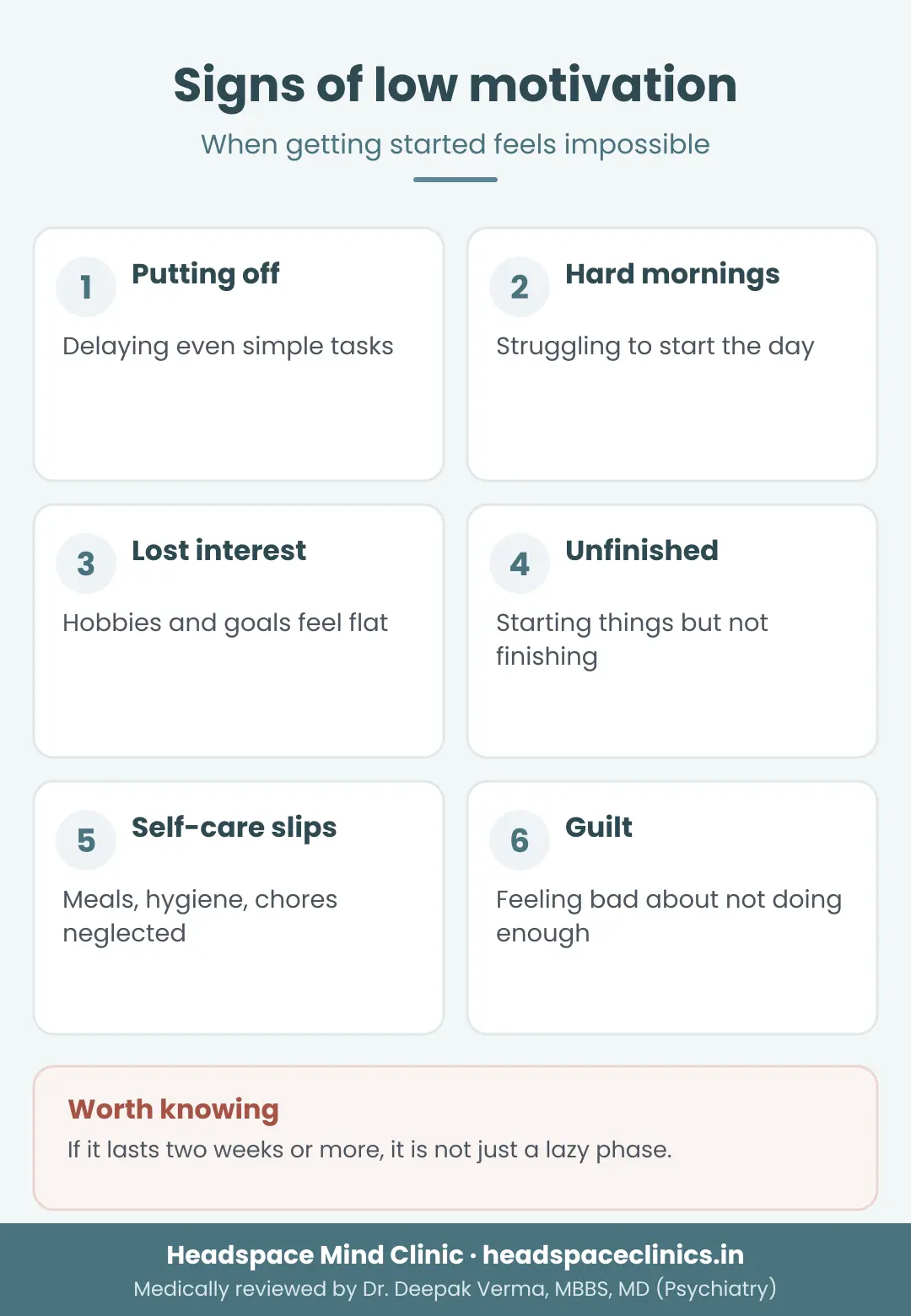
Signs of low motivation. Tap the image to enlarge.

When someone says they have lost motivation, I try to understand whether they are experiencing exhaustion, emotional distress, reduced interest or difficulty initiating activities. Persistent loss of motivation can occur in depression and several other conditions. It should not automatically be labelled as laziness or a lack of willpower.
Dr. Deepak Verma, MBBS, MD (Psychiatry), Consultant Psychiatrist, Headspace Mind Clinic
Why lack of motivation is not the same as laziness
Being called lazy, by others or by yourself, usually makes things worse. Dr. Verma separates several different experiences that all get described as “no motivation”:
- Exhaustion: you want to do things but have no energy, which may point to poor sleep, burnout, anaemia, thyroid problems or depression.
- Emotional distress: stress, grief or worry take up so much space that there is little left for anything else.
- Reduced interest: things that used to bring pleasure now feel flat, a core feature of depression.
- Difficulty starting: you know what to do but cannot get going, common in depression and ADHD.
Working out which of these fits you is the first step, because each has a different solution.
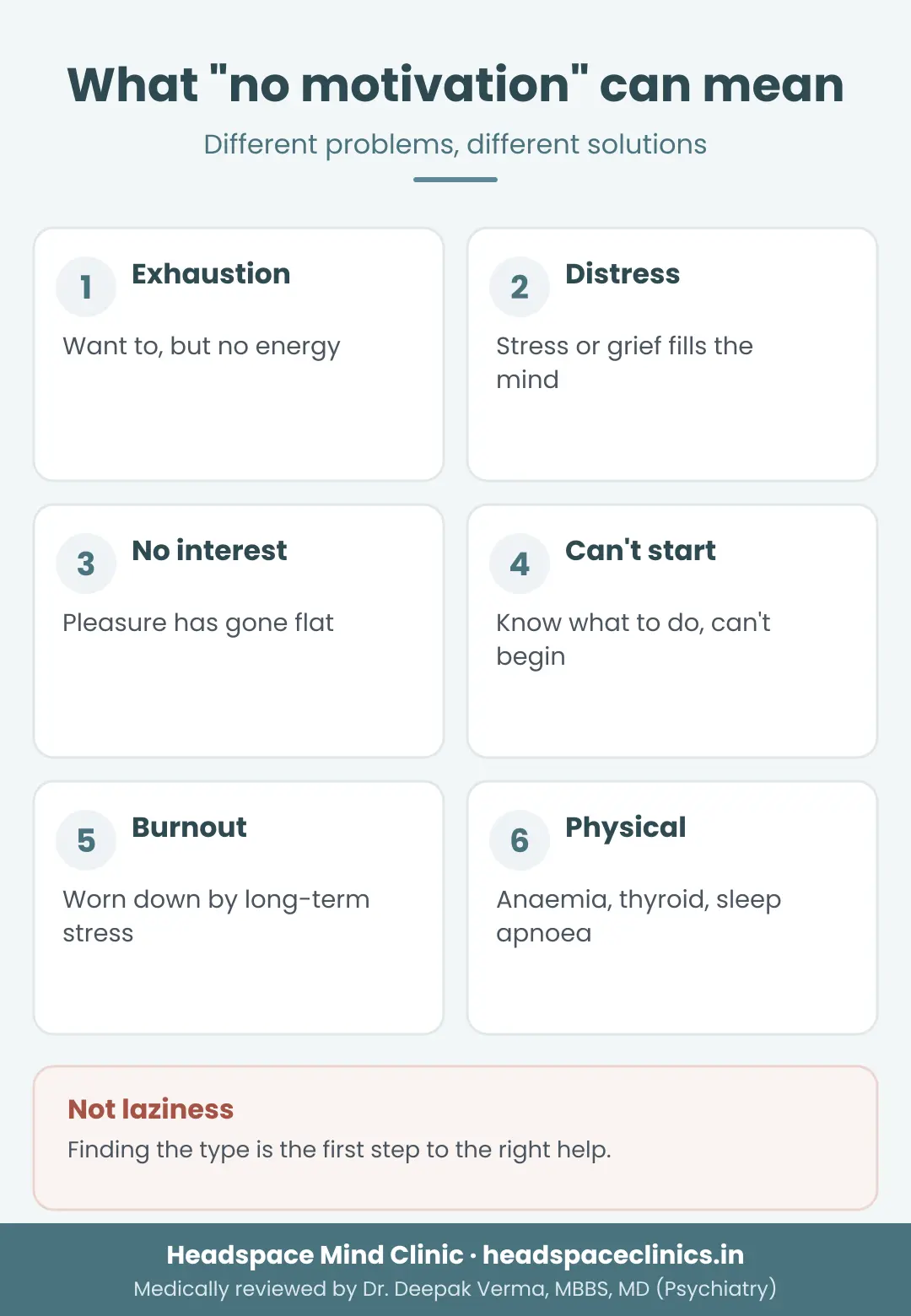
What “no motivation” can mean. Tap the image to enlarge.
What can cause a lack of motivation?
Common causes include long-term stress and burnout, poor sleep, an unhealthy routine, too much screen time and feeling stuck or without clear goals. Physical causes include anaemia, thyroid problems, vitamin B12 or D deficiency, sleep apnoea and side effects of some medicines. Regular cannabis or alcohol use can also blunt motivation.
Persistent low motivation may be part of:
Loss of interest, low energy and low mood
Trouble starting, organising and finishing tasks
Low mood that does not lift
Poor sleep drains energy and drive
When focus slips, tasks feel harder
Substances that blunt drive over time
What helps when motivation is low
Action often comes before motivation, not after it.
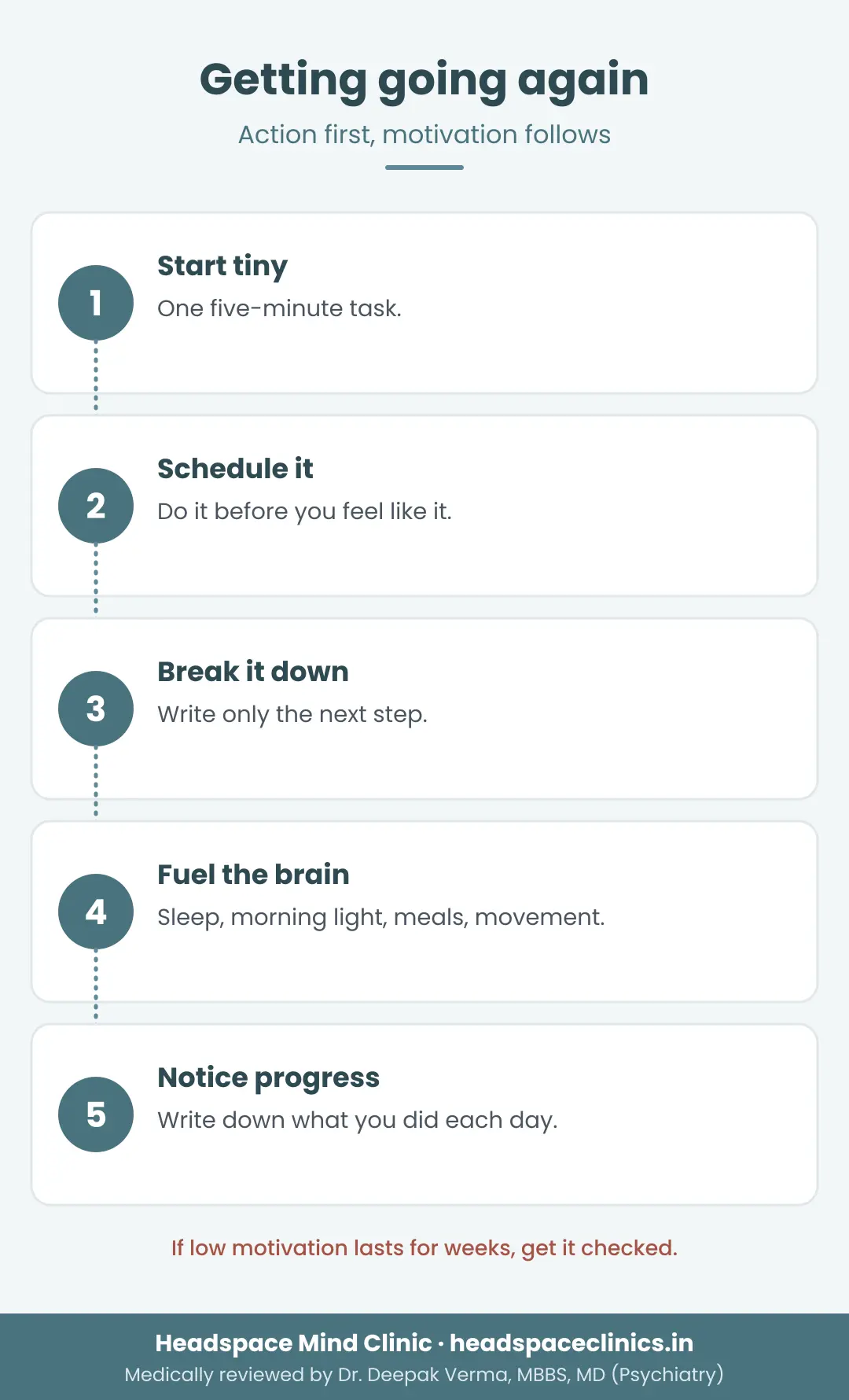
Getting going again. Tap the image to enlarge.
Start very small. Pick a task that takes five minutes and do only that. Finishing something small builds momentum.
Do it before you feel like it. When mood is low, waiting to feel motivated rarely works. Schedule the activity and treat it as an appointment.
Break tasks into steps. “Clean the house” becomes “clear the table”. Write the next step down.
Look after energy. Regular sleep, daylight in the morning, meals and some movement give the brain more to work with.
Reduce easy distractions. Keep the phone in another room for set periods.
Notice progress. Write down what you did each day, however small. Low mood tends to erase it from memory.
Is my lack of motivation a sign to get help?
A quick way to decide whether to talk to a professional. It is not a diagnosis.
Tick the statements that apply to you. Nothing you tick is stored or sent anywhere.
This self-check is an educational aid, not a diagnostic test. Only a qualified professional can assess you properly.
When to see a doctor about low motivation
See a doctor if low motivation has lasted two weeks or more, if it comes with low mood, loss of interest or exhaustion, or if it is affecting work, studies or self-care. Lifelong difficulty starting and finishing tasks is also worth assessing for ADHD.
Your psychiatrist will ask about mood, sleep, energy, routine, substance use and medicines, and may suggest blood tests (for example haemoglobin, thyroid, vitamin B12 and D) to look for physical causes.
How low motivation is treated
Treatment follows the cause. Behavioural activation, a structured way of rebuilding activity step by step, is effective for depression-related low motivation, often combined with CBT. Antidepressants may help when depression is moderate to severe. ADHD has its own treatments. Physical causes such as anaemia or thyroid problems are treated directly, and we can coordinate with your physician.
- Assessment by our consultant psychiatrist
- Talking therapy, including CBT, with our clinical psychologists
- Medicines only when they are needed, with regular reviews
- Video follow-ups for existing patients
कुछ भी करने का मन न करना (Lack of motivation in Hindi)
अगर हफ़्तों से कुछ भी करने का मन नहीं करता, काम शुरू करना मुश्किल लगता है, पहले की पसंदीदा चीज़ों में दिलचस्पी नहीं रही, तो इसे हमेशा आलस समझना ठीक नहीं। थकान, तनाव, डिप्रेशन, नींद की कमी, ADHD, थायरॉइड या ख़ून की कमी भी इसकी वजह हो सकती है। सही कारण जानने के लिए जाँच ज़रूरी है। यह जानकारी केवल शिक्षा के लिए है। अपॉइंटमेंट के लिए कॉल करें: +91 99711 66040
Founder of Headspace Mind Clinic. Dr. Verma sees patients at our Paschim Vihar, Rohini and Narela clinics. About our psychiatry service →
Three clinics in West and North Delhi
Psychiatrist consultation fee: ₹1,800 at Paschim Vihar and Rohini, ₹500 at Narela. All appointments are scheduled; please call or book online.
Frequently asked questions
It can be. Loss of interest and low energy are core features of depression. Low motivation can also come from burnout, poor sleep, ADHD or physical health problems, so an assessment helps find the cause.
Probably not. People who are struggling with motivation usually want to do things and feel guilty when they cannot. Exhaustion, low mood, loss of interest and difficulty starting are real problems with real causes.
Exam stress, fear of failure, poor sleep, too much screen time, low mood and attention difficulties are common reasons. If it has lasted weeks and comes with low mood or anxiety, talk to a professional. Exam anxiety in teenagers.
Low iron (anaemia), vitamin B12 or vitamin D deficiency and thyroid problems can cause tiredness and low drive. A doctor can arrange simple blood tests. Please do not start supplements in high doses without advice.
Burnout is exhaustion, cynicism and reduced effectiveness caused by long-term work stress that has not been managed. The WHO lists it as an occupational phenomenon, not a medical condition. It overlaps with depression and deserves attention.
It varies with the cause. Many people notice small improvements within a few weeks of starting behavioural changes or treatment. Progress is usually gradual rather than sudden.
Related symptom guides
Book a consultation
Choose your preferred clinic and our team will call you to confirm a time. This form is for appointments only; please do not use it in an emergency.
References
- Marin RS. Apathy: a neuropsychiatric syndrome. Journal of Neuropsychiatry and Clinical Neurosciences. 1991;3(3):243–254.
- Gautam S, Jain A, Gautam M, Vahia VN, Grover S. Clinical Practice Guidelines for the management of Depression. Indian Journal of Psychiatry. 2017;59(Suppl 1):S34–S50.
- National Institute for Health and Care Excellence (NICE). Depression in adults: treatment and management (NG222). nice.org.uk
- World Health Organization. Burn-out an “occupational phenomenon”: International Classification of Diseases. 2019. who.int
- Tele-MANAS, National Tele Mental Health Programme, Ministry of Health and Family Welfare, Government of India. Helpline 14416.
Medically reviewed by Dr. Deepak Verma (MBBS, MD Psychiatry; DMC Reg. No. 37616). Last reviewed: 15 November 2026.
Medical disclaimer. The information on this page is provided for general educational purposes only. It is not medical advice and is not intended to diagnose, treat, cure or prevent any condition. Reading this page or using the self-check does not create a doctor–patient relationship with Dr. Deepak Verma or Headspace Mind Clinic. Please consult a qualified doctor about any symptom, diagnosis or treatment, and do not start, stop or change any medicine without talking to the doctor who prescribed it. Do not ignore professional advice, or delay seeking it, because of something you have read here. Symptoms, causes and responses to treatment differ from person to person, and no particular result is promised. Links to other websites are given for reference only, and we are not responsible for their content. If you think you or someone else may be facing a medical or mental health emergency, call 112, call Tele-MANAS on 14416 (free, 24×7) or go to the nearest hospital emergency department.