
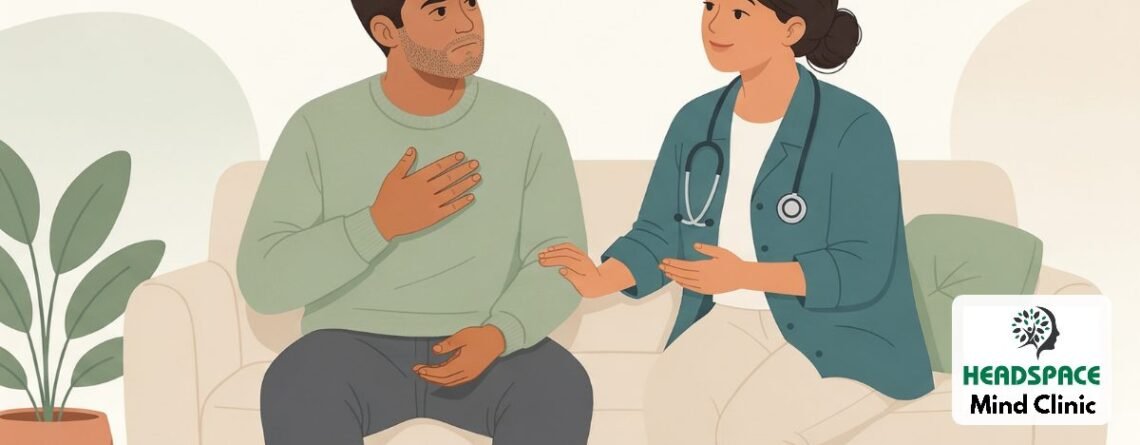
A tight chest, a racing heart and the feeling that you can’t breathe properly are frightening. Many people who come to us have spent months, sometimes years, going from one heart test to the next, only to be told their heart is fine. Anxiety can cause real, physical chest pain. But chest pain can also be a heart problem, so the first rule matters more than anything else on this page.
First: when to treat chest pain as an emergency
Safety first: the right order
Or pain with sweating, breathlessness, pain spreading to arm or jaw
Call 112 or go to the nearest emergency
But symptoms keep coming back
About anxiety and panic
Call 112 or go to the nearest hospital emergency straight away if you have chest pain that:
- is new, or different from pain you’ve had checked before
- feels like heavy pressure, squeezing or tightness, especially if it lasts more than a few minutes
- spreads to your arm, jaw, neck or back
- comes with breathlessness, sweating, nausea, dizziness or fainting
- starts during physical effort
Take extra care if you are over 40, or have diabetes, high blood pressure, high cholesterol, kidney disease, smoke, or have heart disease in the family. Never assume chest pain is “just anxiety” until a doctor has checked your heart. Only an examination and tests can tell the two apart with confidence.
How anxiety causes chest pain
When you feel anxious, your body releases stress hormones such as adrenaline. This prepares you to deal with danger, and it has physical effects:
- Your heart beats faster and harder, which you feel as pounding or palpitations.
- You breathe faster and more shallowly. Over-breathing can cause chest tightness, light-headedness and tingling in the hands and lips.
- The muscles of your chest wall tense up. This can cause sharp, stabbing or aching pain, sometimes sore to the touch, that can linger after the anxiety settles.
- Your attention locks onto your chest. Noticing every beat makes the anxiety, and so the symptoms, worse.
How anxiety chest pain often differs
These are common patterns, not rules. Many symptoms overlap, which is why a heart check comes first.
| Often seen with anxiety | More worrying for the heart |
|---|---|
| Sharp or stabbing pain in one small spot | Heavy pressure or squeezing across the chest |
| Comes on at rest, during worry or stress | Comes on with effort, such as walking fast or climbing stairs |
| With tingling, trembling and fear | With sweating, nausea or breathlessness |
| Eases as the panic settles, often within 10–20 minutes | Lasts, or keeps coming back with effort |
| Heart tests already normal | Spreads to the arm, jaw, neck or back |
Your heart tests are normal. What now?
If a doctor has examined you and your ECG and other tests were normal, but the symptoms keep coming back, anxiety or panic attacks are a likely cause. This is common, and it is treatable. Repeating the same heart tests again and again usually doesn’t help, and it can keep the fear going. If a new or different symptom appears, get it checked; otherwise, it’s time to treat the anxiety itself.
Palpitations: how to calm a racing heart caused by anxiety
- Slow your breathing: breathe in through your nose for a count of 4 and out slowly through your mouth for a count of 6. Keep going for 5 minutes.
- Remind yourself what is happening: “This is my body’s alarm. It is uncomfortable, but it will pass.”
- Cut down caffeine: tea, coffee, energy drinks and cola can all trigger palpitations. So can smoking and alcohol.
- Sleep and move: poor sleep makes palpitations more likely; regular walking or exercise lowers resting anxiety.
See a doctor promptly if palpitations come with fainting, chest pain or breathlessness, feel very fast or irregular, or if you have known heart disease.
Try this: slow breathing for a racing heart
- Sit down, shoulders relaxed
- Breathe in through the nose for 4 counts
- Breathe out slowly for 6 counts
- Repeat for 3 to 5 minutes
The health anxiety loop
The loop keeps going until it is broken. Understanding it, slow breathing and treatment all help.
Some people get caught in a cycle: a symptom appears, they check their pulse, search online, feel more frightened, the symptoms get stronger, and they rush for another test. The relief after a normal result lasts a short time, until the next symptom. Breaking this loop is a large part of treatment, and therapy is good at it.
Treatment
What happens when you come to us
20–30 min, sometimes longer
Symptoms, health, tests if needed
Therapy, medicines or both
Check progress, adjust the plan
- Therapy: cognitive behavioural therapy (CBT) is one of the most effective treatments for panic attacks and health anxiety. You learn to understand your body’s alarm system and to respond to symptoms without spiralling.
- Medicines: when needed, a doctor may prescribe medicine. Some people are given a medicine also used for blood pressure, because it eases a racing heart and trembling; it is prescribed for the anxiety, not because you have high blood pressure. Common questions about medicines
- Many people do best with both.
At Headspace Mind Clinic, our psychiatrist and psychologists treat anxiety and panic at our outpatient (OPD) clinics in Paschim Vihar, Rohini and Narela, and our psychologists also offer therapy online. Anxiety treatment · What to expect at your first visit · Hindi readers: घबराहट क्यों होती है?
Common questions
Can anxiety chest pain last for days?
The sharp pain of a panic attack usually settles within minutes. Tense chest muscles can leave a dull ache or soreness for hours or a day or two. Any new chest pain, or pain that is getting worse, should still be checked.
Can anxiety cause a heart attack?
A panic attack makes your heart race, but in a healthy heart it doesn’t usually cause damage. Long-term stress and anxiety are, however, linked to heart disease over the years, which is one more reason to treat anxiety rather than live with it.
Should I go to the emergency every time I get chest pain?
If the pain is new, different, severe, or comes with the warning signs above, yes. If your doctor has already checked your heart and your symptoms are the same familiar pattern, agree a plan with your doctor about when to seek urgent care.
In an emergency: if you or someone else is in immediate danger, call 112, Tele-MANAS 14416 (24×7, free) or go to the nearest hospital emergency.
Reviewed by Dr. Deepak Verma (MBBS, MD Psychiatry; DMC Reg. No. 37616). Last reviewed: 25 November 2026. General information, not a substitute for advice from your own doctor.


Leave a Reply