
Support for children, teenagers and their parents
A child psychologist helps children and teenagers with emotional, behavioural, developmental and learning difficulties, and works closely with parents. Most help is through assessment, talking and play-based therapy, and practical guidance for the family, without medicines.
At Headspace Mind Clinic, our RCI-registered clinical psychologists see children and adolescents at all three of our clinics, and work with our psychiatrist when a medical opinion is needed.
For education only. This page explains a treatment in general terms. It is not medical advice and cannot replace a consultation with a qualified doctor who knows your history. Whether a treatment suits you can only be decided after an assessment. If you are in danger or think you may harm yourself, call 112 or Tele-MANAS 14416 now.
What a child psychologist can help with
Parents most often come to us about:
- Tantrums, anger, defiance or aggression
- Worry, fears, school refusal or low mood
- Attention, hyperactivity and difficulties at school
- Development, social skills and communication (autism)
- Screen use, sleep or eating habits that cause conflict
- Teenage stress, exams, peer problems and self-esteem
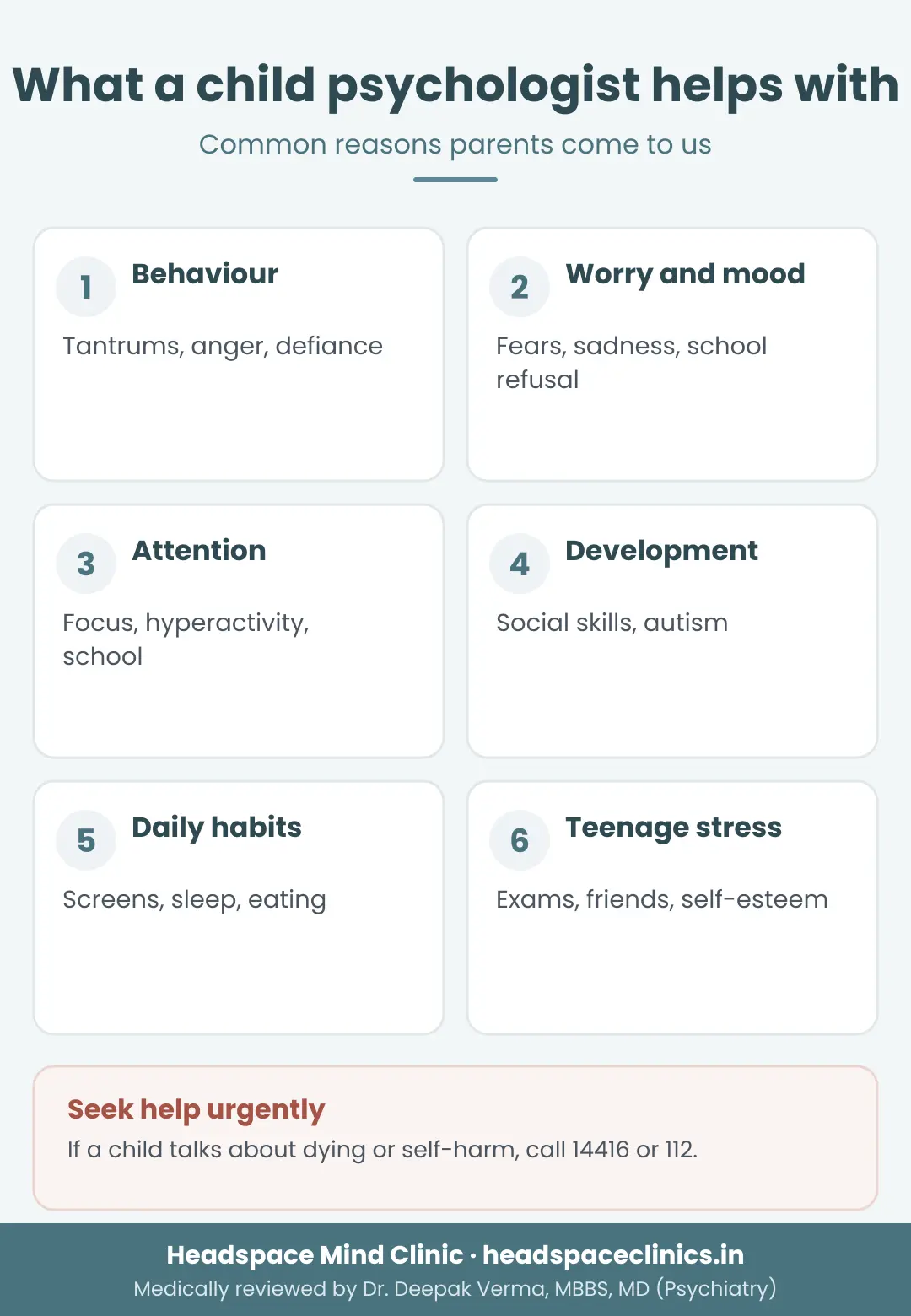
What a child psychologist helps with. Tap the image to enlarge.
When should parents seek help?
All children go through difficult phases. It is worth seeing a child psychologist when a difficulty:
- has lasted for several weeks or keeps coming back
- is affecting school, friendships or family life
- is noticed by teachers or other adults, not only at home
- is getting worse rather than better
- leaves you, as a parent, feeling stuck or exhausted
Seek help urgently if a child or teenager talks about wanting to die, harms themselves, or seems out of touch with reality. Call Tele-MANAS 14416 or 112, or go to the nearest hospital emergency. See also self-harm and suicidal thoughts.
How child psychology helps
Children cannot always explain what they feel, so it often shows up as behaviour. A child psychologist looks at the child’s development, temperament, school and family together, then works with both the child and the parents. Approaches are chosen for the child’s age and needs, for example behaviour therapy and parent guidance for younger children, and CBT for older children and teenagers. Related pages:
IQ, autism and other testing
Changing difficult behaviour
For worry and low mood
Working with the whole family
Assessment and support
When medical treatment is needed
What happens at the first visit
What parents can expect.
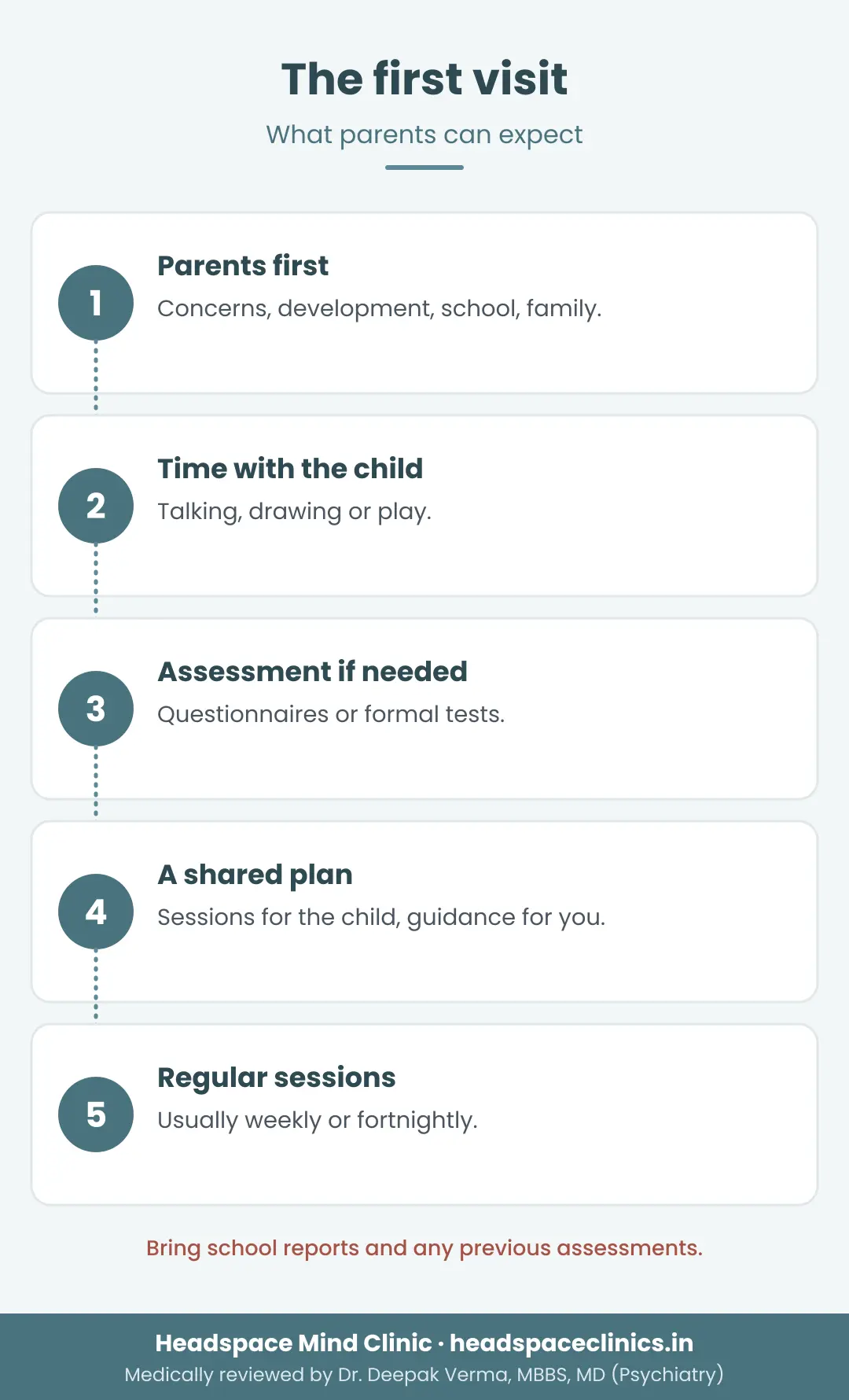
What happens at the first visit. Tap the image to enlarge.
Parents first. Usually we start by talking with parents about the concern, the child’s development, health, school and family.
Time with the child. The psychologist meets the child in an age-appropriate way, through talking, drawing or play, and with teenagers often partly on their own.
Assessment if needed. Sometimes questionnaires, school reports or formal tests help to understand the difficulty.
A shared plan. We explain what we think is going on and agree a plan, which often includes sessions for the child and guidance for parents.
Regular sessions. Usually weekly or every two weeks. The number of sessions depends on the difficulty.
Please bring any school reports, previous assessments and prescriptions to the first visit.
Child psychologist or child psychiatrist?
A child psychologist assesses and treats through talking, play, behaviour therapy and parent guidance, and does not prescribe medicines. A psychiatrist is a medical doctor who can diagnose, check for medical causes and prescribe medicines when they are needed.
Most children start with a psychologist. A psychiatrist’s opinion is helpful when symptoms are severe, when there are concerns about safety, or when conditions such as ADHD may need medicine. At Headspace both work together, so you do not need to start again elsewhere. See child and adolescent psychiatry.
Child and adolescent psychology at Headspace Mind Clinic
Children and teenagers are seen by our RCI-registered clinical psychologists, including Pooja Sharma, who has worked extensively with children, adolescents and parents, including at Sir Ganga Ram Hospital, Dr. Tanuja Bhardwaj and Surmeet Kaur. Appointments are available at all three of our clinics, with our psychiatrist Dr. Deepak Verma involved when needed.
चाइल्ड साइकोलॉजिस्ट कैसे मदद करते हैं? (Child psychologist in Hindi)
चाइल्ड साइकोलॉजिस्ट बच्चों और किशोरों की भावनात्मक, व्यवहार संबंधी, विकास और पढ़ाई से जुड़ी कठिनाइयों में मदद करते हैं, जैसे गुस्सा और ज़िद, डर और चिंता, ध्यान की कमी, स्कूल जाने से इनकार या परीक्षा का तनाव। वे बच्चे के साथ-साथ माता-पिता को भी मार्गदर्शन देते हैं। अगर बच्चा खुद को नुकसान पहुँचाने की बात करे, तो तुरंत Tele-MANAS 14416 या 112 पर कॉल करें। यह जानकारी केवल शिक्षा के लिए है। अपॉइंटमेंट के लिए कॉल करें: +91 99711 66040

Founder of Headspace Mind Clinic. Dr. Verma sees patients at our Paschim Vihar, Rohini and Narela clinics. About our psychiatry service →
Three clinics in West and North Delhi
Psychiatrist consultation fee: ₹1,800 at Paschim Vihar and Rohini, ₹500 at Narela. All appointments are scheduled; please call or book online.
Frequently asked questions
There is no lower age limit. Young children are usually helped mainly through their parents and play-based sessions, and older children and teenagers take part more directly.
Psychologists do not prescribe medicines. Most children are helped through therapy and parent guidance. If medicine might help, our psychiatrist will discuss it with you first.
Often, yes, especially for younger children. With teenagers, part of the session is usually private, and the psychologist explains how confidentiality works.
Parents can come for the first session on their own. The psychologist can suggest how to explain the visit to your child.
Yes. We look at learning, attention, emotions and behaviour, and can suggest support at school. A psychological assessment may help.
Yes. Information is shared only with your consent, except where there is a risk to the child’s safety.
Related symptom guides
Explore other treatments
PsychotherapyCognitive behavioural therapy (CBT)Dialectical behaviour therapy (DBT)Exposure and response prevention (ERP)Family therapyBehaviour therapyMindfulness therapySupportive therapyClinical psychologist in DelhiPsychological assessmentsNeuromodulation (rTMS, tDCS)rTMS for depressionrTMS for OCDrTMS for anxietyAntidepressants explainedDepression medication guideAnti-anxiety medicinesAnxiety medication guide
Book a consultation
Choose your preferred clinic and our team will call you to confirm a time. This form is for appointments only; please do not use it in an emergency.
References
- Weisz JR, Kuppens S, Ng MY, et al. What five decades of research tells us about the effects of youth psychological therapy: a multilevel meta-analysis and implications for science and practice. American Psychologist. 2017;72(2):79–117.
- National Institute for Health and Care Excellence (NICE). Antisocial behaviour and conduct disorders in children and young people: recognition and management (CG158). nice.org.uk
- National Institute for Health and Care Excellence (NICE). Autism spectrum disorder in under 19s: recognition, referral and diagnosis (CG128). nice.org.uk
- Tele-MANAS, National Tele Mental Health Programme, Ministry of Health and Family Welfare, Government of India. Helpline 14416.
Medically reviewed by Dr. Deepak Verma (MBBS, MD Psychiatry; DMC Reg. No. 37616). Last reviewed: 15 November 2026.
Medical disclaimer. The information on this page is provided for general educational purposes only. It is not medical advice and is not intended to diagnose, treat, cure or prevent any condition. Reading this page or using the self-check does not create a doctor–patient relationship with Dr. Deepak Verma or Headspace Mind Clinic. Please consult a qualified doctor about any symptom, diagnosis or treatment, and do not start, stop or change any medicine without talking to the doctor who prescribed it. Do not ignore professional advice, or delay seeking it, because of something you have read here. Symptoms, causes and responses to treatment differ from person to person, and no particular result is promised. Links to other websites are given for reference only, and we are not responsible for their content. If you think you or someone else may be facing a medical or mental health emergency, call 112, call Tele-MANAS on 14416 (free, 24×7) or go to the nearest hospital emergency department.