
When anger feels out of control
Anger is a normal emotion. Anger issues means anger that comes too often, too strongly or in ways that hurt you or others: shouting, breaking things, saying things you regret or getting physical. Many people with frequent outbursts feel ashamed afterwards and do not know why it keeps happening.
Understanding what happens before, during and after an outburst is the key to changing it. Stress, poor sleep, alcohol, depression, anxiety, ADHD and other conditions can all fuel anger, and most of them can be treated.
Signs your anger may need attention
Ask yourself honestly, or ask someone close to you, whether these apply:
- Losing your temper several times a week
- Shouting, swearing or throwing and breaking things
- Anger that is far bigger than the situation
- Feeling it builds up quickly and you cannot stop it
- Saying or doing things you regret afterwards
- Family members feeling afraid of your reactions
- Problems at work, on the road or with the law because of anger
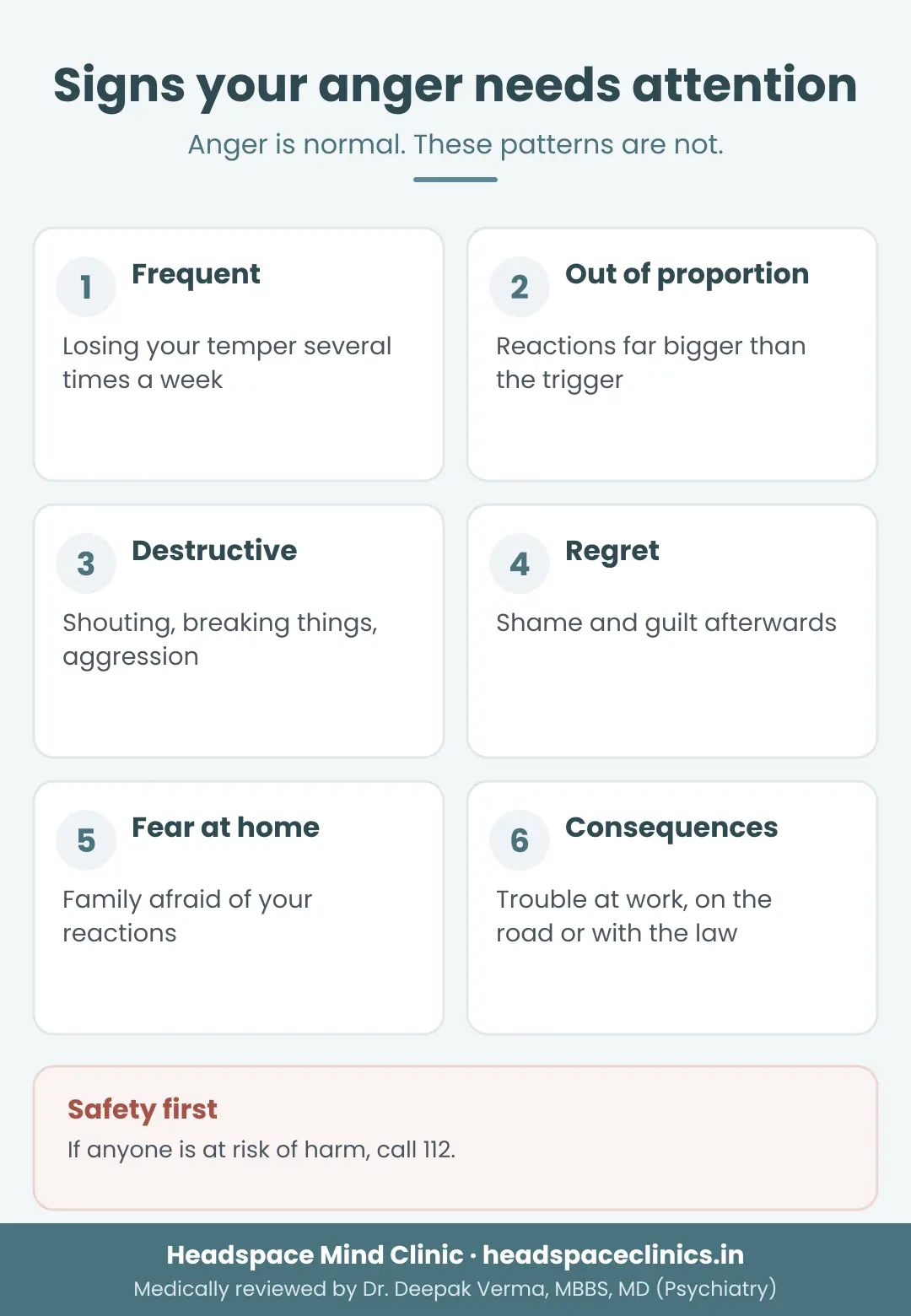
Signs your anger needs attention. Tap the image to enlarge.

In my consultations, I try to understand what happens before, during and after an episode of anger. Frequent anger outbursts may be associated with stress, emotional regulation difficulties, mood disorders, substance use or other underlying concerns. The goal is to identify the triggers and patterns rather than simply telling someone to control their temper.
Dr. Deepak Verma, MBBS, MD (Psychiatry), Consultant Psychiatrist, Headspace Mind Clinic
What happens before, during and after an outburst
Anger rarely comes from nowhere. Dr. Verma asks patients to walk through an episode step by step, because the pattern usually points to the cause and to the places where change is possible.
Before: a trigger (criticism, feeling ignored, delays, money worries) lands on a body that is already tired, hungry, stressed or affected by alcohol. Thoughts like “they are doing this on purpose” add fuel.
During: the body moves into fight mode. Heart rate rises, muscles tense and thinking narrows, so it becomes very hard to reason.
After: people often feel drained, guilty or ashamed, and relationships take damage. Sometimes the outburst brings short-term relief, which can make it more likely next time.
Changing anger means working on all three stages, not only the moment of the outburst.
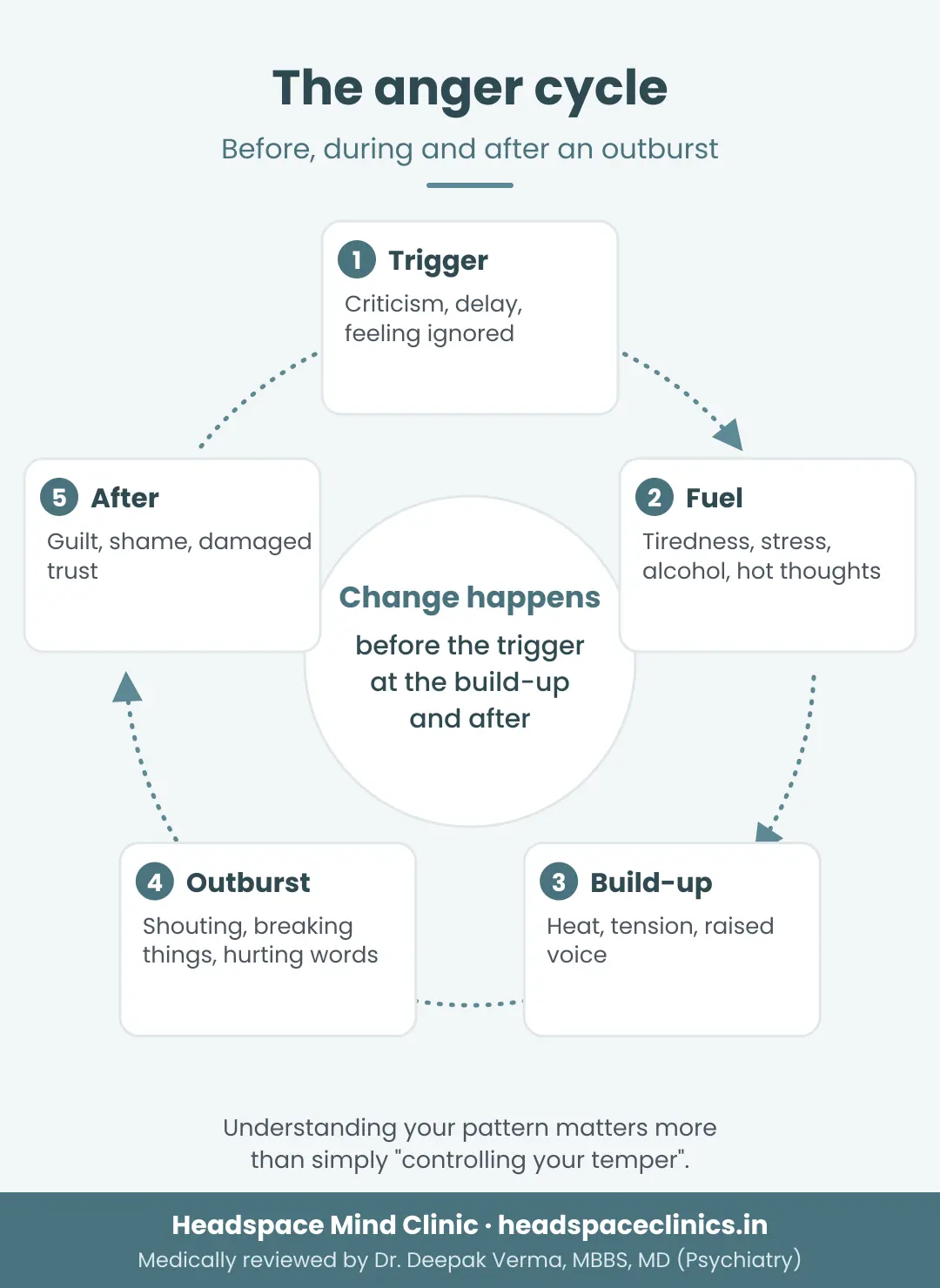
The anger cycle. Tap the image to enlarge.
What can fuel frequent anger?
Ongoing stress, conflict at home or work, long hours, lack of sleep and pain all lower the threshold for anger. Alcohol and drugs remove the brakes. Some people never learned other ways of handling strong feelings, and past trauma can make people quick to sense threat.
Frequent anger can also be part of:
Irritability and anger instead of sadness
Anger and irritability during episodes
Impulsivity and low frustration tolerance
Substances that remove self-control
Intense emotions that are hard to regulate
A short fuse that comes before outbursts
Managing anger: practical steps
Skills that work best when practised regularly, not only in the heat of the moment.
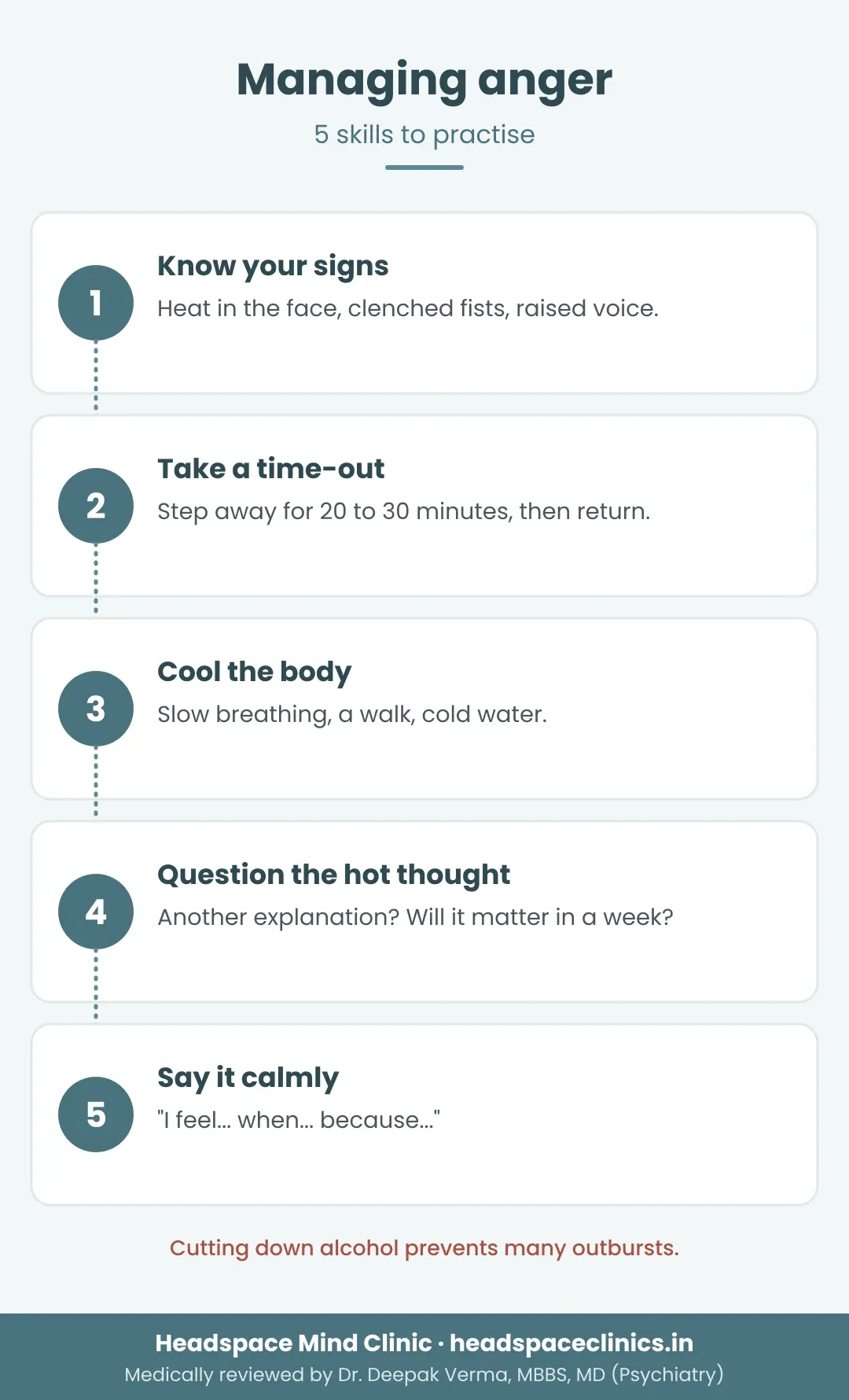
Managing anger. Tap the image to enlarge.
Know your warning signs. Heat in the face, a clenched fist, a raised voice. These are signals to act before anger peaks.
Take a time-out. Agree in advance with your family that either of you can say “time-out” and step away for 20 to 30 minutes, then return to the conversation.
Cool the body. Slow breathing, a walk or splashing water on your face brings the heart rate down so you can think again.
Question the hot thought. Ask, “Is there another explanation? Will this matter in a week?”
Say it, do not shout it. When calm, use “I feel… when… because…” to explain what upset you.
Cut down alcohol. A large share of outbursts happen after drinking.
Is my anger a sign to get help?
A quick way to decide whether to talk to a professional. It is not a diagnosis.
Tick the statements that apply to you. Nothing you tick is stored or sent anywhere.
This self-check is an educational aid, not a diagnostic test. Only a qualified professional can assess you properly.
When to see a doctor about anger
Seek help if outbursts are frequent, if anyone has been hurt or frightened, or if anger is affecting your work or relationships. If there is an immediate risk of violence, call 112.
At the consultation your psychiatrist will go through recent episodes in detail, ask about sleep, mood, alcohol, drugs, medicines and stress, and look for conditions such as depression, bipolar disorder or ADHD that may be driving the anger.
How anger problems are treated
Cognitive behavioural approaches to anger are well studied. They teach you to recognise triggers and early signs, change the thoughts that fuel anger and practise calmer responses. Treating an underlying condition, such as depression, bipolar disorder, ADHD or alcohol use, often reduces anger a great deal. Where relationships have been affected, family or couple sessions can help.
- Assessment by our consultant psychiatrist
- Talking therapy, including CBT, with our clinical psychologists
- Medicines only when they are needed, with regular reviews
- Video follow-ups for existing patients
ज़्यादा ग़ुस्सा आना (Anger issues in Hindi)
ग़ुस्सा एक सामान्य भावना है, लेकिन जब यह बार-बार, बहुत तेज़ आए, चीज़ें तोड़ने, चिल्लाने या हाथ उठाने तक पहुँच जाए, और बाद में पछतावा हो, तो इसे ध्यान देने की ज़रूरत है। तनाव, नींद की कमी, शराब, डिप्रेशन, बाइपोलर डिसऑर्डर और ADHD इसके पीछे हो सकते हैं। ग़ुस्से से पहले, दौरान और बाद में क्या होता है, यह समझना इलाज का पहला क़दम है। यह जानकारी केवल शिक्षा के लिए है। अपॉइंटमेंट के लिए कॉल करें: +91 99711 66040
Founder of Headspace Mind Clinic. Dr. Verma sees patients at our Paschim Vihar, Rohini and Narela clinics. About our psychiatry service →
Three clinics in West and North Delhi
Psychiatrist consultation fee: ₹1,800 at Paschim Vihar and Rohini, ₹500 at Narela. All appointments are scheduled; please call or book online.
Frequently asked questions
No. Anger is a normal emotion. It becomes a problem when it is frequent, intense or harmful. Persistent anger outbursts can be linked to stress, mood disorders, ADHD, substance use or difficulty regulating emotions, which a professional can assess.
It is a diagnosis for repeated, sudden outbursts of verbal or physical aggression that are far out of proportion to the trigger and are not better explained by another condition. Only a professional can make this diagnosis.
Yes. Some people with depression feel mostly irritable or angry rather than sad. Treating the depression often reduces the anger.
Yes, when practised regularly. Learning to recognise warning signs, take time-outs, calm the body and challenge angry thoughts helps most people reduce outbursts. Structured therapy works better than reading tips alone.
There is no specific medicine for anger. When anger comes from a condition such as depression, bipolar disorder or ADHD, treating that condition, sometimes with medicine, usually helps.
Choose a calm moment to talk, describe specific incidents and how they affected you, and encourage them to get help. Your safety comes first: if you feel unsafe, leave the situation and call 112 if needed.
Related symptom guides
Book a consultation
Choose your preferred clinic and our team will call you to confirm a time. This form is for appointments only; please do not use it in an emergency.
References
- American Psychological Association. Control anger before it controls you. apa.org
- Beck R, Fernandez E. Cognitive-behavioral therapy in the treatment of anger: a meta-analysis. Cognitive Therapy and Research. 1998;22(1):63–74.
- World Health Organization. International Classification of Diseases, 11th Revision (ICD-11). icd.who.int: 6C73 Intermittent explosive disorder.
- Tele-MANAS, National Tele Mental Health Programme, Ministry of Health and Family Welfare, Government of India. Helpline 14416.
Medically reviewed by Dr. Deepak Verma (MBBS, MD Psychiatry; DMC Reg. No. 37616). Last reviewed: 15 November 2026.
Medical disclaimer. The information on this page is provided for general educational purposes only. It is not medical advice and is not intended to diagnose, treat, cure or prevent any condition. Reading this page or using the self-check does not create a doctor–patient relationship with Dr. Deepak Verma or Headspace Mind Clinic. Please consult a qualified doctor about any symptom, diagnosis or treatment, and do not start, stop or change any medicine without talking to the doctor who prescribed it. Do not ignore professional advice, or delay seeking it, because of something you have read here. Symptoms, causes and responses to treatment differ from person to person, and no particular result is promised. Links to other websites are given for reference only, and we are not responsible for their content. If you think you or someone else may be facing a medical or mental health emergency, call 112, call Tele-MANAS on 14416 (free, 24×7) or go to the nearest hospital emergency department.