
Sadness that stays, and what it might mean
Persistent sadness is low mood that lasts most of the day, on most days, for two weeks or more. It does not always look like crying. Many people describe feeling empty, flat or cut off from things they used to enjoy.
Sadness after a loss or disappointment is a normal human response and usually eases with time. When it stays, deepens or starts to affect sleep, appetite, work or relationships, it may be depression, which is common and treatable.
Signs of persistent sadness
Low mood can show up in the mind, the body and in behaviour. Family members sometimes notice the changes before the person does. Look out for:
- Feeling sad, empty or numb most of the day
- Losing interest or pleasure in things you used to enjoy
- Crying more easily, or not being able to cry at all
- Sleeping much more or much less than usual
- Changes in appetite or weight
- Low energy and tiredness that rest does not fix
- Feeling worthless or guilty
- Pulling away from friends and family
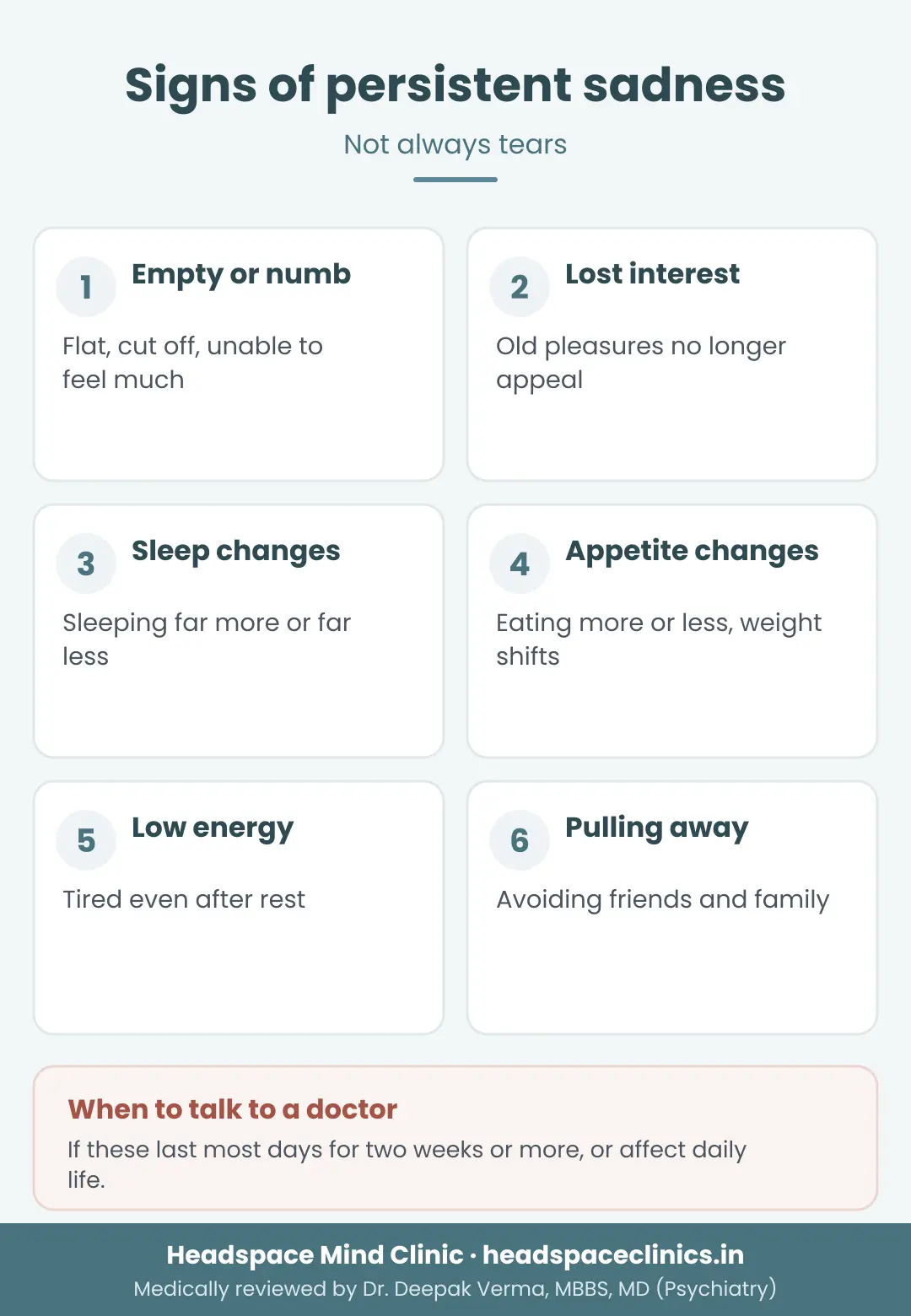
Signs of persistent sadness. Tap the image to enlarge.

In my clinical practice, I have seen that persistent sadness is not always expressed through crying. Some people describe feeling emotionally empty, disconnected or unable to enjoy things they once loved. When this feeling continues, it deserves a proper mental health assessment rather than being dismissed as a temporary low mood.
Dr. Deepak Verma, MBBS, MD (Psychiatry), Consultant Psychiatrist, Headspace Mind Clinic
Ordinary sadness or depression?
Sadness is a normal response to a loss, a disappointment or a hard time. It tends to come in waves, eases with support and still leaves room for moments of enjoyment.
Depression is more than sadness. It lasts at least two weeks, affects most of the day and usually brings other changes: loss of interest, disturbed sleep and appetite, poor concentration, low self-worth and sometimes thoughts that life is not worth living. As Dr. Verma notes, it does not always involve tears. Feeling empty or disconnected can be just as significant.
If you are unsure which one you are going through, an assessment can help you find out. You do not need to wait until things are severe. If you have been wondering why you feel low without an obvious reason, you may also find Why am I feeling sad for no reason? useful.
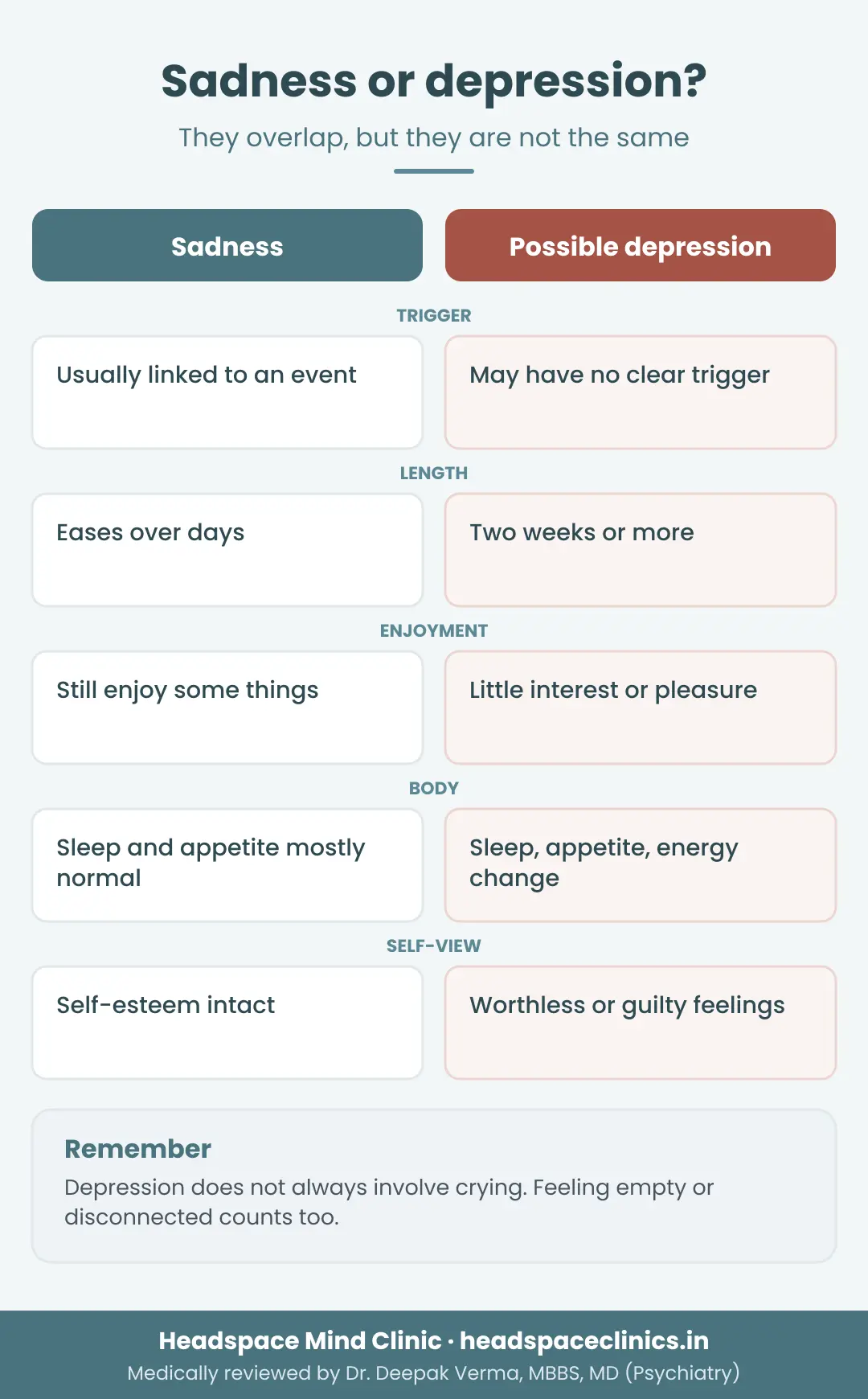
Sadness vs depression. Tap the image to enlarge.
What can cause persistent sadness?
Low mood usually builds from several things at once. Stressful life events such as bereavement, a break-up, job loss or money problems can trigger it. Long-term stress, loneliness, physical illness, chronic pain, thyroid problems, some medicines, alcohol and drug use, and changes around childbirth can all contribute. Depression also runs in some families.
Persistent sadness may be part of:
Low mood and loss of interest for two weeks or more
Periods of depression with periods of high mood
Worry and low mood often come together
Struggling to start or finish things
Poor sleep and low mood feed each other
Substances can deepen low mood
What can help while you seek support
These steps help many people, though they are not a replacement for treatment.
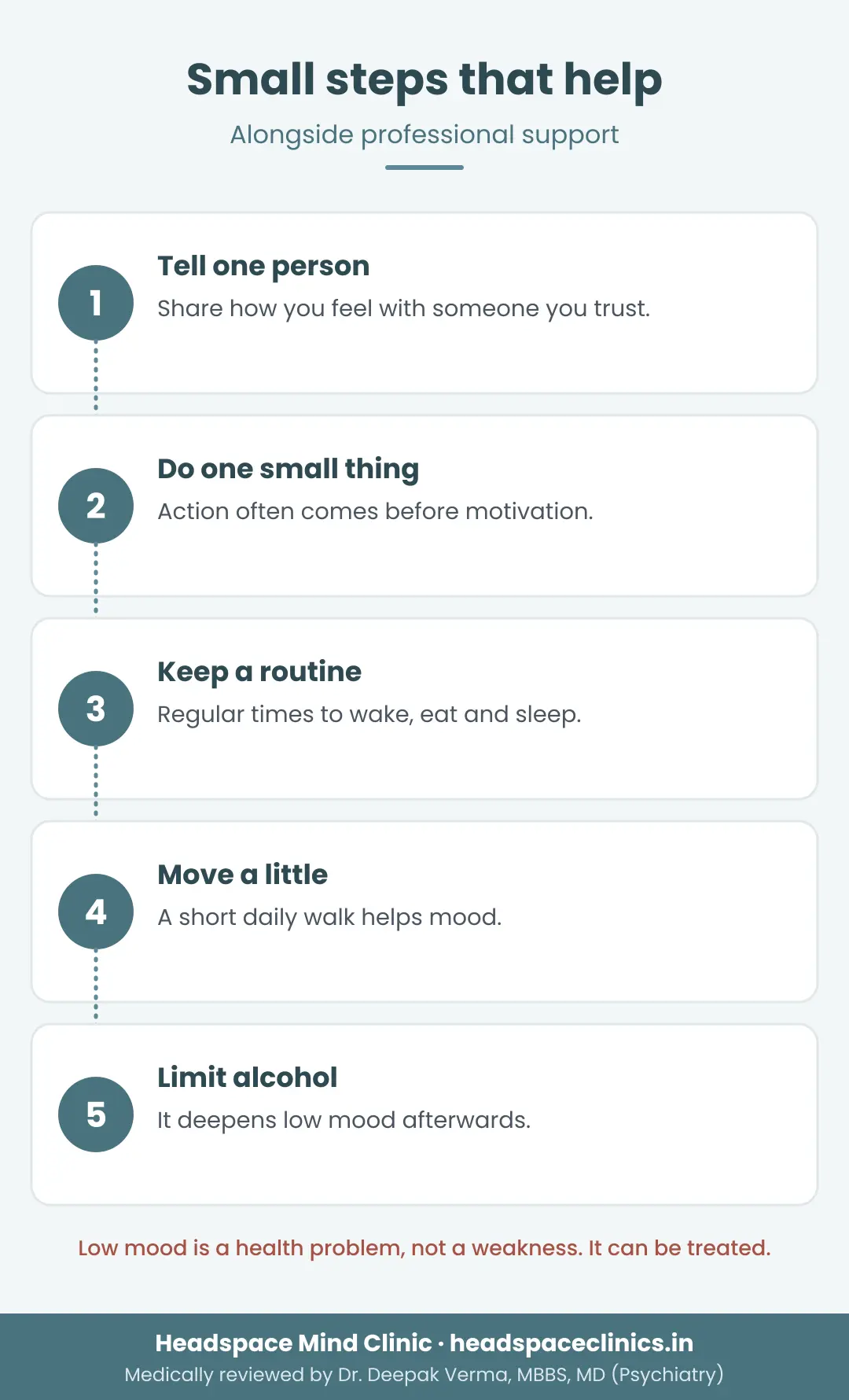
Small steps that help. Tap the image to enlarge.
Tell one person. Choose a family member or friend you trust and say how you have been feeling. Low mood tends to grow in isolation.
Plan small, doable activities. When mood is low, motivation follows action rather than leading it. A short walk, a call to a friend or one household task counts.
Keep a regular routine. Get up and eat at roughly the same times each day, even if you slept badly.
Move a little every day. Gentle physical activity has a measurable effect on mood.
Go easy on alcohol. It may seem to help briefly but deepens low mood over the following days.
Be kind to yourself. Low mood is not a weakness or a choice. It is a health problem that can be treated.
Is my sadness a sign to get help?
A quick way to decide whether to talk to a professional. It is not a diagnosis.
Tick the statements that apply to you. Nothing you tick is stored or sent anywhere.
This self-check is an educational aid, not a diagnostic test. Only a qualified professional can assess you properly.
When to see a doctor about low mood
Book a consultation if low mood has lasted two weeks or more, if it is affecting daily life, or if people close to you are worried. Seek help today if you have any thoughts of suicide or self-harm (call Tele-MANAS 14416 or 112).
At the first visit your psychiatrist will ask about your mood, sleep, appetite, energy, stresses, physical health and any medicines, and may suggest blood tests such as thyroid function.
How persistent sadness and depression are treated
Treatment depends on the cause and how severe it is. Talking therapies such as CBT and behavioural activation help many people with mild to moderate depression. For moderate to severe depression, antidepressant medicines are often recommended, usually alongside therapy, and are taken for several months after recovery to prevent relapse. For selected patients whose depression has not improved with standard treatment, we offer rTMS and tDCS.
- Assessment by our consultant psychiatrist
- Talking therapy, including CBT, with our clinical psychologists
- Medicines only when they are needed, with regular reviews
- Video follow-ups for existing patients
लगातार उदासी (Persistent sadness in Hindi)
अगर दो हफ़्ते या उससे ज़्यादा समय से ज़्यादातर दिन मन उदास, ख़ाली या सुन्न लगता है, पहले जिन चीज़ों में मज़ा आता था उनमें दिलचस्पी नहीं रही, नींद या भूख बदल गई है, तो यह डिप्रेशन का संकेत हो सकता है। उदासी हमेशा रोने के रूप में नहीं दिखती। डिप्रेशन आम है और इसका इलाज संभव है। यह जानकारी केवल शिक्षा के लिए है। अपॉइंटमेंट के लिए कॉल करें: +91 99711 66040
Founder of Headspace Mind Clinic. Dr. Verma sees patients at our Paschim Vihar, Rohini and Narela clinics. About our psychiatry service →
Three clinics in West and North Delhi
Psychiatrist consultation fee: ₹1,800 at Paschim Vihar and Rohini, ₹500 at Narela. All appointments are scheduled; please call or book online.
Frequently asked questions
If low mood lasts most of the day, most days, for two weeks or more, or if it is affecting your daily life, it is worth speaking to a doctor.
Yes. Many people with depression rarely cry. They describe feeling empty, flat, numb or disconnected, and losing interest in things. These feelings matter as much as tearfulness.
Low mood does not always have an obvious trigger. Biological factors, stress that has built up quietly, poor sleep, hormonal changes and physical illness can all play a part. Read more: Why am I feeling sad for no reason?
Some people are naturally more emotional. Crying more than usual over small things, especially with other changes in mood or sleep, can be a sign of stress or depression. Why do I cry so easily?
Not always. Mild depression often improves with therapy and lifestyle changes. Antidepressants are considered for moderate to severe depression or when other approaches have not helped. Your psychiatrist will explain the benefits and side effects so you can decide together.
Spend time with them, listen without judging and gently encourage them to see a doctor. Offer practical help, such as going with them to the appointment. If they talk about wanting to die, take it seriously and seek help the same day.
Book a consultation
Choose your preferred clinic and our team will call you to confirm a time. This form is for appointments only; please do not use it in an emergency.
References
- World Health Organization. International Classification of Diseases, 11th Revision (ICD-11). icd.who.int: 6A70 Single episode depressive disorder.
- Gautam S, Jain A, Gautam M, Vahia VN, Grover S. Clinical Practice Guidelines for the management of Depression. Indian Journal of Psychiatry. 2017;59(Suppl 1):S34–S50.
- National Institute for Health and Care Excellence (NICE). Depression in adults: treatment and management (NG222). nice.org.uk
- World Health Organization. Depressive disorder (depression): fact sheet. who.int
- Tele-MANAS, National Tele Mental Health Programme, Ministry of Health and Family Welfare, Government of India. Helpline 14416.
Medically reviewed by Dr. Deepak Verma (MBBS, MD Psychiatry; DMC Reg. No. 37616). Last reviewed: 15 November 2026.
Medical disclaimer. The information on this page is provided for general educational purposes only. It is not medical advice and is not intended to diagnose, treat, cure or prevent any condition. Reading this page or using the self-check does not create a doctor–patient relationship with Dr. Deepak Verma or Headspace Mind Clinic. Please consult a qualified doctor about any symptom, diagnosis or treatment, and do not start, stop or change any medicine without talking to the doctor who prescribed it. Do not ignore professional advice, or delay seeking it, because of something you have read here. Symptoms, causes and responses to treatment differ from person to person, and no particular result is promised. Links to other websites are given for reference only, and we are not responsible for their content. If you think you or someone else may be facing a medical or mental health emergency, call 112, call Tele-MANAS on 14416 (free, 24×7) or go to the nearest hospital emergency department.