
Why you might be more irritable than usual
Irritability means getting annoyed, impatient or frustrated more easily than usual, often over small things. Occasional irritability after a bad night or a long day is normal. When it becomes your usual state, it can be an early or hidden sign of stress, poor sleep, depression or anxiety, even if you do not feel sad or worried.
It is worth looking at how long it has lasted, what else has changed, and how it is affecting the people around you.
Signs of irritability
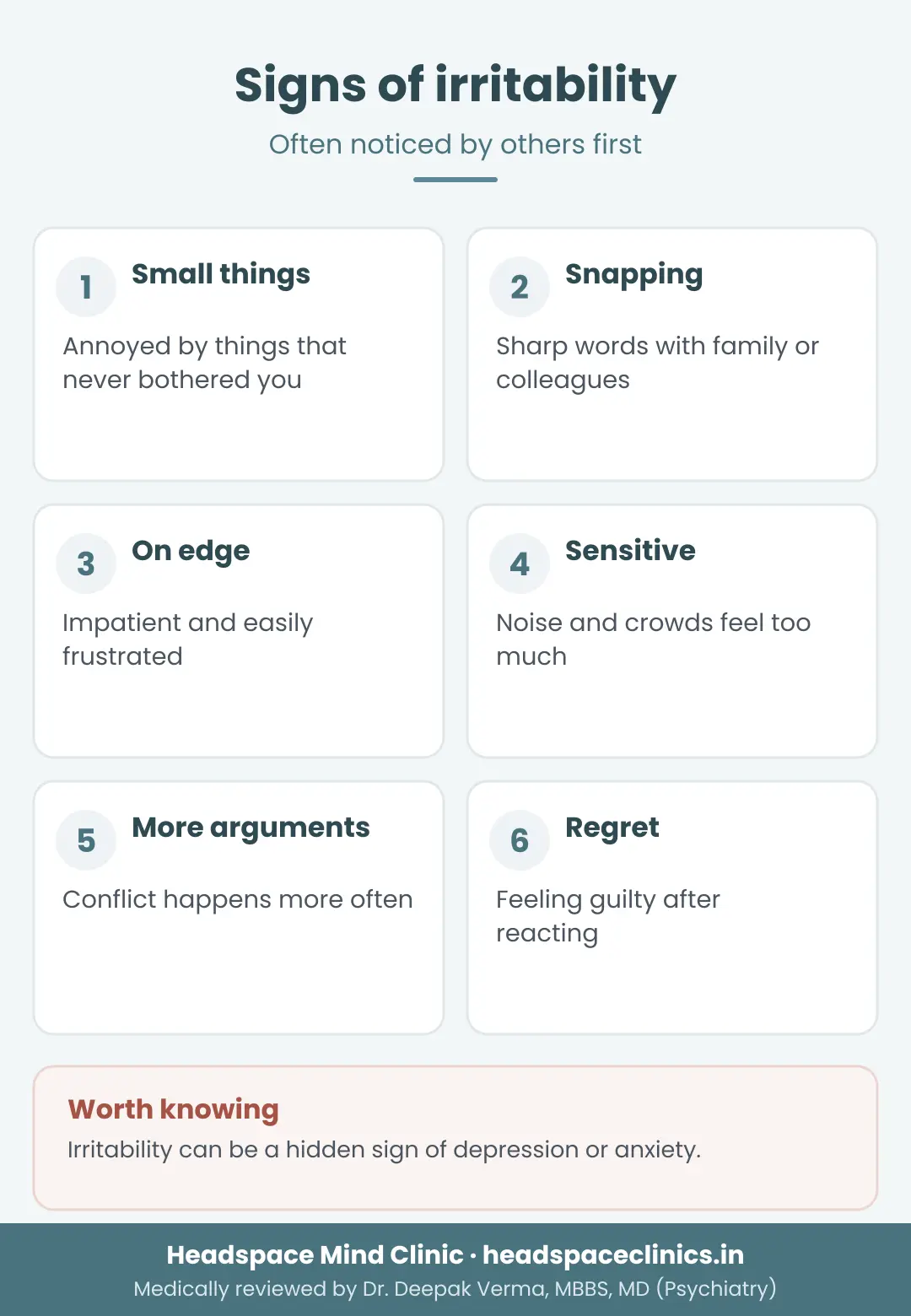
Irritability is often noticed first by family members or colleagues. Signs include:
- Getting annoyed by small things that would not normally bother you
- Snapping at family, colleagues or children
- Feeling impatient, on edge or easily frustrated
- Being more sensitive to noise, crowds or interruptions
- Arguments happening more often
- Feeling guilty afterwards about how you reacted
- Physical tension: clenched jaw, tight shoulders, headaches
Signs of irritability. Tap the image to enlarge.

Irritability can sometimes be an early or less obvious sign of emotional distress. A person may become unusually impatient, frustrated or sensitive to small situations without necessarily feeling sad or anxious. I assess the duration, associated symptoms, sleep and changes in daily functioning to understand what may be driving it.
Dr. Deepak Verma, MBBS, MD (Psychiatry), Consultant Psychiatrist, Headspace Mind Clinic
When irritability is a hidden sign of distress
Many people expect depression to look like sadness and anxiety to look like fear. In practice, both can show up mainly as irritability. This is especially common in men, teenagers and people under long-term pressure at work or home. They may say they are “fine, just tired of everyone”.
Dr. Verma looks at how long the irritability has been present, what else has changed (sleep, appetite, energy, interest, alcohol use) and whether daily functioning has slipped. A sudden change in temperament in an older adult also deserves a check-up, because memory problems and some physical illnesses can first appear this way.
What can cause irritability?
Everyday causes include poor sleep, hunger, pain, overwork, noise and ongoing stress. Caffeine, and withdrawal from nicotine or alcohol, can make people short-tempered. Hormonal changes before periods and around menopause, thyroid problems and some medicines can also play a part.
Persistent irritability can be part of:
Often shows as irritability rather than sadness
Constant tension wears patience thin
Irritable mood can occur during episodes
Poor sleep shortens the fuse
Frustration, restlessness and impulsivity
When irritability turns into outbursts
What helps with irritability
Small changes that lower the background tension.
Calming a short fuse. Tap the image to enlarge.
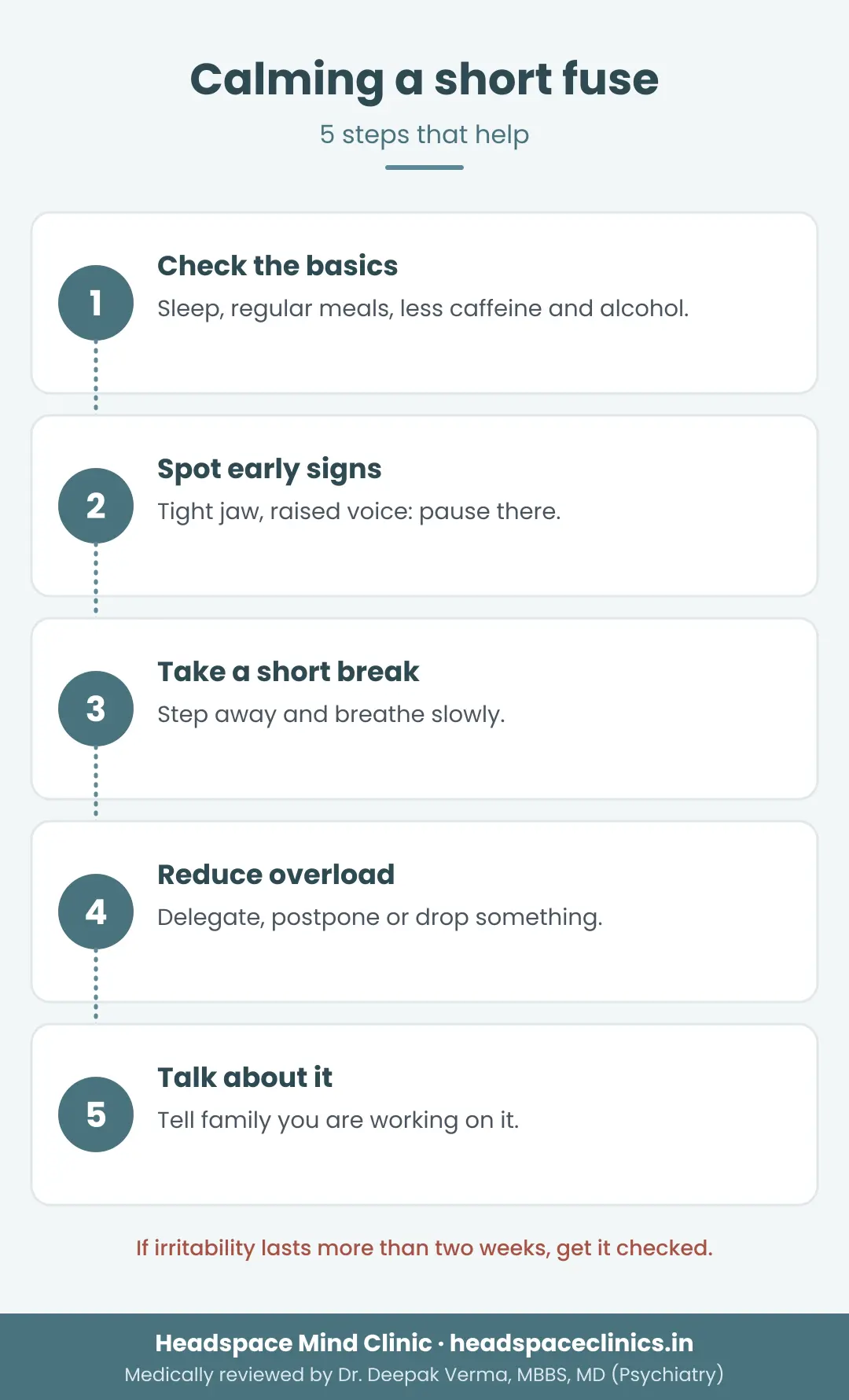
Check the basics first. Are you sleeping enough, eating regularly and drinking less caffeine and alcohol? Fixing these alone helps many people.
Spot the early signs. Notice the tight jaw, the raised voice or the sigh. That is your cue to pause before you react.
Take a short break. Step away for a few minutes, breathe slowly and come back when you are calmer.
Reduce overload. Look at what can be delegated, postponed or dropped. Constant overload is one of the most common reasons for a short fuse.
Talk about it. Let the people close to you know you are aware of it and working on it. That alone often reduces conflict.
Is my irritability a sign to get help?
A quick way to decide whether to talk to a professional. It is not a diagnosis.
Tick the statements that apply to you. Nothing you tick is stored or sent anywhere.
This self-check is an educational aid, not a diagnostic test. Only a qualified professional can assess you properly.
When to see a doctor about irritability
See a doctor if irritability has lasted more than two weeks, if it comes with changes in sleep, mood, appetite or energy, or if it is harming your relationships or work. Seek urgent help if there is any risk of harm to yourself or others.
Your psychiatrist will ask about your mood, sleep, stress, alcohol and medicines, and may suggest blood tests such as thyroid function to rule out physical causes.
How irritability is treated
Treatment targets the cause. When irritability is part of depression or anxiety, talking therapy and, if needed, medicines usually help it settle along with the other symptoms. CBT and emotion-regulation skills help people notice triggers and respond differently. Sleep problems, alcohol use and stress are addressed directly, and family members can be involved if they wish.
- Assessment by our consultant psychiatrist
- Talking therapy, including CBT, with our clinical psychologists
- Medicines only when they are needed, with regular reviews
- Video follow-ups for existing patients
चिड़चिड़ापन क्यों आता है? (Irritability in Hindi)
छोटी-छोटी बातों पर ग़ुस्सा आना, बेसब्री और झुंझलाहट को चिड़चिड़ापन कहते हैं। नींद की कमी, तनाव, भूख, दर्द, कैफ़ीन, हार्मोनल बदलाव और थायरॉइड इसकी आम वजहें हैं। कई बार चिड़चिड़ापन डिप्रेशन या एंग्ज़ायटी का छुपा हुआ संकेत होता है, ख़ासकर पुरुषों और किशोरों में। अगर यह दो हफ़्ते से ज़्यादा रहे या रिश्तों पर असर डाले, तो डॉक्टर से मिलें। यह जानकारी केवल शिक्षा के लिए है। अपॉइंटमेंट के लिए कॉल करें: +91 99711 66040
Founder of Headspace Mind Clinic. Dr. Verma sees patients at our Paschim Vihar, Rohini and Narela clinics. About our psychiatry service →
Three clinics in West and North Delhi
Psychiatrist consultation fee: ₹1,800 at Paschim Vihar and Rohini, ₹500 at Narela. All appointments are scheduled; please call or book online.
Frequently asked questions
Common reasons include poor sleep, stress, overwork, hunger, caffeine and hormonal changes. When irritability is constant and lasts for weeks, it can also be a sign of depression, anxiety or another condition that a doctor can assess.
Yes. Depression does not always look like sadness. Some people, particularly men and teenagers, mainly feel irritable, impatient or angry. If irritability comes with poor sleep, low energy or loss of interest, it is worth getting checked.
Often. Ongoing anxiety keeps the body tense and on alert, which makes it harder to stay patient. Treating the anxiety usually eases the irritability too.
Hormonal changes before a period can affect mood. If irritability or low mood before periods is severe and disrupts daily life, it may be premenstrual dysphoric disorder (PMDD), which can be treated.
Notice your early warning signs, take a short break before responding, and look after sleep and stress. Explaining to your family that you are working on it helps. If it continues, a consultation can uncover the cause.
Yes. Even one or two short nights make people more reactive. If you are sleeping poorly for weeks, see our guide on sleep problems.
Related symptom guides
Book a consultation
Choose your preferred clinic and our team will call you to confirm a time. This form is for appointments only; please do not use it in an emergency.
References
- Vidal-Ribas P, Brotman MA, Valdivieso I, Leibenluft E, Stringaris A. The status of irritability in psychiatry: a conceptual and quantitative review. Journal of the American Academy of Child and Adolescent Psychiatry. 2016;55(7):556–570.
- Gautam S, Jain A, Gautam M, Vahia VN, Grover S. Clinical Practice Guidelines for the management of Depression. Indian Journal of Psychiatry. 2017;59(Suppl 1):S34–S50.
- National Institute for Health and Care Excellence (NICE). Depression in adults: treatment and management (NG222). nice.org.uk
- World Health Organization. International Classification of Diseases, 11th Revision (ICD-11). icd.who.int
- Tele-MANAS, National Tele Mental Health Programme, Ministry of Health and Family Welfare, Government of India. Helpline 14416.
Medically reviewed by Dr. Deepak Verma (MBBS, MD Psychiatry; DMC Reg. No. 37616). Last reviewed: 15 November 2026.
Medical disclaimer. The information on this page is provided for general educational purposes only. It is not medical advice and is not intended to diagnose, treat, cure or prevent any condition. Reading this page or using the self-check does not create a doctor–patient relationship with Dr. Deepak Verma or Headspace Mind Clinic. Please consult a qualified doctor about any symptom, diagnosis or treatment, and do not start, stop or change any medicine without talking to the doctor who prescribed it. Do not ignore professional advice, or delay seeking it, because of something you have read here. Symptoms, causes and responses to treatment differ from person to person, and no particular result is promised. Links to other websites are given for reference only, and we are not responsible for their content. If you think you or someone else may be facing a medical or mental health emergency, call 112, call Tele-MANAS on 14416 (free, 24×7) or go to the nearest hospital emergency department.