
Mood swings: what they can mean, and what they usually do not
Mood swings are noticeable shifts in mood, from cheerful to low, calm to irritable, sometimes within a day. Most people have ups and downs linked to stress, sleep, hormones or events. They become a concern when they are intense, last for days or weeks, come with changes in sleep and energy, or start to damage work and relationships.
Not every mood swing means bipolar disorder. A psychiatrist looks at how long the changes last, how strong they are, what triggers them and what happens to sleep and energy, because many different causes can produce similar swings.
Signs your mood swings may need attention
Everyday ups and downs pass quickly and make sense in context. Mood swings that need attention tend to be stronger, longer or harder to explain. Notice whether you have:
- Shifts in mood that feel out of proportion to what happened
- Periods of very high energy and little need for sleep
- Periods of low mood lasting days or weeks
- Sudden anger or irritability that surprises others
- Racing thoughts, talking fast or taking big risks when "up"
- Changes that people close to you have commented on
- Problems at work or in relationships because of mood changes
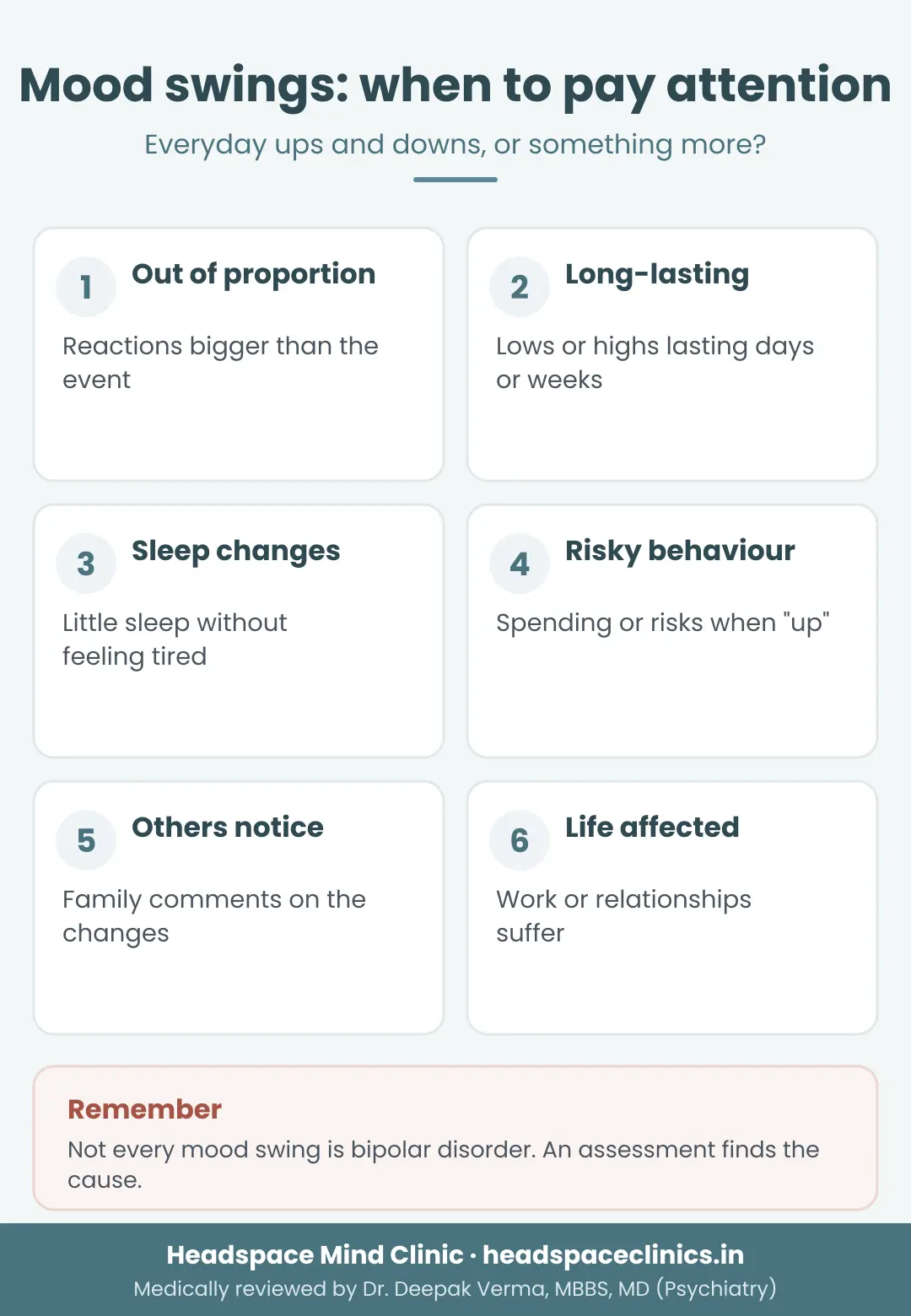
When mood swings need attention. Tap the image to enlarge.

Not every change in mood indicates bipolar disorder. In my practice, I look beyond the mood change itself and assess its duration, intensity, triggers, sleep pattern, energy levels and impact on functioning. This distinction is important because mood fluctuations can have several psychological, psychiatric and medical explanations.
Dr. Deepak Verma, MBBS, MD (Psychiatry), Consultant Psychiatrist, Headspace Mind Clinic
Is it bipolar disorder?
Bipolar disorder involves episodes: periods of depression and periods of mania or hypomania that last days to weeks, not minutes or hours. During a high episode a person may sleep very little without feeling tired, talk fast, have racing ideas, feel unusually confident and spend money or take risks they normally would not.
Mood that shifts several times a day in response to events is more often linked to stress, anxiety, sleep loss, hormonal changes, substance use or personality style. That is why, as Dr. Verma explains, a careful assessment of duration, intensity, triggers, sleep and energy matters more than the mood change on its own.
Do not try to diagnose yourself from a checklist. If you are worried, an assessment gives a clear answer.
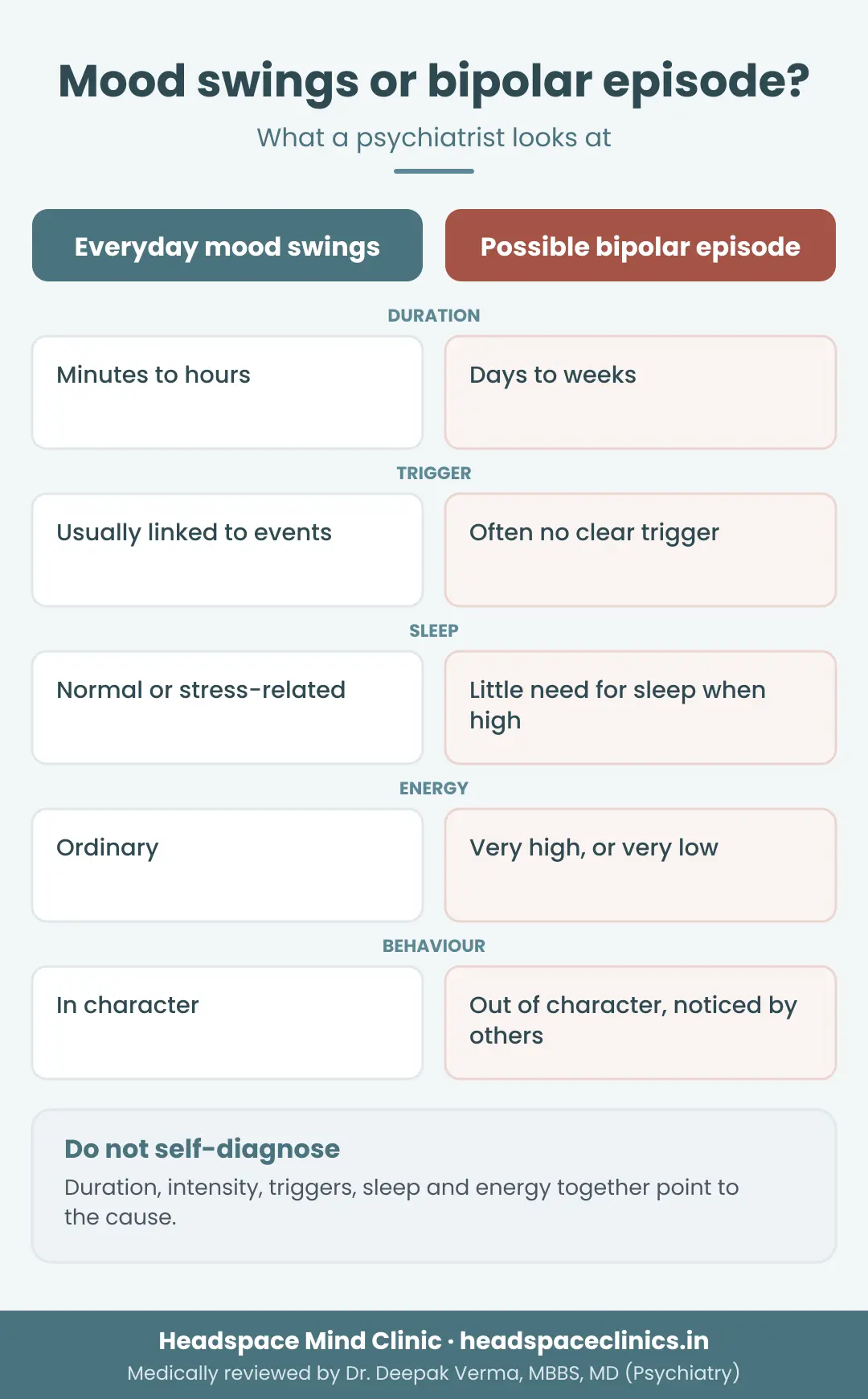
Mood swings vs bipolar episode. Tap the image to enlarge.
What can cause mood swings?
Common causes include stress, lack of sleep, irregular meals, alcohol, cannabis and other drugs, and hormonal changes around periods, pregnancy, after childbirth and in perimenopause. Thyroid problems and some medicines, including steroids, can affect mood. Long-standing patterns of intense, quickly shifting emotions may be linked to personality style.
Mood swings can be part of:
Episodes of depression and of high mood
Low mood with irritability or tearfulness
Intense emotions that change quickly
Short temper and impatience
Outbursts that feel hard to control
Substances that unsettle mood
What helps with mood swings
Practical steps while you work out what is behind them.
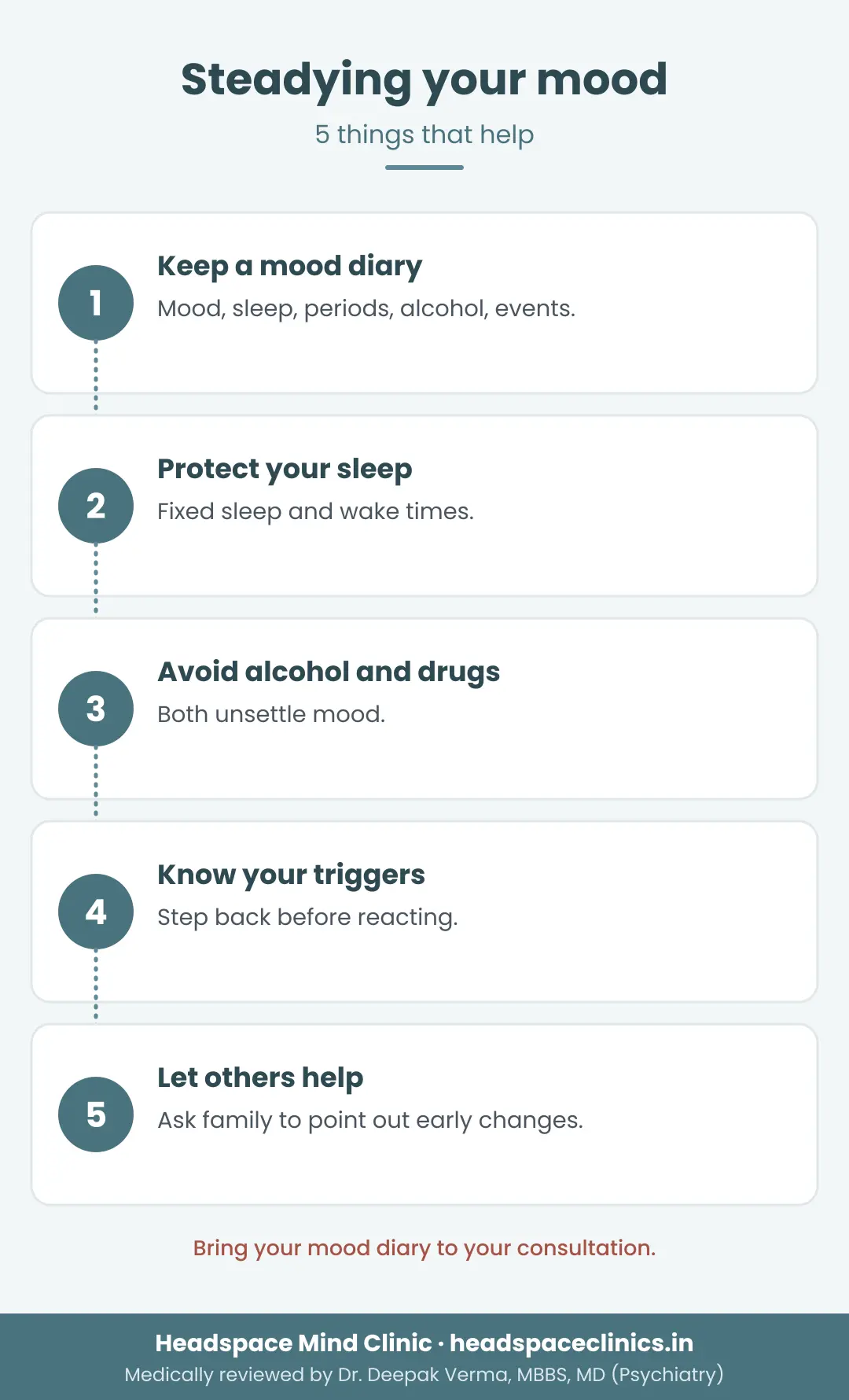
Steadying your mood. Tap the image to enlarge.
Keep a mood diary. Note your mood, sleep, periods, alcohol and major events each day for two to four weeks. Patterns often appear, and the diary is very useful to your doctor.
Protect sleep. Regular sleep and wake times steady mood more than almost anything else. A sudden drop in sleep can be an early warning sign of a high episode.
Cut down alcohol and avoid drugs. Both make mood less stable.
Notice triggers and early signs. Knowing what sets you off gives you a chance to step back before reacting.
Talk to someone close. Family members often notice changes first. Ask them to tell you gently when they see a shift.
Are my mood swings a sign to get help?
A quick way to decide whether to talk to a professional. It is not a diagnosis.
Tick the statements that apply to you. Nothing you tick is stored or sent anywhere.
This self-check is an educational aid, not a diagnostic test. Only a qualified professional can assess you properly.
When to see a doctor about mood swings
See a doctor if mood swings are affecting your life, if you have had episodes of very high energy with little sleep, if low periods last two weeks or more, or if there is a family history of bipolar disorder. Seek urgent help if someone is behaving in a way that puts themselves or others at risk.
Your psychiatrist will ask about the pattern of your moods, sleep, energy, substance use, medicines, periods and family history, and may suggest blood tests. Bringing a mood diary or a family member who knows you well helps a lot.
How mood swings are treated
Treatment depends on the cause. Bipolar disorder is usually treated with mood-stabilising medicines and education about early warning signs, together with therapy. Mood swings linked to anxiety, depression or stress often improve with CBT or other talking therapies, and medicines where needed. Dialectical behaviour therapy (DBT) skills help people with intense, fast-changing emotions. Where alcohol or drugs play a part, we offer outpatient de-addiction care.
- Assessment by our consultant psychiatrist
- Talking therapy, including CBT, with our clinical psychologists
- Medicines only when they are needed, with regular reviews
- Video follow-ups for existing patients
मूड स्विंग्स का मतलब (Mood swings meaning in Hindi)
मूड स्विंग्स का मतलब है मूड का बार-बार और अचानक बदलना, जैसे कभी बहुत ख़ुश, कभी उदास या चिड़चिड़ा। हर मूड स्विंग बाइपोलर डिसऑर्डर नहीं होता। तनाव, नींद की कमी, हार्मोन, शराब या नशा, थायरॉइड और कुछ दवाइयाँ भी इसकी वजह हो सकती हैं। अगर मूड में बदलाव कई दिन या हफ़्तों तक रहे, नींद और ऊर्जा बदल जाए, या काम और रिश्तों पर असर पड़े, तो मनोचिकित्सक से सलाह लें। यह जानकारी केवल शिक्षा के लिए है। अपॉइंटमेंट के लिए कॉल करें: +91 99711 66040
Founder of Headspace Mind Clinic. Dr. Verma sees patients at our Paschim Vihar, Rohini and Narela clinics. About our psychiatry service →
Three clinics in West and North Delhi
Psychiatrist consultation fee: ₹1,800 at Paschim Vihar and Rohini, ₹500 at Narela. All appointments are scheduled; please call or book online.
Frequently asked questions
Not usually. Bipolar disorder involves episodes of depression and of mania or hypomania that last days to weeks. Mood that changes several times a day is more often linked to stress, sleep, hormones, anxiety or personality style. An assessment can clarify the cause.
Mood swings are short and usually triggered by events. Bipolar episodes last longer and come with changes in sleep, energy, speech, thinking and behaviour that others notice. A psychiatrist looks at duration, intensity, triggers, sleep and energy to tell them apart.
Yes. Hormonal changes before periods, during pregnancy, after childbirth and around menopause can affect mood. When symptoms are severe, such as in premenstrual dysphoric disorder or postnatal depression, treatment helps.
Yes. Even a few nights of poor sleep make emotions harder to manage. In people with bipolar disorder, a sudden drop in sleep can also be an early sign of a high episode.
Some moodiness is part of adolescence. Talk to a professional if a teenager’s mood changes are severe, last for weeks, affect school or friendships, or come with self-harm, substance use or talk of not wanting to live.
Keep regular sleep and meal times, track your moods, cut down alcohol and avoid drugs, and notice early signs. If mood swings continue or are severe, please see a doctor.
Related symptom guides
Book a consultation
Choose your preferred clinic and our team will call you to confirm a time. This form is for appointments only; please do not use it in an emergency.
References
- World Health Organization. International Classification of Diseases, 11th Revision (ICD-11). icd.who.int: 6A60 Bipolar type I disorder; 6A61 Bipolar type II disorder.
- National Institute for Health and Care Excellence (NICE). Bipolar disorder: assessment and management (CG185). nice.org.uk
- National Institute of Mental Health (NIMH). Bipolar Disorder. nimh.nih.gov
- Tele-MANAS, National Tele Mental Health Programme, Ministry of Health and Family Welfare, Government of India. Helpline 14416.
Medically reviewed by Dr. Deepak Verma (MBBS, MD Psychiatry; DMC Reg. No. 37616). Last reviewed: 15 November 2026.
Medical disclaimer. The information on this page is provided for general educational purposes only. It is not medical advice and is not intended to diagnose, treat, cure or prevent any condition. Reading this page or using the self-check does not create a doctor–patient relationship with Dr. Deepak Verma or Headspace Mind Clinic. Please consult a qualified doctor about any symptom, diagnosis or treatment, and do not start, stop or change any medicine without talking to the doctor who prescribed it. Do not ignore professional advice, or delay seeking it, because of something you have read here. Symptoms, causes and responses to treatment differ from person to person, and no particular result is promised. Links to other websites are given for reference only, and we are not responsible for their content. If you think you or someone else may be facing a medical or mental health emergency, call 112, call Tele-MANAS on 14416 (free, 24×7) or go to the nearest hospital emergency department.