
If you are thinking of ending your life or are in danger right now
Please call Tele-MANAS 14416 (free, 24×7, many Indian languages) or 112, or go to the nearest hospital emergency department. If you can, tell someone you trust and stay with them. You can also call us on +91 99711 66040 during clinic hours to arrange an urgent consultation. Headspace Mind Clinic is an outpatient clinic and not an emergency service.
Self-harm: understanding it, without judgement
Self-harm means hurting yourself on purpose, often as a way of coping with emotions that feel overwhelming or hard to put into words. It is a sign of distress, not attention-seeking, and the person deserves care and understanding.
If you have hurt yourself, please get medical care for any injury, and go to the nearest hospital emergency if it is serious or you have taken an overdose. If you feel unsafe or are thinking of ending your life, call Tele-MANAS 14416 or 112 now. Support can help you understand what is behind the urges and find safer ways to cope.
Why people self-harm
People describe many different reasons. Often self-harm brings brief relief, which is why it can become a pattern, but the underlying pain remains. Common reasons include:
- To get relief from overwhelming emotions
- To feel something when feeling numb or empty
- To express pain that is hard to put into words
- To punish themselves because of guilt or self-hatred
- To feel some control when life feels out of control
- To cope with memories of trauma or abuse
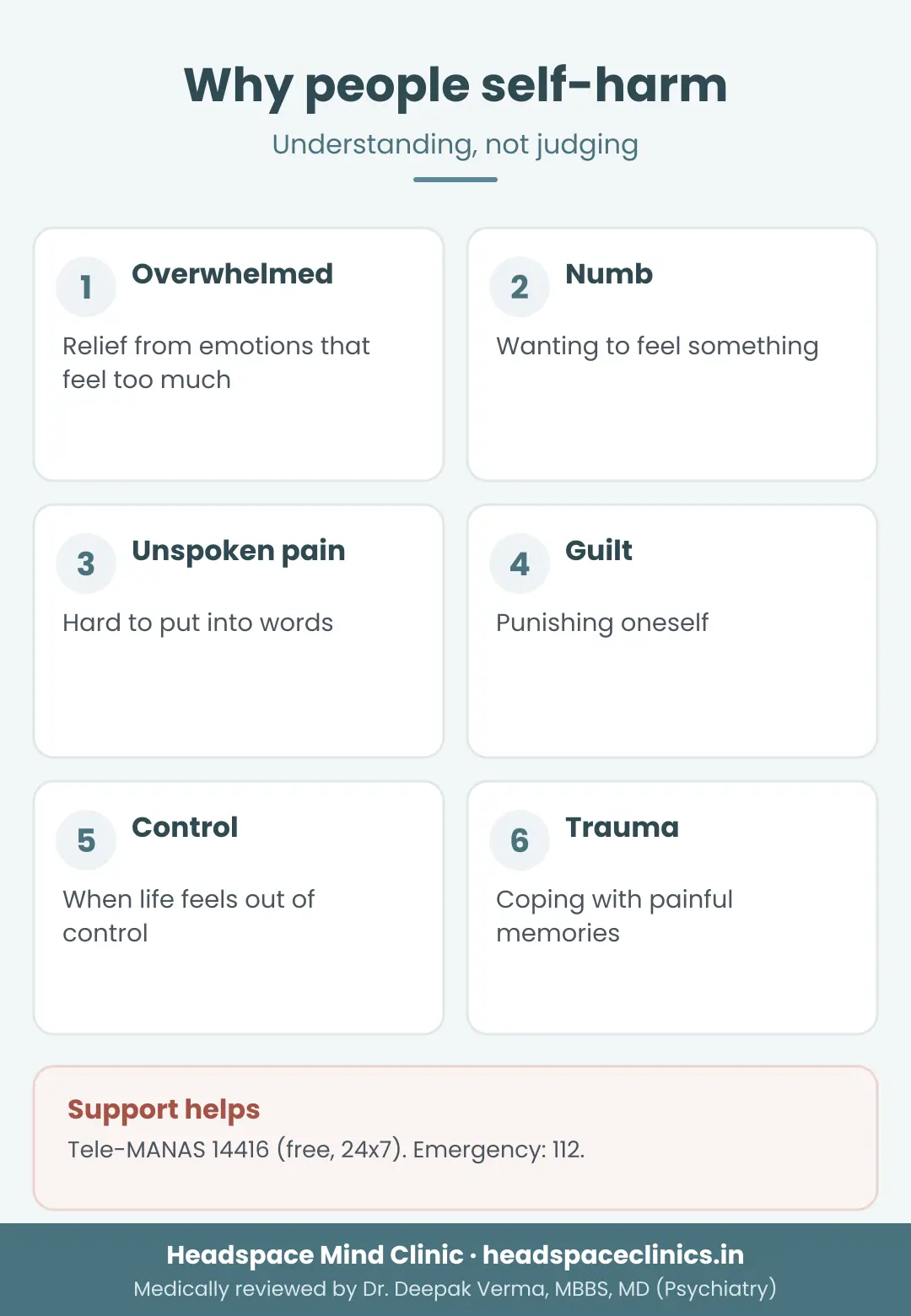
Why people self-harm. Tap the image to enlarge.

Self-harm is often a sign that someone is experiencing emotional distress that feels difficult to communicate or manage. Rather than judging the behaviour, I focus on understanding its triggers, the emotions surrounding it and the person’s immediate safety. Support involves addressing the underlying distress and developing safer ways to cope.
Dr. Deepak Verma, MBBS, MD (Psychiatry), Consultant Psychiatrist, Headspace Mind Clinic
Support without judgement
Many people who self-harm hide it because they fear being judged, shouted at or not taken seriously. Dr. Verma’s focus is on understanding the triggers, the emotions surrounding self-harm and the person’s immediate safety, not on judging the behaviour.
Self-harm and suicidal thoughts are different, but they can occur together, and self-harm increases the risk of suicide over time. That is why every person who self-harms deserves a careful, kind assessment, including a conversation about safety.
What can lead to self-harm?
Self-harm often starts in the teenage years, though it can happen at any age. Bullying, academic or family pressure, relationship problems, abuse, trauma, loss, feeling different or isolated, and alcohol or drug use can all contribute. It is often linked with:
Low mood, hopelessness and self-criticism
Overwhelming tension and worry
Intense emotions that are hard to manage
Support with parents involved
Help and safety planning
Substances that increase risk
When the urge to self-harm comes
Urges rise and fall. These steps can help you get through without hurting yourself.
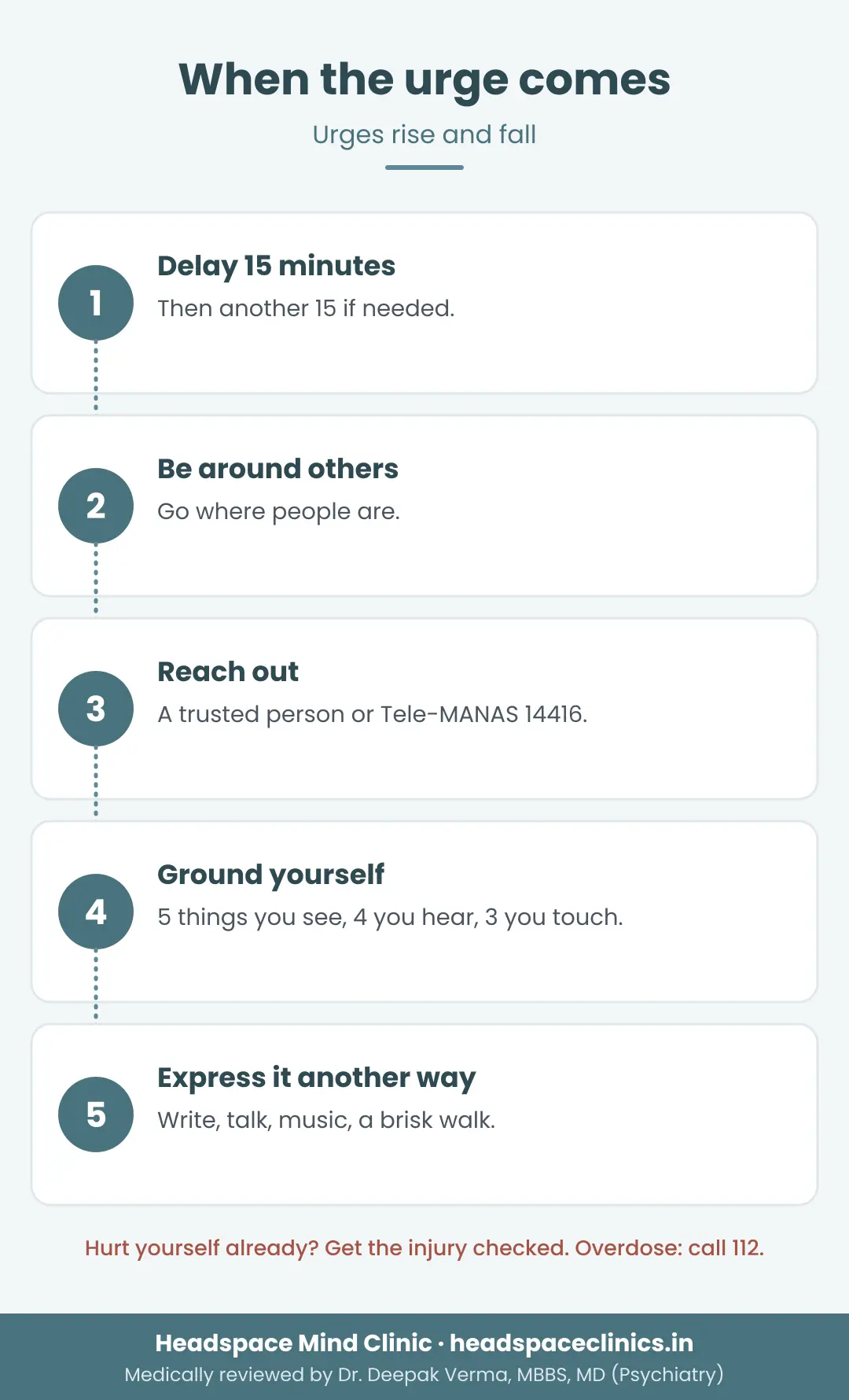
When the urge comes. Tap the image to enlarge.
Delay. Tell yourself you will wait 15 minutes. Urges often peak and then fade. If it is still there, wait another 15.
Move away from being alone. Go to a room where other people are, or step outside.
Reach out. Call or message someone you trust, or call Tele-MANAS 14416. You do not have to explain everything.
Ground yourself gently. Notice 5 things you can see, 4 you can hear and 3 you can touch. Breathe slowly, in for 4 and out for 6.
Let the feelings out another way. Write, talk, cry, listen to music or go for a brisk walk.
Make your surroundings safer. Ask someone to keep things you might use to hurt yourself away from you for now.
If you have already hurt yourself, please get the injury looked at. Go to an emergency if it is serious or you have taken an overdose, even if you feel fine.
If someone you love is self-harming
- Stay calm. Anger, shock or panic can make the person feel more ashamed and less likely to talk.
- Listen first. Ask how they are feeling and what has been happening, rather than focusing only on the injuries.
- Make sure injuries are looked after. Get medical care for wounds, and emergency care for anything serious or any overdose.
- Avoid ultimatums. Demanding that they stop immediately rarely works and can drive self-harm into hiding.
- Help them get support. Offer to arrange an appointment and go with them.
- Look after yourself. Supporting someone is hard. Tele-MANAS 14416 is also available for family members.
Getting support
If you are in danger or have taken an overdose: call 112 or go to the nearest hospital emergency. For immediate emotional support, call Tele-MANAS 14416.
If you are not in immediate danger: please arrange to see a doctor. Call us on +91 99711 66040. The psychiatrist will talk with you about what has been happening, how you are feeling and how to keep you safe, and agree a plan with you. For young people, parents or carers can be involved in a way that feels right.
Headspace Mind Clinic is an outpatient clinic, not an emergency service.
What support can involve
Support focuses on the distress behind self-harm. Talking therapies help people understand their triggers, manage intense emotions and build safer ways of coping; dialectical behaviour therapy (DBT) skills are often useful. When depression, anxiety or another condition is present, it is treated too. Safety planning and regular follow-up are part of care, and families can be included if the person wishes.
- Tele-MANAS 14416: free, 24x7 counselling in many Indian languages
- Urgent and planned consultations with our consultant psychiatrist
- Talking therapy with our clinical psychologists
- Family involvement and safety planning, when you want it
ख़ुद को नुक़सान पहुँचाना (Self-harm in Hindi)
ख़ुद को जानबूझकर चोट पहुँचाना अक्सर इस बात का संकेत है कि व्यक्ति ऐसी भावनात्मक तकलीफ़ में है जिसे शब्दों में कहना या सँभालना मुश्किल लग रहा है। यह ध्यान खींचने का तरीक़ा नहीं है, और ऐसे व्यक्ति को डाँट की नहीं, समझ और मदद की ज़रूरत है। चोट लगी हो तो इलाज करवाएँ, गंभीर चोट या दवाइयों की ज़्यादा मात्रा लेने पर तुरंत 112 पर कॉल करें। भावनात्मक मदद के लिए टेली-मानस 14416 (मुफ़्त, 24 घंटे) पर कॉल करें। यह जानकारी केवल शिक्षा के लिए है। अपॉइंटमेंट के लिए कॉल करें: +91 99711 66040
Founder of Headspace Mind Clinic. Dr. Verma sees patients at our Paschim Vihar, Rohini and Narela clinics. About our psychiatry service →
Three clinics in West and North Delhi
Psychiatrist consultation fee: ₹1,800 at Paschim Vihar and Rohini, ₹500 at Narela. All appointments are scheduled; please call or book online.
Frequently asked questions
No. Most people who self-harm hide it. It is usually a way of coping with emotional pain that feels overwhelming. Whatever the reason, it is a sign that someone needs support.
Not always. Many people self-harm to cope rather than to end their life. However, self-harm increases the risk of suicide over time, so safety should always be discussed with a professional.
Most people find it easier with support. Delaying the urge, being around others, reaching out to someone, grounding yourself and finding other ways to express feelings can help. Therapy helps you understand and manage the emotions behind the urges.
Stay calm, listen, make sure any injuries are cared for and arrange a consultation. Avoid anger or ultimatums. Our team sees children and adolescents with parents involved. Child and adolescent psychiatry.
Yes, if the injury is deep, will not stop bleeding, or if you have taken an overdose of any medicine, even if you feel fine. Some overdoses cause serious harm hours later. Call 112 or go to the nearest emergency.
Yes. What you share is kept confidential. The only exception is if there is a serious risk to your life or someone else’s, in which case the doctor will discuss with you who needs to know to keep you safe.
Related symptom guides
Book a consultation
Choose your preferred clinic and our team will call you to confirm a time. This form is for appointments only; please do not use it in an emergency.
References
- National Institute for Health and Care Excellence (NICE). Self-harm: assessment, management and preventing recurrence (NG225). nice.org.uk
- Hawton K, Saunders KEA, O’Connor RC. Self-harm and suicide in adolescents. The Lancet. 2012;379(9834):2373–2382.
- World Health Organization. Suicide: fact sheet. who.int
- Tele-MANAS, National Tele Mental Health Programme, Ministry of Health and Family Welfare, Government of India. Helpline 14416.
Medically reviewed by Dr. Deepak Verma (MBBS, MD Psychiatry; DMC Reg. No. 37616). Last reviewed: 15 November 2026.
Medical disclaimer. The information on this page is provided for general educational purposes only. It is not medical advice and is not intended to diagnose, treat, cure or prevent any condition. Reading this page or using the self-check does not create a doctor–patient relationship with Dr. Deepak Verma or Headspace Mind Clinic. Please consult a qualified doctor about any symptom, diagnosis or treatment, and do not start, stop or change any medicine without talking to the doctor who prescribed it. Do not ignore professional advice, or delay seeking it, because of something you have read here. Symptoms, causes and responses to treatment differ from person to person, and no particular result is promised. Links to other websites are given for reference only, and we are not responsible for their content. If you think you or someone else may be facing a medical or mental health emergency, call 112, call Tele-MANAS on 14416 (free, 24×7) or go to the nearest hospital emergency department.