
If you are thinking of ending your life or are in danger right now
Please call Tele-MANAS 14416 (free, 24×7, many Indian languages) or 112, or go to the nearest hospital emergency department. If you can, tell someone you trust and stay with them. You can also call us on +91 99711 66040 during clinic hours to arrange an urgent consultation. Headspace Mind Clinic is an outpatient clinic and not an emergency service.
If you are having thoughts of ending your life
If you are thinking about suicide, you are not alone, and these thoughts can change with help. Many people have had them during very painful times and gone on to feel better.
If you might act on these thoughts, or feel unsafe right now, call Tele-MANAS 14416 or 112, or go to the nearest hospital emergency. If you are not in immediate danger, please talk to someone today: a person you trust, Tele-MANAS or a doctor. Suicidal thoughts should always be taken seriously, even without a plan.
What suicidal thoughts can be like
Suicidal thoughts can be fleeting or constant, passive (“I wish I would not wake up”) or more active. They often come when pain feels unbearable and endless. Signs that someone may be struggling include:
- Talking or writing about wanting to die or not being here
- Feeling hopeless, trapped or like a burden to others
- Withdrawing from friends, family and activities
- Saying goodbye or giving away belongings
- Drinking more or using drugs
- Sudden calm after a period of deep distress
- Searching for ways to end their life
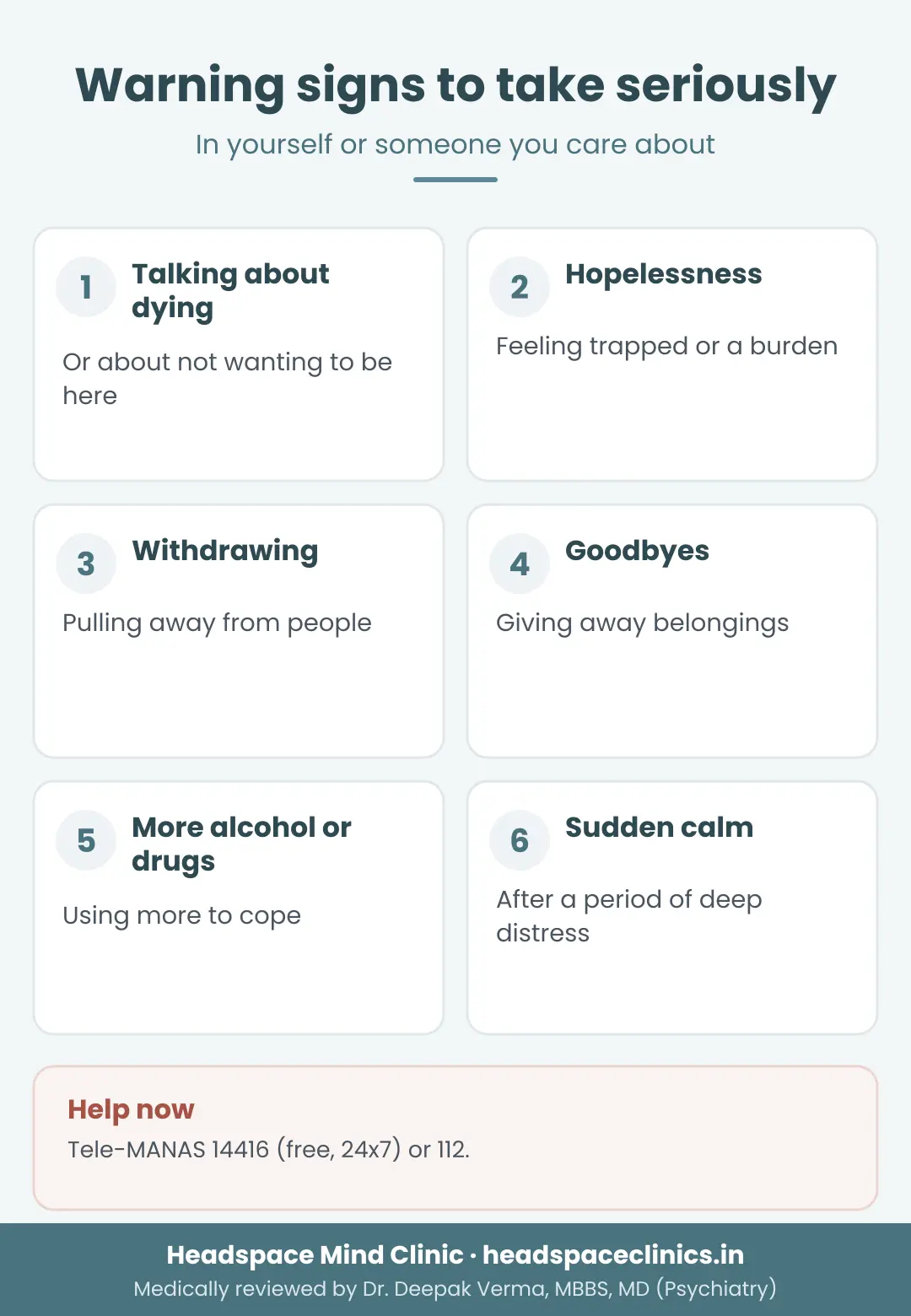
Warning signs to take seriously. Tap the image to enlarge.

Suicidal thoughts should always be taken seriously, even when a person has not made a plan or expressed an intention to act. I believe it is important to create a safe, non-judgmental space where people can speak openly about these thoughts. A timely assessment of immediate safety, risk factors and available support is essential.
Dr. Deepak Verma, MBBS, MD (Psychiatry), Consultant Psychiatrist, Headspace Mind Clinic
Talking about suicide does not make it more likely
Many people worry that asking about suicide will put the idea in someone’s head. Research does not support this. Asking directly and listening without judgement usually brings relief and opens the door to help.
Dr. Verma’s approach is to create a safe, non-judgemental space where people can speak openly about these thoughts. In a consultation he will ask about what you are going through, how often the thoughts come, whether you have made any plans, what has kept you safe so far, and who can support you. The aim is to understand and to help, not to judge or to take control away from you.
What can lead to suicidal thoughts?
There is rarely a single reason. Depression and other mental health conditions, alcohol and drug use, relationship breakdown, loss, money problems, exam or job pressure, abuse, bullying, chronic pain or illness, and feeling isolated can all contribute. A past suicide attempt and a family history of suicide increase risk. Many of these can be treated or eased with support.
Conditions that commonly come with suicidal thoughts:
Hopelessness and low mood
Especially during low or mixed episodes
Substances increase risk and impulsivity
Low mood that does not lift
Understanding and support
Voices or beliefs that cause distress
Making a safety plan
A short written plan for difficult moments. Make it with someone you trust or with your doctor.
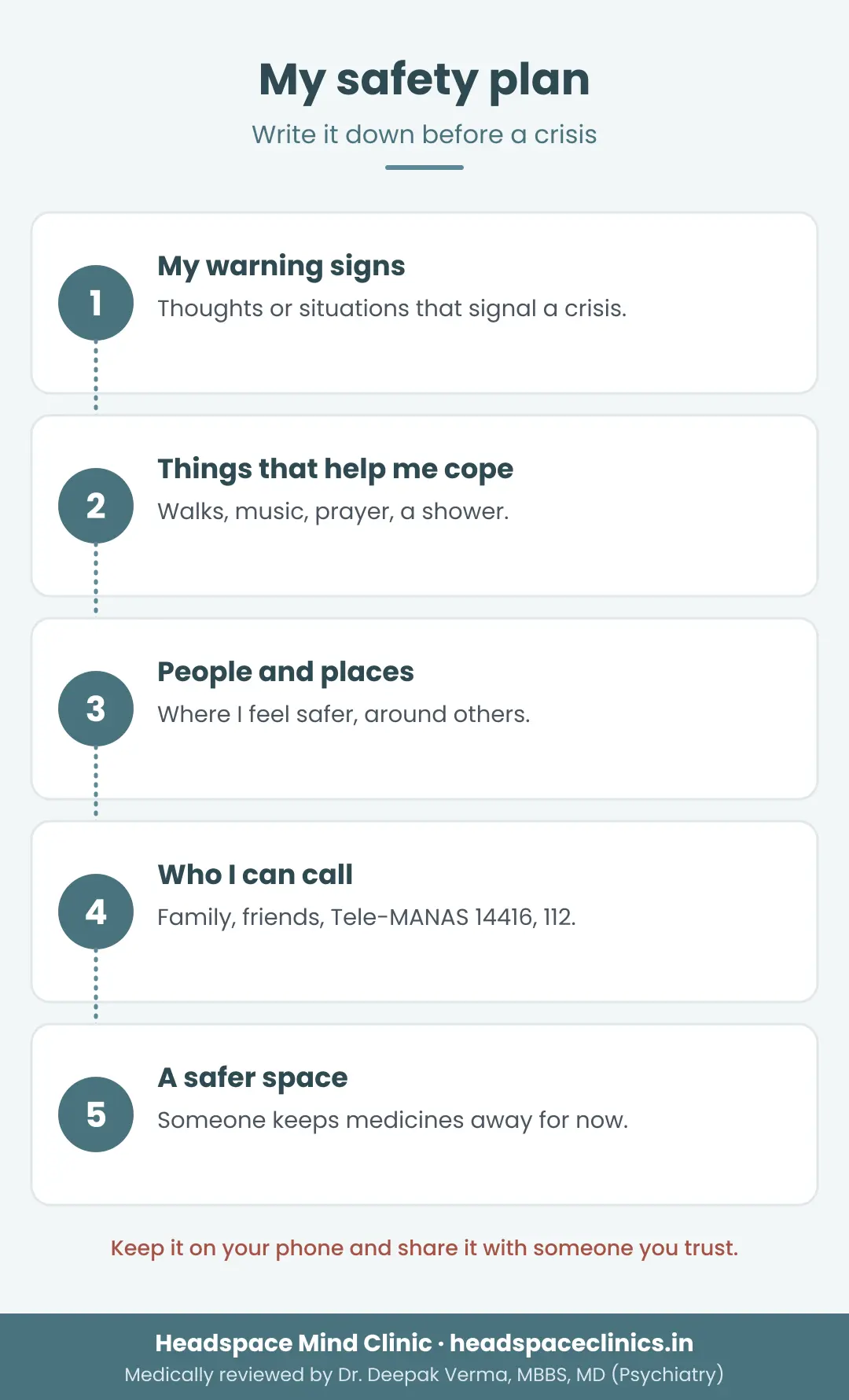
A safety plan. Tap the image to enlarge.
1. My warning signs. The thoughts, feelings or situations that tell me a crisis may be building.
2. Things I can do to get through. Activities that have helped before, such as going for a walk, music, prayer or a shower.
3. People and places that help. Who I can be with, and places where I feel safer around others.
4. People I can ask for help. Names and phone numbers of family or friends.
5. Professional help. Tele-MANAS 14416, emergency 112, my doctor, and the nearest hospital emergency.
6. Making my surroundings safer. Asking someone to keep medicines and anything I could use to harm myself away from me for now.
Keep the plan on your phone and on paper, and share it with someone you trust.
How to help someone who may be suicidal
- Ask directly. “Are you thinking about suicide?” A direct question shows you care and can handle the answer.
- Listen. Let them talk. Avoid arguing, lecturing or promising to keep it secret.
- Stay with them if they are at immediate risk, and call 112 or Tele-MANAS 14416.
- Make the surroundings safer. With their agreement, keep medicines and anything that could be used for self-harm out of reach.
- Help them connect. Offer to make the call or go with them to a doctor.
- Follow up. Check in over the following days. Look after yourself too.
Getting help
Right now, if you are in danger: call Tele-MANAS 14416 or 112, or go to the nearest hospital emergency. Stay with someone if you can.
If you are not in immediate danger: please arrange to see a doctor soon. You can call us on +91 99711 66040 and tell the team it is urgent. At the consultation the psychiatrist will assess your immediate safety, the factors behind the thoughts and the support around you, and agree a plan with you.
Headspace Mind Clinic is an outpatient clinic, not an emergency service. If hospital care is needed, we will help with a referral.
What treatment can involve
Suicidal thoughts usually ease when the underlying problems are treated and support is in place. Treatment may include talking therapy, treatment of depression or other conditions with medicines where appropriate, help with alcohol or drug use, family involvement and a written safety plan. Follow-up is arranged closely, especially in the early weeks.
- Tele-MANAS 14416: free, 24x7 counselling in many Indian languages
- Urgent and planned consultations with our consultant psychiatrist
- Talking therapy with our clinical psychologists
- Family involvement and safety planning, when you want it
आत्महत्या के विचार आ रहे हों तो (Suicidal thoughts in Hindi)
अगर आपके मन में अपनी ज़िंदगी ख़त्म करने के विचार आ रहे हैं, तो आप अकेले नहीं हैं और मदद उपलब्ध है। अगर आप अभी ख़तरे में हैं, तो तुरंत टेली-मानस 14416 (मुफ़्त, 24 घंटे) या 112 पर कॉल करें, या नज़दीकी अस्पताल की इमरजेंसी में जाएँ। किसी भरोसेमंद व्यक्ति को बताएँ और उनके साथ रहें। ये विचार इलाज और सहारे से बदल सकते हैं। यह जानकारी केवल शिक्षा के लिए है, आपात स्थिति में डॉक्टर या हेल्पलाइन से तुरंत संपर्क करें। अपॉइंटमेंट के लिए कॉल करें: +91 99711 66040
Founder of Headspace Mind Clinic. Dr. Verma sees patients at our Paschim Vihar, Rohini and Narela clinics. About our psychiatry service →
Three clinics in West and North Delhi
Psychiatrist consultation fee: ₹1,800 at Paschim Vihar and Rohini, ₹500 at Narela. All appointments are scheduled; please call or book online.
Frequently asked questions
If you feel you might act on them, call Tele-MANAS 14416 or 112, or go to the nearest hospital emergency, and stay with someone you trust. If you are not in immediate danger, tell someone today and arrange to see a doctor soon.
They often occur with depression or other mental health conditions, but they can also come during overwhelming life stress. Either way, they deserve to be taken seriously and talked about with a professional.
No. Asking directly and calmly does not increase risk. It often brings relief and helps the person get support.
Tele-MANAS is the Government of India’s free, 24×7 mental health helpline. Call 14416 to speak to a trained counsellor in many Indian languages.
Most people with suicidal thoughts are treated as outpatients with a safety plan and close follow-up. Hospital care is considered only when someone cannot be kept safe otherwise. Your doctor will discuss options with you and, if you wish, your family.
Yes. For most people they pass as the underlying problems are treated and support increases. Many people who once felt this way go on to live full lives.
Related symptom guides
Book a consultation
Choose your preferred clinic and our team will call you to confirm a time. This form is for appointments only; please do not use it in an emergency.
References
- World Health Organization. Suicide: fact sheet. who.int
- World Health Organization. LIVE LIFE: an implementation guide for suicide prevention in countries. Geneva: WHO; 2021.
- Stanley B, Brown GK. Safety planning intervention: a brief intervention to mitigate suicide risk. Cognitive and Behavioral Practice. 2012;19(2):256–264.
- Dazzi T, Gribble R, Wessely S, Fear NT. Does asking about suicide and related behaviours induce suicidal ideation? What is the evidence? Psychological Medicine. 2014;44(16):3361–3363.
- Tele-MANAS, National Tele Mental Health Programme, Ministry of Health and Family Welfare, Government of India. Helpline 14416.
Medically reviewed by Dr. Deepak Verma (MBBS, MD Psychiatry; DMC Reg. No. 37616). Last reviewed: 15 November 2026.
Medical disclaimer. The information on this page is provided for general educational purposes only. It is not medical advice and is not intended to diagnose, treat, cure or prevent any condition. Reading this page or using the self-check does not create a doctor–patient relationship with Dr. Deepak Verma or Headspace Mind Clinic. Please consult a qualified doctor about any symptom, diagnosis or treatment, and do not start, stop or change any medicine without talking to the doctor who prescribed it. Do not ignore professional advice, or delay seeking it, because of something you have read here. Symptoms, causes and responses to treatment differ from person to person, and no particular result is promised. Links to other websites are given for reference only, and we are not responsible for their content. If you think you or someone else may be facing a medical or mental health emergency, call 112, call Tele-MANAS on 14416 (free, 24×7) or go to the nearest hospital emergency department.