
Home › School Mental Health › When a child tells you about abuse
When a child tells you about abuse: believe, protect, report
Children are safest when they know the names of their body parts, know which touches are not okay, and know they can tell a trusted adult. If a child tells you something has happened, how you respond in the first minutes matters a lot. This guide gives clear steps, including what the POCSO Act asks adults to do.
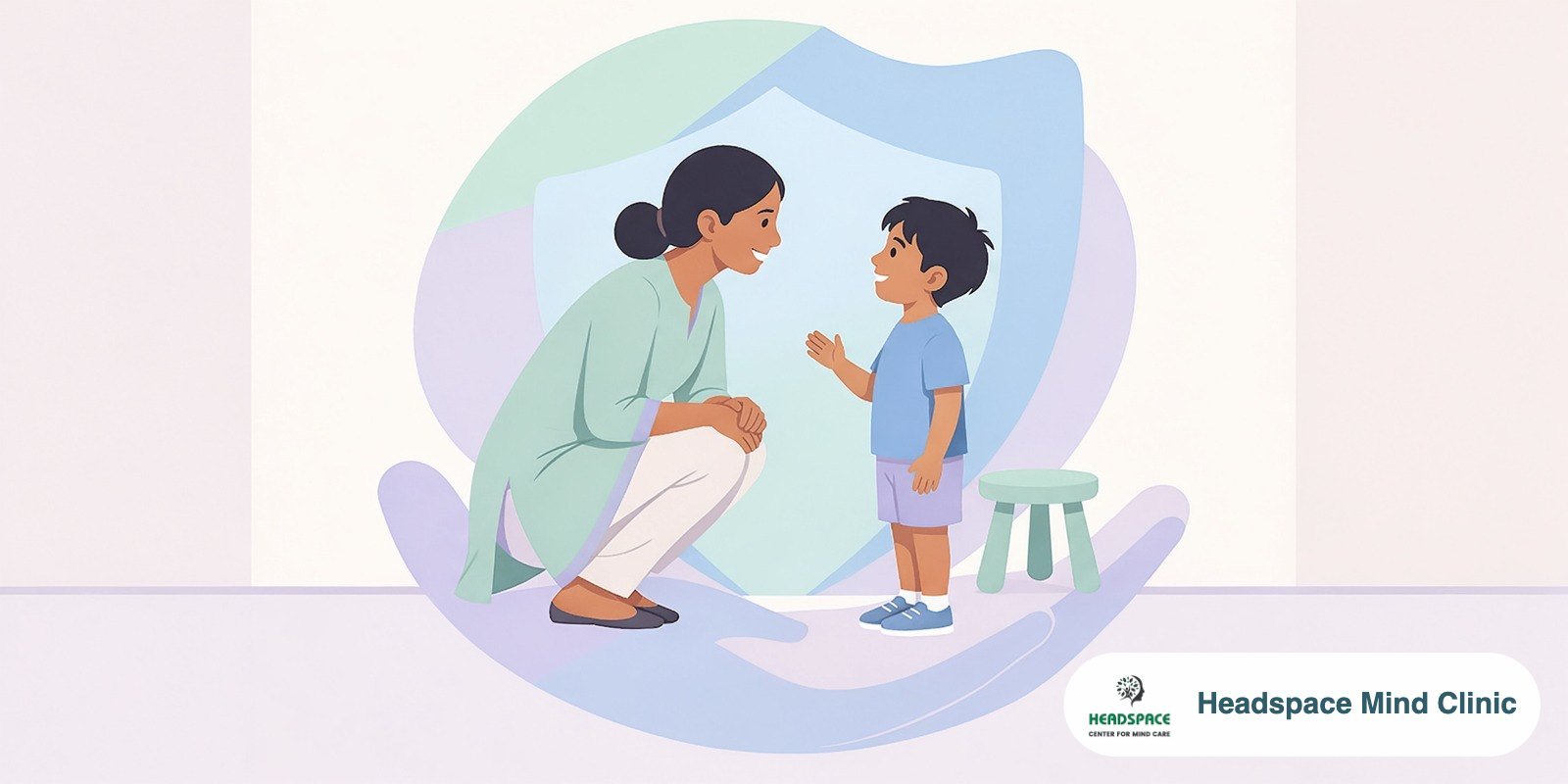
Does this sound familiar?
Real worries we hear from Delhi families and schools.
My daughter said uncle’s games make her uncomfortable. I didn’t know if I was overreacting.
A child drew something that worried me. I didn’t know whom to tell first.
Teachers ask me if they must report even when they are not sure. The law says report.
He said it was our secret and no one would believe me.
In India: the numbers
Small references show where each number comes from.
Signs to notice
One sign alone is not a diagnosis. Look for a pattern that lasts.
Sudden behaviour change
Fear, anger, clinginess or withdrawal without clear reason.Fear of a person or place
Doesn’t want to be with a certain person, or go to a certain place.Sleep and toileting
Nightmares, bedwetting after being dry, fear of the bathroom.Body signs
Pain, bleeding or infections in private parts: see a doctor.Sexual knowledge beyond age
Words, play or drawings not expected for the child’s age.Secrets and gifts
Unexplained gifts, money, or a “special secret” with an adult or older child.What helps, step by step
Pick your role. Each tab has practical steps you can start today.
Teachers have a legal and moral duty to act. You don’t need proof to report.
At home, open talk keeps children safer than fear.
Counsellors guide the school through a careful, child-first response.
What to say, what to avoid
Try saying
- “Thank you for telling me. You did the right thing.”
- “I believe you.”
- “It is not your fault.”
- “I will help keep you safe, and I need to tell people who can help.”
Better to avoid
- “Are you sure? He is a good man.”
- “Why didn’t you tell me earlier?”
- “Don’t tell anyone, it will spoil the family’s name.”
- “I promise I won’t tell anyone.”
When to get help
Use this as a rough guide, not a test.
- Child knows body-safety rules
- Knows trusted adults
- Family talks openly
- Unexplained fear of a person or place
- Sexual words or play beyond age
- Secret gifts from an adult
- Child tells you about abuse
- Injury, bleeding or pain in private parts
- Child is in immediate danger: call 112
From worry to a plan
Myths and facts
Questions parents and teachers ask
What is “good touch, bad touch”?
A simple way to teach children which touches are safe and which are not. Many schools now say “safe touch and unsafe touch”, and teach children to say no, move away and tell.
Do teachers have to report under POCSO?
Yes. Section 19 of the POCSO Act requires anyone who knows or suspects abuse to report it to the police or Special Juvenile Police Unit. Section 21 makes failure to report an offence.
Should I ask the child for details?
No. Listen and write down what the child says. Detailed questioning is done by trained police, doctors and counsellors.
Where can we report in Delhi?
Call 112, Childline 1098, or go to the nearest police station. Schools should have a clear protocol.
Will the child need therapy?
Many children benefit from trauma-focused therapy. Support from a caring family and school helps recovery a lot.
Where to get help in Delhi
Start with the person closest to the child. Help is available, and asking early is normal.
Headspace Mind Clinic (outpatient) in West and North Delhi:
- Paschim Vihar: GH-14/49, near Bosco Public School, Paschim Vihar, Delhi 110087 · +91 99711 66040
- Rohini: C-8/273, near Gurudwara, Sector 8, Rohini, Delhi 110085 (near Rohini East Metro) · +91 90990 97381
- Narela: 48/1 Singhu Border Road, Krishna Colony, Narela, Delhi 110040 · +91 74530 00444
Easy to reach from Paschim Vihar, Rohini, Narela, Pitampura, Punjabi Bagh, Shalimar Bagh, Nangloi, Bawana and nearby areas. All clinic details
More school mental health guides
Guides by role: Parents · Teachers · Counsellors · हिंदी में पढ़ें
Sources
- Ministry of Women and Child Development. Study on Child Abuse: India 2007 (summary via systematic review)
- Maity S, Chakraborty PR. Implications of the POCSO Act and determinants of child sexual abuse in India. Humanities and Social Sciences Communications, 2022
- Protection of Children from Sexual Offences Act, 2012 (Sections 19 and 21)
Reviewed by Dr. Deepak Verma, Consultant Psychiatrist (MBBS, MD Psychiatry), 26 November 2026. Headspace Mind Clinic, Delhi.