
School Mental Health: free guides for Delhi parents, teachers and school counsellors

Home › School Mental Health

FreeEnglish and हिंदीPrint and share

School Mental Health: simple guides for Delhi families and schools

What you might notice in a child, what helps at home and in class, and when to get support. Written in plain words, with Indian data and sources, for parents, teachers and school counsellors.

Reviewed by Dr. Deepak Verma, Consultant Psychiatrist (MBBS, MD Psychiatry) · Updated 26 November 2026
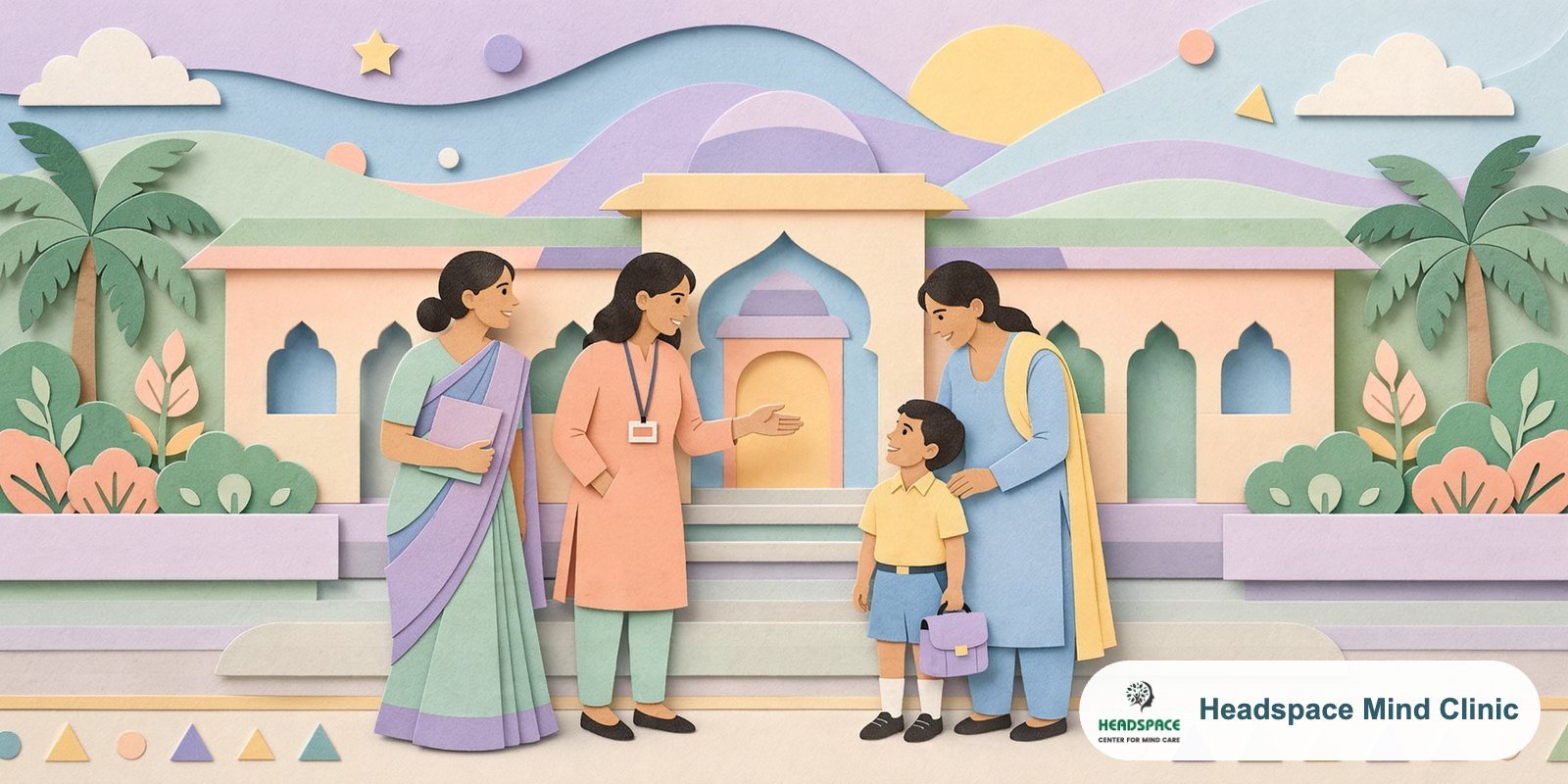
Illustration: a school with children, a teacher and parents

Mental health is part of health. Struggling is not a weakness, and talking early helps children feel better sooner. Mann ki baat karna normal hai.

I am a…

Pick your door. Each page has the questions people like you ask most.

Topics, explained simply

One page per topic, with a section each for parents, teachers and counsellors.

Free printables

Print them for the staff room or share them in the parents’ group.

“Is this normal?” age guide

For parents

Open and print

Inclusive lesson checklist

For teachers

Open and print

Classroom routine plan

For teachers

Open and print

Case history template

For counsellors

Open and print

Session note template

For counsellors

Open and print

Referral letter format

For counsellors

Open and print

In India: the numbers

Small references show where each number comes from.

7.3%
of Indian teenagers aged 13–17 had a mental health condition in the National Mental Health Survey.
NMHS 2015–16, NIMHANS
1 in 8
children aged 2–9 had at least one neurodevelopmental condition, such as ADHD, autism, or learning or speech difficulties.
INCLEN, PLOS Medicine 2018
41%
of young Indians aged 15–24 felt it is good to seek help for mental health problems: stigma is still strong.
UNICEF–Gallup, 2021

Myths we hear, and the facts

Myth: Children don’t have real stress.
Fact: Children feel stress too. It often shows as stomach aches, anger or not wanting to go to school.
Myth: Seeing a psychiatrist means my child is “mad”.
Fact: A psychiatrist is a doctor for the mind, just as a paediatrician is for the body. Most visits are about everyday problems.
Myth: Talking about self-harm puts the idea in their head.
Fact: Asking calmly and directly is safe and can help a child open up.

What schools in India are asked to do

A plain summary, so parents and staff know what support to expect. Dated and sourced.

Supreme Court (July 2025)

A qualified counsellor in institutions with 100+ students, staff training, and no shaming or segregation by marks.

CBSE (January 2026)

One counselling and wellness teacher per 500 students, with 50 hours of training.

Delhi: Ehsaas 2026

One counsellor per 500 school students, training for staff and parents, and a six-step support chain for serious concerns (as reported).

Read the full summary →

FOR SCHOOLS IN WEST AND NORTH DELHI

Invite us for a talk at your school

If these guides are useful, our psychiatrist and clinical psychologists can talk with your teachers or parents in person. The talks are practical, in English or Hindi, and planned with your school counsellor. The first talk (45 minutes, for staff or parents) is free.

Teachers' sessionWarning signs, what to say, and who to tell. 60 to 120 minutes.
Parents' sessionExam stress, screen time, and when to seek help. 45 to 60 minutes.
Counsellor supportA referral pathway and crisis steps for your school.
Student workshopExam stress and coping, for Classes 9 to 12.
Group sessions onlyNo student data collectedNot therapy in schoolNo referral fees

हिंदी में पढ़ें

बच्चों की mental health पर आसान भाषा में जानकारी, parents और teachers के लिए।

हिंदी गाइड खोलें

Where to get help in Delhi

Start with the person closest to the child. Help is available, and asking early is normal.

Emergency: 112If a child is in danger right now, call 112 and stay with them.
Tele-MANAS 14416Free government mental health helpline, in Hindi and English, any time.
Your school counsellorA good first step for most worries linked to school.
Family doctor or paediatricianTo check sleep, hearing, vision and physical causes.
Child psychologist or psychiatristFor a full assessment if worries last more than a few weeks.

Headspace Mind Clinic (outpatient) in West and North Delhi:

  • Paschim Vihar: GH-14/49, near Bosco Public School, Paschim Vihar, Delhi 110087 · +91 99711 66040
  • Rohini: C-8/273, near Gurudwara, Sector 8, Rohini, Delhi 110085 (near Rohini East Metro) · +91 90990 97381
  • Narela: 48/1 Singhu Border Road, Krishna Colony, Narela, Delhi 110040 · +91 74530 00444

Easy to reach from Paschim Vihar, Rohini, Narela, Pitampura, Punjabi Bagh, Shalimar Bagh, Nangloi, Bawana and nearby areas. All clinic details

Sources

  1. National Mental Health Survey of India 2015–16, NIMHANS (summary)
  2. INCLEN. Neurodevelopmental disorders in children aged 2–9 years in India. PLOS Medicine, 2018 (summary)
  3. Mental health issues among school children in India: systematic review citing UNICEF–Gallup 2021
  4. Supreme Court of India, Sukdeb Saha v. State of Andhra Pradesh, 25 July 2025
  5. CBSE counsellor amendment, 19 January 2026 (Careers360)
  6. Delhi Ehsaas 2026 policy (Education21, November 2026)
Please note: This page is for general education only. It is not medical advice and does not replace a consultation with a qualified doctor. It cannot be used to diagnose or treat any condition. If you have any of the symptoms described here, please consult a psychiatrist or your own doctor. Do not start, stop or change any medicine without your doctor’s advice.
In an emergency, or if a child is in danger right now, call 112. For free mental health support at any time, call Tele-MANAS on 14416.

Reviewed by Dr. Deepak Verma, Consultant Psychiatrist (MBBS, MD Psychiatry), 26 November 2026. Headspace Mind Clinic, Delhi.

Call Now Button