
Home › School Mental Health › ADHD
ADHD in school children: a practical guide
ADHD (attention deficit hyperactivity disorder) is a difference in how the brain manages attention, activity and self-control. It is not bad parenting, it is not laziness, and the child is not doing it on purpose. With the right support at school and at home, children with ADHD do well.
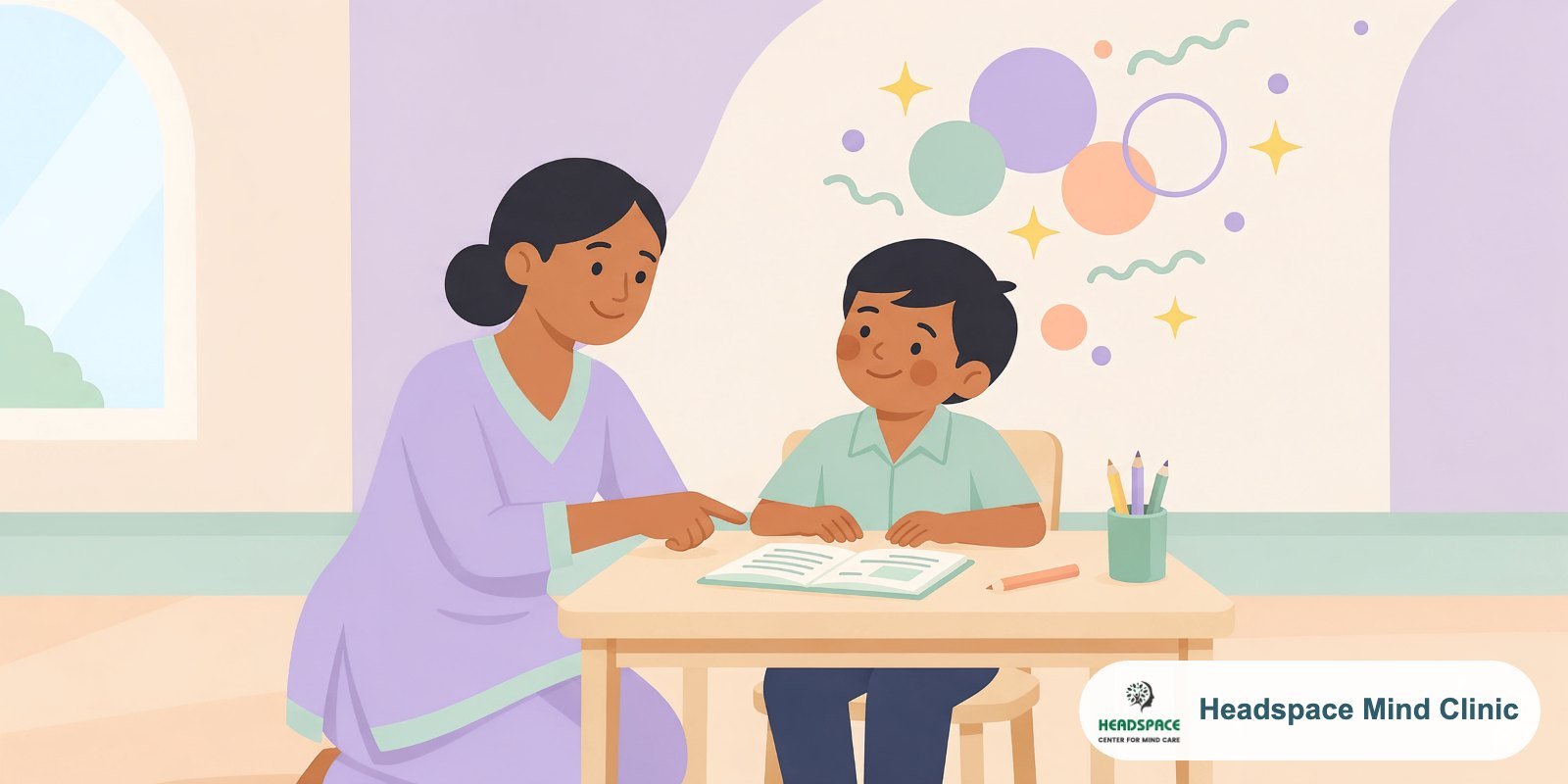
Does this sound familiar?
Aarav knows the answer, but he shouts it out before I finish the question. Then he’s under the desk looking for his pencil. Every single period.
Homework that should take 30 minutes takes three hours, with tears every evening. His tuition teacher says he is “very intelligent but careless”.
Teachers send me the “naughty” boys. The quiet girl at the back who daydreams and never finishes her work rarely gets sent.
ADHD in India: the numbers
You are not alone. In a class of 40, about three children are likely to have ADHD. (based on the Indian average of about 7%)
Girls 5.2%
ADHD in 30 seconds
There are three groups of signs. A child may have mostly one group, or a mix.
Attention
- Drifts off, “in his own world”
- Loses pencils, bottles, tiffin, notebooks
- Forgets instructions after the first step
- Careless mistakes, half-finished work
Hyperactivity
- Fidgets, swings on the chair, taps
- Leaves the seat, runs in the corridor
- Talks non-stop, hums, makes noises
- Always “on the go”, as if driven by a motor
Impulsivity
- Blurts out answers
- Can’t wait in line or for a turn
- Interrupts, grabs things
- Acts first, thinks later, then feels sorry
ADHD, or just being a child?
All children are restless or distracted sometimes. These differences matter.
| Usual childhood behaviour | May be ADHD | |
|---|---|---|
| Attention | Loses focus in a boring period, but can concentrate when interested. | Loses focus even in things they enjoy, every day, in most periods. |
| Energy | Restless after a long day, before Diwali holidays or on sports day. | Restless almost all the time, even when they try very hard to sit still. |
| Where | Happens in one place only, for example only at home. | Happens at school, at home and at tuition. |
| How long | Comes and goes for a few weeks, for example after a house move. | Has been there for 6 months or more, and began before age 12. |
| Effect | Marks and friendships are fine. | Marks, friendships or family life are clearly suffering. |
What it can look like at different ages
Ages 4 to 6
- Can’t sit through circle time or a story
- Runs off in the market or park
- More falls and injuries than other children
- Big tantrums when asked to wait
Ages 7 to 11
- Copying from the board is never finished
- Homework diary and books forgotten
- Interrupts, trouble keeping friends
- Teachers write “can do better” every term
Ages 12 to 17
- Inner restlessness more than running around
- Studies only the night before, misses deadlines
- Hours on games, can’t stop
- Risky choices, low self-esteem, “I’m stupid”
What helps
Choose your role. Each list is practical: things you can start this week.
You don’t need special training to make a big difference. Small, steady changes in class help a child with ADHD, and they help the whole class too.
Evenings with a child with ADHD can feel like a daily battle. These steps make home calmer for everyone, not only for your child.
You are often the first person to put the pieces together. Your notes and your conversation with the family shape everything that follows.
What to say, and what to avoid
Words matter. Children with ADHD often already believe they are “bad”.
Try saying
- “I can see you’re trying hard. Let’s do the first three together.”
- “Let’s make a plan so you don’t forget your books tomorrow.”
- “You got up without asking. Next time, show me the signal and I’ll say yes.”
- “I noticed you finished the whole page today. That took effort.”
Better to avoid
- “Why can’t you be like your sister?”
- “You’re doing it on purpose.”
- “If you don’t sit still, I’ll call your father.”
- “He’s just naughty, he’ll grow out of it.”
When should a child be checked?
Use this as a guide, not a test.
- Restless or distracted now and then
- Mostly on long or boring tasks
- Friends and marks are fine
- Classroom tips are helping
- Signs most days, for 6 months or more
- Seen at school and at home
- Marks or friendships are slipping
- Child is often in trouble or upset
- Unsafe impulsive acts, repeated injuries
- Risk of being suspended or failing a year
- Child says “I’m stupid” or “I’m bad”
- Signs of low mood or anxiety as well
From worry to a plan
The usual path. Nobody is diagnosed on the basis of one bad day.
How ADHD is treated
Treatment is a team effort between home, school and professionals.
Support at school
Seating, shorter tasks, movement breaks, homework diary checks and exam arrangements if eligible.
Parent training
A few sessions with a psychologist on routines, praise and calm, consistent consequences. Very effective for younger children.
Therapy for the child
Skills for planning, managing anger, friendships and self-esteem, suited to the child’s age.
Medicine, if needed
Prescribed and monitored by a doctor, usually when other steps are not enough. Never start or stop it without the doctor.
Myths and facts
Common questions
At what age can ADHD be diagnosed?
Usually from about age 6, though signs often show earlier. The signs must have started before age 12, be present in at least two places (for example school and home) and have lasted at least 6 months.
Can a school counsellor or teacher diagnose ADHD?
No. Teachers and counsellors can notice, observe and use rating scales as a screen. A diagnosis needs a full assessment by a child psychologist or psychiatrist, who also checks for other causes such as learning difficulties, hearing or sleep problems.
Will my child be labelled for life?
A diagnosis is a key that opens the right help, not a label on the forehead. What a child is told, and what the school records, can be discussed with the doctor and the school. Most children with ADHD finish school, go to college and work in every kind of job.
Is ADHD medicine safe? Will it change my child’s personality?
Medicines used for ADHD are among the most studied in child mental health. A doctor decides whether they are needed, usually only when other steps are not enough, starts with a low dose and checks sleep, appetite and growth. The aim is a calmer, more focused version of the same child, not a different child.
Can my child get extra time in board exams for ADHD?
CBSE gives exam concessions such as extra time or a scribe to students with disabilities defined under the Rights of Persons with Disabilities Act 2016, on the recommendation of an authorised medical authority (CBSE circular, April 2019; RPwD Act 2016). Whether ADHD alone qualifies depends on the certificate and current rules, and many children with ADHD also have a learning difficulty that does qualify. Ask the school’s exam in-charge early, ideally in Class 9.
Is too much mobile phone the cause of ADHD?
No. ADHD is a brain-based difference that often runs in families. But heavy screen use and late nights can make attention and sleep much worse, in any child. Cutting down screens helps every child, with or without ADHD.
Where to get help in Delhi
Start with the person closest to the child. Help is available, and asking early is normal.
Headspace Mind Clinic (outpatient) in West and North Delhi:
- Paschim Vihar: GH-14/49, near Bosco Public School, Paschim Vihar, Delhi 110087 · +91 99711 66040
- Rohini: C-8/273, near Gurudwara, Sector 8, Rohini, Delhi 110085 (near Rohini East Metro) · +91 90990 97381
- Narela: 48/1 Singhu Border Road, Krishna Colony, Narela, Delhi 110040 · +91 74530 00444
Easy to reach from Paschim Vihar, Rohini, Narela, Pitampura, Punjabi Bagh, Shalimar Bagh, Nangloi, Bawana and nearby areas. All clinic details
More school mental health guides
Guides by role: Parents · Teachers · Counsellors · हिंदी में पढ़ें
Sources
- Gore M, Morgan J. Children with ADHD in India: strengthening diagnosis, support, training and research. Journal of the Indian Association for Child and Adolescent Mental Health, 2025
- CBSE. Exemptions/concessions to persons with benchmark disabilities, Class X and XII. Circular, 12 April 2019
- The Rights of Persons with Disabilities Act, 2016 (Government of India)
Reviewed by Dr. Deepak Verma, Consultant Psychiatrist (MBBS, MD Psychiatry), 26 November 2026. Headspace Mind Clinic, Delhi.