
Home › School Mental Health › For teachers
For teachers: notice, be kind, pass it on
You see each child for hours every day, often more than anyone else outside the family. That makes you the person most likely to notice when something is wrong. You don’t need to diagnose anything. You need to notice, respond calmly, and know who to tell. This page gives you exactly that.
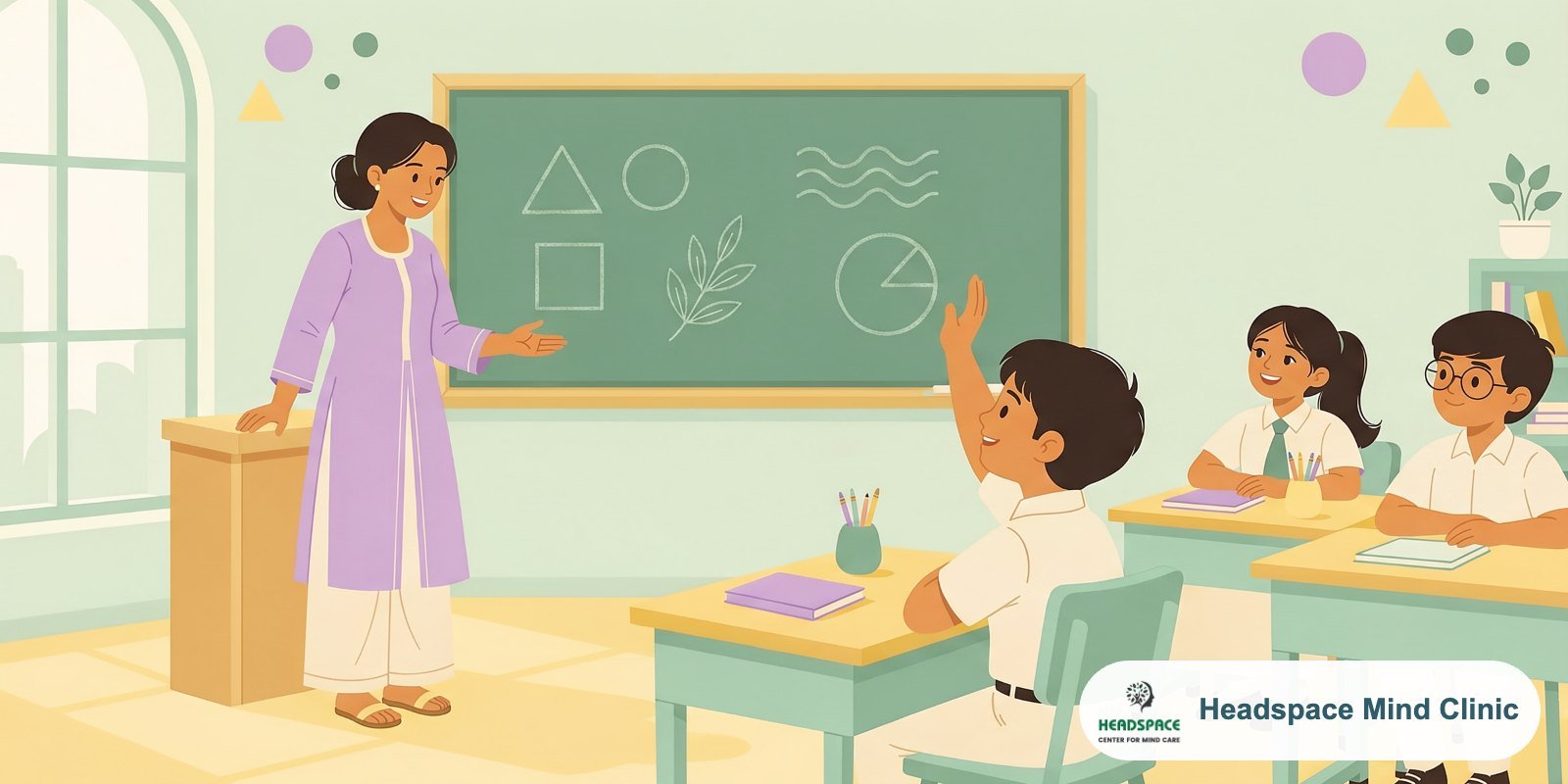
We understand your day
45 children, a syllabus to finish and three periods back to back. When do I even get time to notice one child?
I can see she has changed this term. But what if I say something and make it worse? What if parents get angry with me?
I only see them for one period. Is it even my business?
It is your business, and it can take less than a minute. A teacher who says “I noticed you seem tired lately, is everything okay?” is often the first adult a child opens up to. You are not alone in it: your job is to pass it on, and the counsellor, the parents and professionals do the rest.
Five golden rules for teachers
Keep these in mind for every topic below.
Notice changes
Mood, marks, friends, sleepiness, tiffin coming back, full sleeves in summer. A change matters more than one bad day.
Write facts, not labels
“Left seat 9 times in maths, 12 Jan” helps. “Very naughty” does not. Dates and examples guide the counsellor.
Talk privately
Never in front of the class. Two minutes after the period: “I’ve noticed… how are things?” Then listen.
Pass it on the same day
Tell the counsellor (and the principal for safety concerns). You never have to handle a worry alone.
No shaming, ever
No public scolding, no reading out marks, no jokes about weight, skin, accent or caste. Shame closes children down.
Pick a topic
16 topics, each with practical steps for your role.
Practical resources for you
Guides, checklists and templates you can print and use.
The four calm steps
The same steps work for almost every worry.
A note to the counsellor: what to write
Copy this into your diary or an email. Five lines are enough.
- Who: student name, class and section.
- What you saw: exact behaviour or words, with dates (for example “Wrote ‘I wish I could disappear’ in English essay, 14 Nov”).
- Since when: when you first noticed the change.
- What you have tried: seat change, a private chat, a word with parents.
- How urgent: any talk of self-harm, abuse or danger means you tell the counsellor and principal in person, today, not by note.
What the rules now expect from schools
Mental health support is no longer optional for schools.
Other pages in this section
Want a session at your school?
A talk for your teachers or parents. The first talk is free.
Where to get help in Delhi
Start with the person closest to the child. Help is available, and asking early is normal.
Headspace Mind Clinic (outpatient) in West and North Delhi:
- Paschim Vihar: GH-14/49, near Bosco Public School, Paschim Vihar, Delhi 110087 · +91 99711 66040
- Rohini: C-8/273, near Gurudwara, Sector 8, Rohini, Delhi 110085 (near Rohini East Metro) · +91 90990 97381
- Narela: 48/1 Singhu Border Road, Krishna Colony, Narela, Delhi 110040 · +91 74530 00444
Easy to reach from Paschim Vihar, Rohini, Narela, Pitampura, Punjabi Bagh, Shalimar Bagh, Nangloi, Bawana and nearby areas. All clinic details
Sources
- Supreme Court of India. Sukdeb Saha v. State of Andhra Pradesh, 2025 INSC 893 (25 July 2025).
- Ministry of Education / NCERT. UMMEED: Prevention of Suicide, Guidelines for Schools, May 2025
- CBSE. Guidelines for prevention of bullying and ragging in schools, Circular Acad-17/2015
Reviewed by Dr. Deepak Verma, Consultant Psychiatrist (MBBS, MD Psychiatry), 26 November 2026. Headspace Mind Clinic, Delhi.