
Home › School Mental Health › For teachers › Inclusive classroom
Inclusive classroom: teaching so every child can learn
In almost every Indian class of 40, a few children learn differently: they may read slowly, move a lot, find noise hard, or need more time. Inclusive teaching is not extra work for “special” children. It is good teaching that helps the whole class, and the law now expects it.
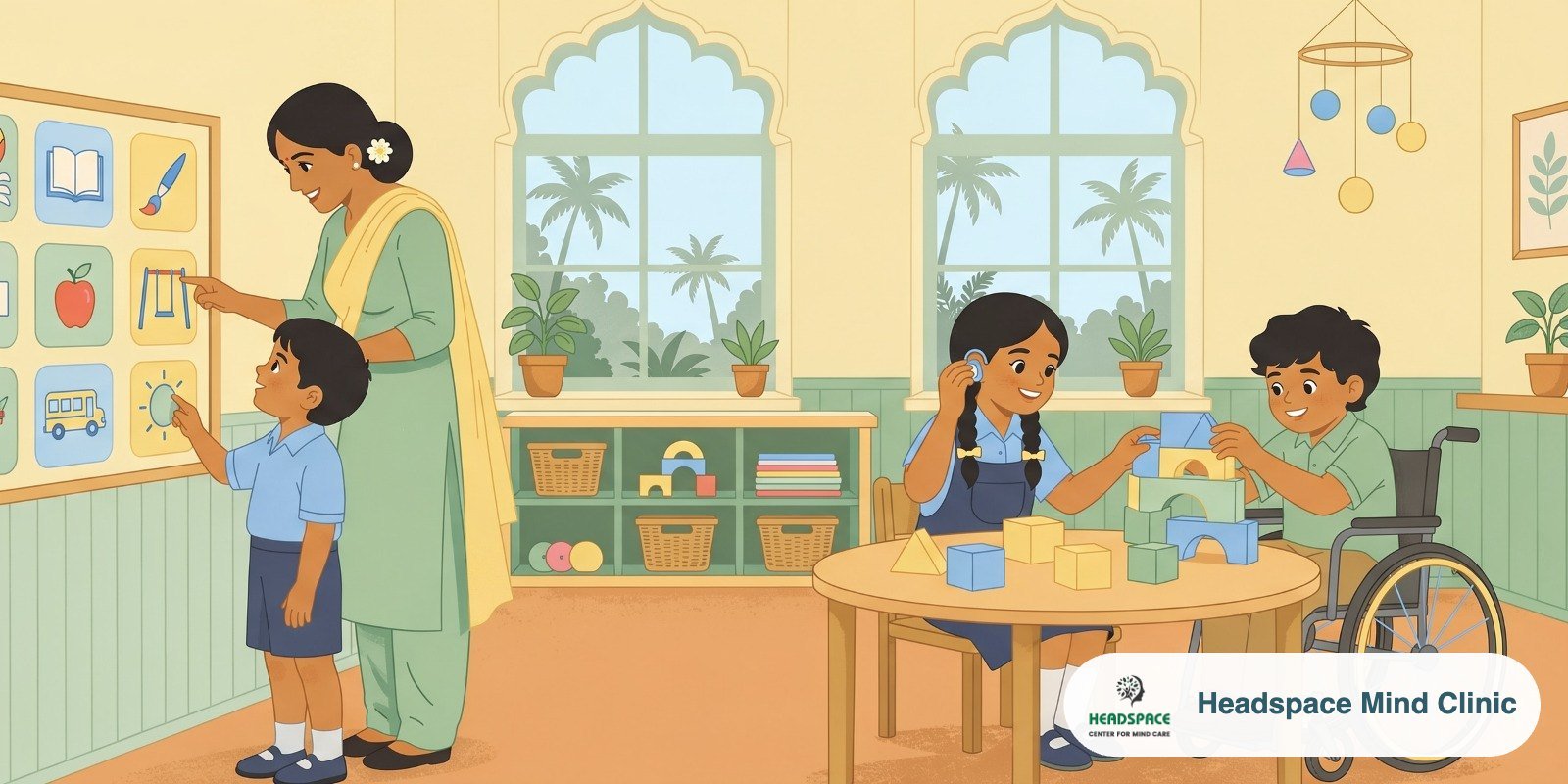
Does this sound familiar?
Real worries we hear from teachers in Delhi schools.
I have 42 children. How do I give extra time to three of them without the others complaining?
The special educator comes twice a week. What do I do on the other days?
Teachers are willing, but nobody showed them what to actually do in class.
My son is clever but writes slowly. Teachers think he is lazy.
In India: the numbers
Small references show where each number comes from.
Who may need support in your class
Many needs are invisible. A child may have more than one.
Learning difficulties
Dyslexia, writing or maths difficulties.ADHD
Restless, distracted, impulsive.Autism
Social, communication and sensory differences.Vision or hearing
Squints, misses instructions, sits close to the board.Physical needs
Mobility, fine-motor or health conditions.Emotional difficulties
Anxiety, low mood, trauma, family stress.What you may see, and what helps
| What you may see | What helps in class |
|---|---|
| Can’t copy from the board in time | Give printed notes or let a buddy share; photograph the board |
| Reads slowly, avoids reading aloud | Never force reading aloud; allow audio, pair reading, extra time |
| Can’t sit still for long | Movement breaks, classroom jobs, stand-up desk spot, fidget |
| Upset by noise or change | Visual timetable, warn before changes, quiet corner |
| Knows answers but writing is poor | Oral answers, keywords, mind maps, scribe as per rules |
| Gets lost in long instructions | One step at a time; write steps on the board; check understanding |
Plan lessons for everyone (UDL)
Universal Design for Learning: plan once, so more children can join in.
What the rules say
RPwD Act 2016
Recognises 21 disabilities, including learning disability and autism, and requires inclusive education in schools.CBSE concessions
For eligible students: scribe or reader, compensatory time, exemptions as per CBSE circulars.Individual Education Plan
A written plan with goals and supports, made with parents, special educator and counsellor.Equal respect
No teasing, no labels in front of the class, and the same chances for everyone.What to say, what to avoid
Try saying
- “Take your time, I will wait.”
- “You can show me your answer in a drawing.”
- “Everyone learns in different ways.”
- “Let’s do the first step together.”
Better to avoid
- “Why can’t you be like the others?”
- “You are just lazy.”
- “Read it aloud now, everyone is waiting.”
- “This child is a special case.”
Printable checklist: inclusive lesson
Print and keep it on your desk.
Before the lesson, did I…
Plan
- Write the goal on the board
- Prepare one visual (picture, chart, object)
- Break the task into short steps
During
- Give instructions one at a time
- Check understanding with 2–3 children
- Allow a movement break
After
- Offer more than one way to show learning
- Note who needs extra help next time
- Share concerns with the special educator or counsellor
Free to print and share in your school. Headspace Mind Clinic, Delhi.
Questions parents and teachers ask
How can I give extra time without others feeling it is unfair?
Explain to the class that fair means everyone gets what they need, like glasses for someone who can’t see the board. Most children accept this well.
Do I need a diagnosis to help a child?
No. Good inclusive teaching helps all children. A formal assessment helps plan specific support and exam concessions.
What exam concessions does CBSE allow?
For students with benchmark disabilities (including specific learning disability and autism), CBSE allows supports such as a scribe or reader, compensatory time and some subject exemptions, as per its circulars and with certificates.
How do I talk to parents about a possible learning difficulty?
Share specific examples, focus on the child’s strengths, and suggest an assessment as a way to understand how the child learns.
Who can do a learning disability assessment in Delhi?
Clinical psychologists, child psychiatrists and government hospital child guidance clinics can assess. Your school counsellor can guide the family.
Where to get help in Delhi
Start with the person closest to the child. Help is available, and asking early is normal.
Headspace Mind Clinic (outpatient) in West and North Delhi:
- Paschim Vihar: GH-14/49, near Bosco Public School, Paschim Vihar, Delhi 110087 · +91 99711 66040
- Rohini: C-8/273, near Gurudwara, Sector 8, Rohini, Delhi 110085 (near Rohini East Metro) · +91 90990 97381
- Narela: 48/1 Singhu Border Road, Krishna Colony, Narela, Delhi 110040 · +91 74530 00444
Easy to reach from Paschim Vihar, Rohini, Narela, Pitampura, Punjabi Bagh, Shalimar Bagh, Nangloi, Bawana and nearby areas. All clinic details
More resources for teachers
All topics: ADHD · Exam stress · Learning difficulties · Bullying · Self-harm warning signs · Screen time and gaming · Anger and behaviour · Low mood and depression · Anxiety and worry · Autism signs · School refusal · Sleep problems · Alcohol, vaping and drugs · Grief and loss · Body image and eating · When a child tells you about abuse
Sources
- Arora NK et al. Neurodevelopmental disorders in children aged 2–9 years in India. PLOS Medicine, 2018 (summary)
- Prevalence and pattern of learning disability in India: meta-analysis. 2022
- Gore M, Morgan J. Children with ADHD in India. J Indian Assoc Child Adolesc Ment Health, 2025
- Rights of Persons with Disabilities Act, 2016
- CBSE circular on exemptions and concessions for persons with benchmark disabilities, 12 April 2019
Reviewed by Dr. Deepak Verma, Consultant Psychiatrist (MBBS, MD Psychiatry), 26 November 2026. Headspace Mind Clinic, Delhi.