
For School Counsellors: Checklists, Parent Meetings and Referrals

Home › School Mental Health › For school counsellors

For school counsellors and wellness teachersPractical checklists5 guides ready

For school counsellors: connect the dots, and know when to refer

You may be the only counsellor for a thousand students, with teachers sending you “problem children” and parents who don’t want to hear the word psychologist. This page brings together what you need for the most common situations: how to observe, how to talk to parents, how to keep a child safe, and when and how to refer.
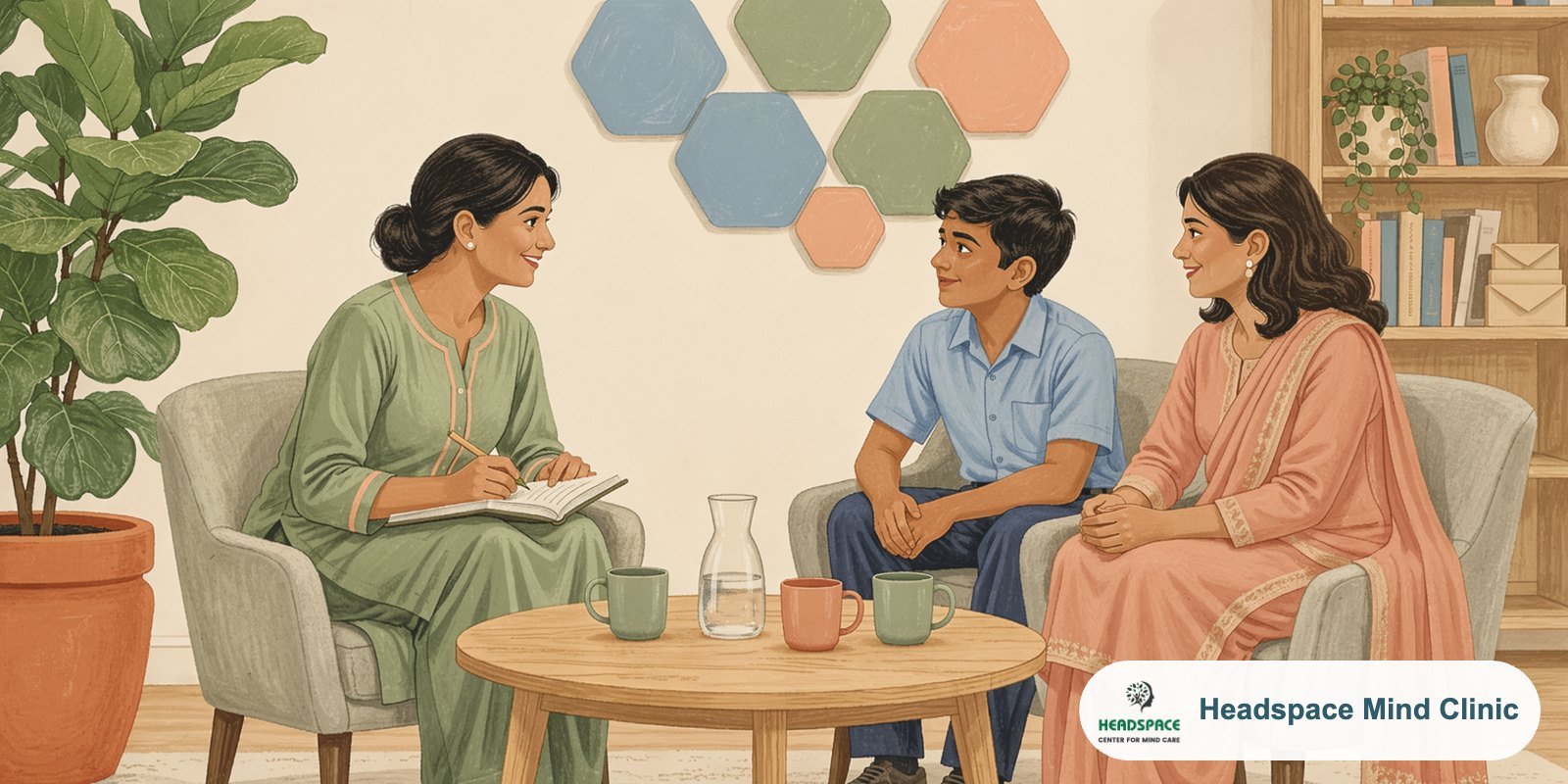
Illustration of a school counsellor talking with a parent and a teenage student around a small table

We understand your work

A counsellor in a Delhi CBSE school
Teachers send me the noisy boys. The quiet children who are really struggling hardly ever reach me.
A counsellor in a Narela school
The moment I suggest an assessment, parents say “hamara baccha pagal nahi hai”. I don’t know how to say it so they listen.
A new wellness teacher
If a student tells me about self-harm or abuse, what exactly am I supposed to do, and who do I tell first?

Your role in five points

Observe, don’t diagnose

Watch in at least two settings, collect teacher notes and work samples, use rating scales as screens only.

Bridge school and home

Bring the class teacher and parents to the same page, with one agreed plan and a review date.

Keep children safe

A written protocol for self-harm, abuse and bullying, known to every staff member, before a crisis happens.

Refer clearly

A good referral note saves weeks: what, where, since when, what was tried, and screening results.

Look after yourself

Get supervision or peer support. You should not carry difficult cases alone.

Pick a topic

16 topics, each with practical steps for your role.

ADHD

Restless, distracted or both

Read the counsellors’ section →

Exam stress

Boards, entrances, results

Read the counsellors’ section →

Learning difficulties

Reading, writing, maths

Read the counsellors’ section →

Bullying

In class, online, on the bus

Read the counsellors’ section →

Self-harm warning signs

What to notice, what to do

Read the counsellors’ section →

Screen time and gaming

Phones, games, reels

Read the counsellors’ section →

Anger and behaviour

Tantrums, fights, back-talk

Read the counsellors’ section →

Low mood and depression

Sad, quiet, not themselves

Read the counsellors’ section →

Anxiety and worry

Fears, panic, tummy aches

Read the counsellors’ section →

Autism signs

Talking, play, routines

Read the counsellors’ section →

School refusal

Crying, pain, not going

Read the counsellors’ section →

Sleep problems

Late nights, tired mornings

Read the counsellors’ section →

Alcohol, vaping and drugs

Early signs, calm talks

Read the counsellors’ section →

Grief and loss

When someone dies or leaves

Read the counsellors’ section →

Body image and eating

Weight worries, skipping meals

Read the counsellors’ section →

When a child tells you about abuse

Good touch, bad touch, POCSO

Read the counsellors’ section →

Practical resources for you

Guides, checklists and templates you can print and use.

Talking to parents so they listen

Most parents are scared, not stubborn. How the first meeting goes decides whether they take the next step.

1
Start with the child’s strengths“Riya is kind and very good at drawing.”
2
Describe, don’t label“She finds it hard to finish written work, even when she knows the answers.”
3
Ask what they see at homeParents often say “same at home”. Now it is shared.
4
Normalise help“Many children need a little extra help. An assessment just tells us how to help her.”
5
Give optionsGovernment hospital, private clinic, online. Names and numbers in writing.
6
Fix a review date“Let’s meet again in 3 weeks.”

Referral note checklist

Attach this to every referral to a psychologist or psychiatrist (with parents’ consent).

  • Child’s age, class, and who is concerned (teacher, parent, child).
  • What has been seen, where (class, playground, home, tuition) and since when, with dated examples.
  • Screening tools used and scores, clearly marked as screening only.
  • What has already been tried in school, and what helped.
  • Academic picture: recent marks, notebooks, teacher comments.
  • Any safety concern (self-harm, abuse, bullying) and what was done.
  • Your name, phone and a good time to reach you.

What the rules now expect from schools

1 per 500
CBSE schools now need one Counselling and Wellness Teacher for every 500 students.
CBSE affiliation bye-laws amendment, January 2026
Wellness Team
UMMEED asks every school to form a School Wellness Team with a written plan for students at risk.
Ministry of Education / NCERT, May 2025
Report, don’t investigate
Under the POCSO Act, suspected sexual abuse of a child must be reported to the police or Special Juvenile Police Unit.
POCSO Act 2012, sections 19 and 21

Other pages in this section

Want a session at your school?

A talk for your teachers or parents. The first talk is free.

Invite us to your school →

Where to get help in Delhi

Start with the person closest to the child. Help is available, and asking early is normal.

Emergency: 112If a child is in danger right now, call 112 and stay with them.
Tele-MANAS 14416Free government mental health helpline, in Hindi and English, any time.
Your school counsellorA good first step for most worries linked to school.
Family doctor or paediatricianTo check sleep, hearing, vision and physical causes.
Child psychologist or psychiatristFor a full assessment if worries last more than a few weeks.

Headspace Mind Clinic (outpatient) in West and North Delhi:

  • Paschim Vihar: GH-14/49, near Bosco Public School, Paschim Vihar, Delhi 110087 · +91 99711 66040
  • Rohini: C-8/273, near Gurudwara, Sector 8, Rohini, Delhi 110085 (near Rohini East Metro) · +91 90990 97381
  • Narela: 48/1 Singhu Border Road, Krishna Colony, Narela, Delhi 110040 · +91 74530 00444

Easy to reach from Paschim Vihar, Rohini, Narela, Pitampura, Punjabi Bagh, Shalimar Bagh, Nangloi, Bawana and nearby areas. All clinic details

हिंदी में पढ़ें →

Sources

  1. CBSE. Amendment to Affiliation Bye-Laws: Counselling and Wellness Teacher, January 2026 (as reported by Careers360 and Deccan Herald).
  2. Ministry of Education / NCERT. UMMEED: Prevention of Suicide, Guidelines for Schools, May 2025
  3. The Protection of Children from Sexual Offences (POCSO) Act, 2012
  4. CBSE. Press release: Psycho-Social Counselling Support, 6 January 2026
Please note: This page is for general education only. It is not medical advice and does not replace a consultation with a qualified doctor. It cannot be used to diagnose or treat any condition. If you have any of the symptoms described here, please consult a psychiatrist or your own doctor. Do not start, stop or change any medicine without your doctor’s advice.
In an emergency, or if a child is in danger right now, call 112. For free mental health support at any time, call Tele-MANAS on 14416.

Reviewed by Dr. Deepak Verma, Consultant Psychiatrist (MBBS, MD Psychiatry), 26 November 2026. Headspace Mind Clinic, Delhi.

Call Now Button